
All his life, Friedrich Merz wanted to be German chancellor. So, it’s surprising just how ill-prepared he often appears.
He certainly didn’t see the deep crisis coming that is now engulfing his chancellorship, 16 months after taking office. In July, he botched a cabinet reshuffle. He has managed to set new records in unpopularity. Now, regional elections in Saxony-Anhalt in early September as well as in Mecklenburg-Western Pomerania and Berlin two weeks later have seen the far-right Alternative für Deutschland (AfD) surging, while Merz’ center-right Christian Democrats (CDU) have seen historic lows. In Mecklenburg-Western Pomerania, the CDU even failed to pass the 5-percent hurdle and thus is not represented in a regional parliament for the first time in its history. To top it all, this happened in the federal state where former long-time chancellor (and Merz’ nemesis), Angela Merkel, used to have her constituency. Merz, while unwilling to resign, appears unable turn the situation around.
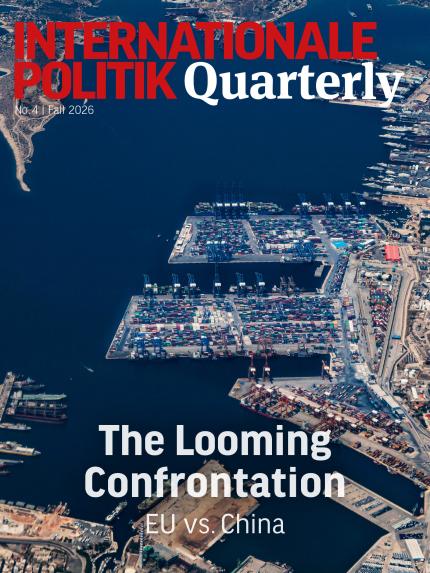
The chancellor’s unsureness of touch and zigzagging also extends to his China policy. Presenting himself as a China hawk when opposition leader, Merz, as chancellor, went out of his way to praise his hosts when he first visited Beijing this February. However, it was already clear then, and is more than obvious now, that the crippling trade imbalance between the European Union and China is threatening to eradicate Europe’s industrial base, leading to massive job losses and much besides.
European Commissioner Stéphane Séjourné, who is responsible for industrial policy, told Euronews on September 23 that the issue was now “existential” for the EU and its member states. Customs data shows that the trade deficit with China currently clocks in at €1 billion per day. The majority view in the EU has strongly shifted toward implementing trade measures against China, regardless of Beijing’s reaction. EU leaders will decide at their next summit on October 15-16.
In the German government, ministerial infighting has long caused paralysis, even though the ministries involved are all CDU-led. On the one side there is Economy Minister Katherina Reiche, who seems to struggle with the very concept of economic security, and keeps insisting that it’s all a competitiveness issue. Foreign Minister Johann Wadephul, whose initial forthright criticism of the Chinese leadership led to a breakdown in relations last year, thinks a tougher line is required; his ministry is sure that Europe is experiencing a “China Shock 2.0.” In Merz’ chancellery, Foreign Affairs and Security Advisor Günter Sautter as well as Europe Advisor Michael Clauß are in the same camp, while Merz’ Economic Advisor Levin Holle worries that the EU wouldn’t survive a trade war with China for long. While there has been movement recently, it’s not really clear yet what a deeply weakened Merz will decide.
In this issue, Andrew Small and Janka Oertel argue that a showdown with Beijing is now inevitable. Tim Rühlig explains how the German position has evolved recently, while Noah Gordon takes a closer look at how Beijing has wielded its strongest economic weapon—export controls of critical raw materials—against the United States and EU member states, and what would happen if the Chinese were to decide to reintroduce the ban, which has only been lifted temporarily.
Elsewhere, Joseph de Weck starts his new EUROSCOPE column by arguing that Germany would be wrong to de-risk from France should it fall to Marine Le Pen and the far right come next spring. Rebecca Christie, in BRUSSELS BRIEFING, recommends diversity when it comes to organize Europe’s security. Aylin Matlé, in INDO-PACIFIC WATCH, suggests that the Europeans should offer their expertise in arms control measures to their Indo-Pacific partners. And J.R. Ellis, in THE WIDER VIEW, makes the case for a revived US-German partnership, explaining how Washington and Berlin could arrive at a new division of labor—one that, in fact, resembles a previous one.
Henning Hoff is executive editor of INTERNATIONALE POLITIK QUARTERLY.
