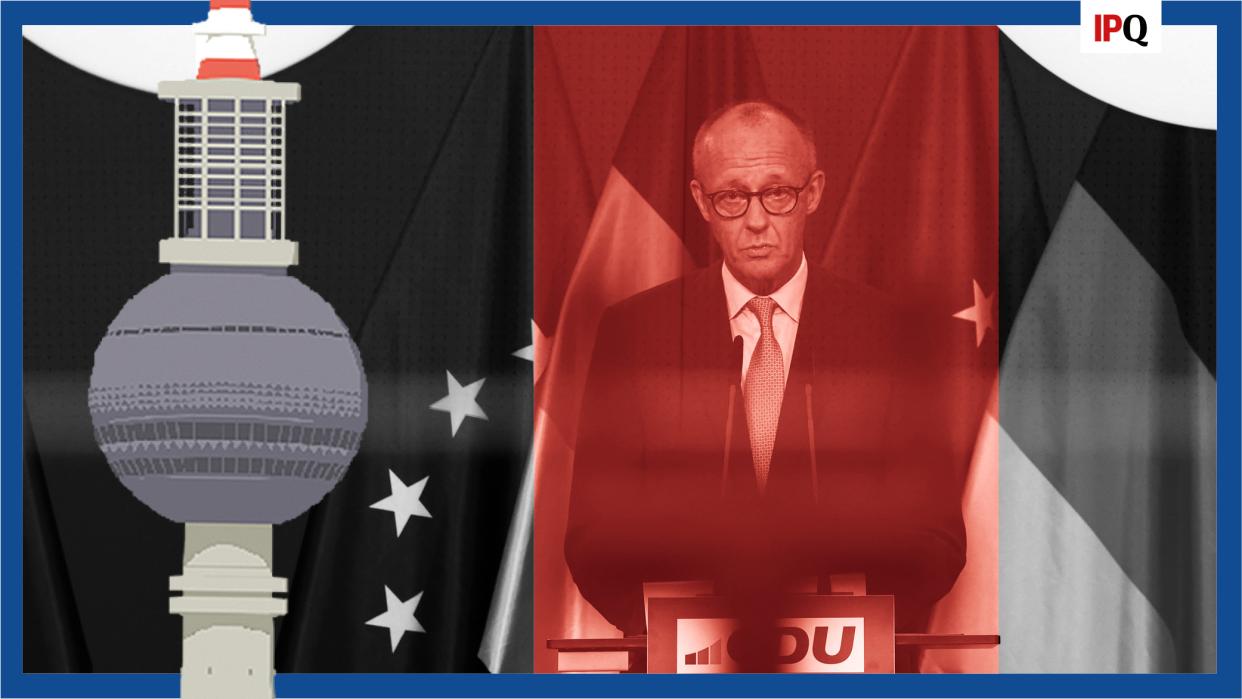
German Chancellor Friedrich Merz is fighting for his political survival. The way he goes about it, though, does not look too promising.
There he was on Sunday night, only 14 minutes after the polls had closed in the federal states of Berlin and Mecklenburg-Western Pomerania at 6:00 pm, offering his reading of what were highly provisional figures. However, Merz was eager to get his response in first against all political traditions.
“A Disaster”
The votes concluded “the election year of 2026,” the chancellor explained, and it hadn’t been all bad for his party. Back in March in economic powerhouse Baden-Württemberg, his center-right Christian Democrats (CDU) had gained substantially, but ultimately lost to the Greens, But the CDU had won outright in Rhineland-Palatinate and returned to power after 35 years on the opposition benches, Merz reflected.
Then again, the result in Saxony-Anhalt two weeks previously had been a “watershed,” the chancellor admitted, with the far-right Alternative für Deutschland (AfD) winning close to 44 percent of the vote, dwarfing the CDU’s result.
Now in Berlin, where the CDU saw its vote drop by almost 10 points to 18.8 percent, there had been difficult circumstances. CDU Mayor Kai Wegner had been caught lying about his whereabouts when 200,000 Berliners suffered electricity outages shortly after New Year’s and withdrew as “lead candidate” only in July. Although Merz said that stand-in Stefan Evers had managed to achieve a “respectable result,” he actually lost his own constituency in Berlin’s southeast to an AfD candidate. Overall, however, the AfD didn’t do particularly well in the German capital, with 16.3 percent of the vote.
The result in Mecklenburg-Western Pomerania, where the AfD ended up winning with 38.8 percent of the vote, was a “disaster,” the chancellor then admitted—possibly an understatement. Merz did not know it then, but after anxious hours of vote-counting, it became clear in the early hours of Monday morning that his CDU had failed to enter a regional German parliament for the first in its entire history, winning only 4.9 percent of the vote (parties need at least 5 percent). Some in the CDU had mentioned such an outcome as potentially deadly for Merz’ political career.
“A Country of New Departures”
Merz then tried to change the focus: It was all about making Germany “fit for the future,” the chancellor declared. In times of great dangers, this required talking about the countries’ weaknesses, but also its strengths. “The answer cannot be a return to the good old days,” Merz explained (which was what his key supporters had indeed hoped for when he was voted in as chancellor 16 months ago, with Merz encouraging such hopes), but talking the country down was no solution either, Merz added, concluding: “I want that our country becomes once again a country of new departures”—“ein Land des Aufbruchs.”
The implementation of the reform agenda his government had launched (from healthcare to pensions and tax) was necessary for that, and he would see in through, Merz vowed, showing “backbone, steadfastness, and patience.” In short, he would be going nowhere.
There is no escaping the fact, however, that Merz struck a lonely figure. His argument is somewhat counterintuitive, but it may buy him some time. The message to his party is essentially this: Accepting his historic unpopularity, Merz tells the CDU that he needs to stay in power to see through unpopular reforms. And the party may well accept this, for now, if only for the lack of an obvious successor ready to act now.
The most plausible candidate, Hendrik Wüst, state premier of North Rhine-Westphalia, seems to want to wait until after having won his own regional election, which takes place in April 2027. Until then, Merz will stay on, but it will be difficult months ahead.
Continued Polarization
Both Berlin and Mecklenburg-Western Pomerania are likely to see left-leaning regional governments: In the capital, it will be most likely be led for the first time by the hard-left Die Linke, which more than doubled its result to 25.7 percent, though it will be tough for the center-left Social Democrats (SPD), Merz’ junior partner at the national level, to come to terms with this (the Greens are also needed). In Schwerin, incumbent SPD state premier, Manuela Schwesig, who almost managed to catch up with the AfD (35.5 percent to their 38.8 percent) by conducting a campaign criticizing the Merz government, did well enough to continue, with Die Linke and the Greens as likely coalition partners.
Most damaging for Merz is the fact that voters in the former communist east are writing the CDU out of the political picture, while the AfD is winning big with a new type of candidate: Ulrich Siegmund in Saxony-Anhalt, a commercial agent for air fresheners, and Leif-Erik Holm in Mecklenburg-Western Pomerania, a former radio DJ, are smooth talkers, who bring a new “feelgood factor” to the AfD’s campaign. In contrast, the AfD’s national leaders, starting with Alice Weidel, used to come across as angry, cold, and preachy. So far, the CDU has found no answer to this.
The big question is what will happen in Saxony-Anhalt. There the AfD will need the support of the Bündnis Sahra Wagenknecht (BSW), a split-off from Die Linke which offers a pro-Russia policy mix of nationalism and socialism (ring a bell?). If the BSW keeps its word and abstains in all rounds of voting to determine the next state premier, Siegmund will not win, and the AfD won’t manage to form the first far-right regional government since 1945. The AfD has 39 seats, and so have all the other parties combined, while the BSW has five. Ambitious national BSW leader Wagenknecht has said her party would not stand in the way of the wish of the people, but bringing the AfD to power may well destroy the BSW. In an ominous sign for the BSW, it narrowly failed to pass the 5-percent “hurdle” in both Berlin and Mecklenburg.
Disappointing Voters
Still, it speaks volumes that German politics are now determined in part by what extremists do next. It may not be all be Merz’ fault, but he certainly carries much responsibility. As long-time Chancellor Angela Merkel’s rival-in-chief, he was never particularly popular, but Merz deeply disappointed many CDU voters after first promising the keep the “debt brake” intact during the 2025 election campaign (while it was entirely obvious that Germany’s rearmament effort demands its loosening), only to perform a U-turn immediately afterwards.
As opposition leader, Merz could have struck a deal with the government of former Chancellor Olaf Scholz on debt-financed rearmament, but he preferred to wait “until I’m chancellor.” This lack of statesmanship is continuing to haunt Merz, and the domestic situation is weakening him on the international stage as well. Lacking authority at home, Merz, who has played a largely positive role, will now struggle to fulfill his ambitions of his leadership in Europe, as most fellow European leaders now wonder: Will he still be in office come next spring? Germany’s “new departure” may well have to wait until then.
NB. This article is a preview from the IPQ Fall 2026 issue "The Looming Confrontation: EU vs. China," out on September 29.
Henning Hoff is executive editor of INTERNATIONALE POLITIK QUARTERLY.
