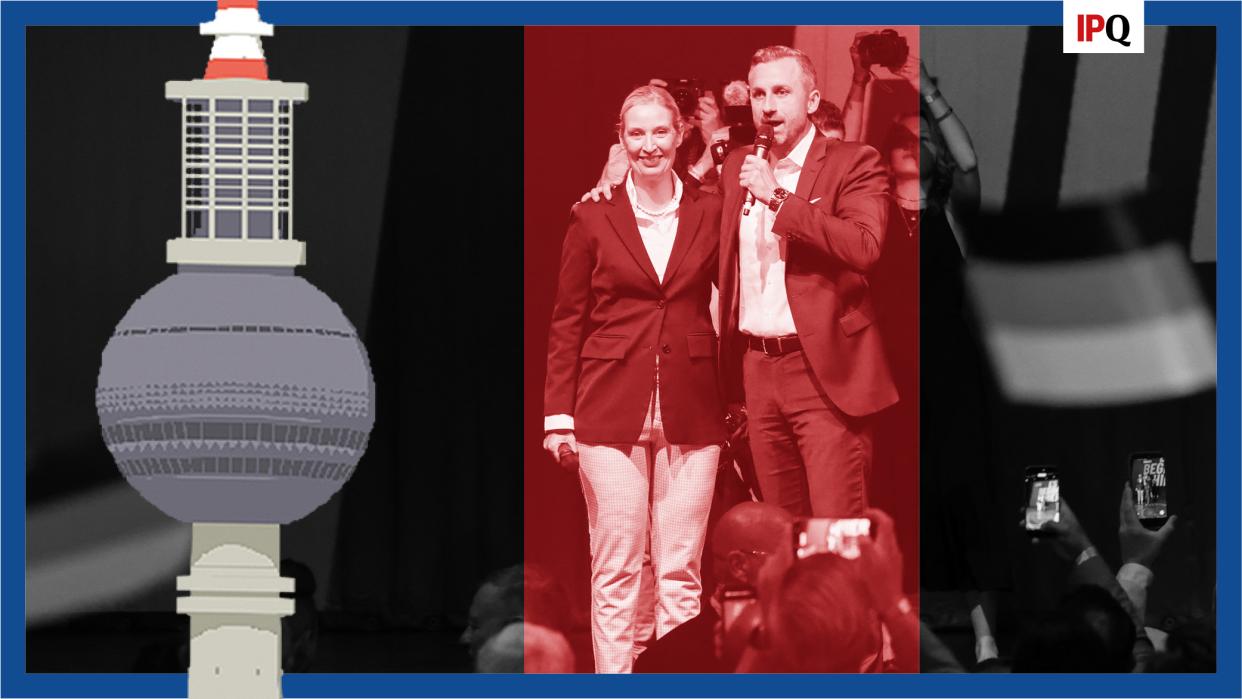
There’s no question about it: The extraordinarily strong showing of the Alternative für Deutschland (AfD) in the federal state elections in Saxony-Anhalt on September 6 represent a shock to postwar Germany. The far-right party, which Germany’s domestic intelligence service considers “indisputably far-right extremist” (“gesichert rechtsextrem”) in that state, won 43.9 percent, slightly exceeding what the polls predicted. In contrast, the center-right Christian Democrats (CDU), the party of German Chancellor Friedrich Merz, lost more badly that expected, registering only 17.4 percent. Half of the CDU’s previous voters in Saxony-Anhalt seem to have backed the far right this time.
Two Scenarios
The AfD is now very close to taking power in the state’s capital, Magdeburg. The party won 39 seats in the 81-seat parliament and only need three more for an absolute majority. The following two scenarios look most likely now:
The first is that the AfD forms a coalition of sorts. The Bündnis Sahra Wagenknecht (BSW), a break-away “movement” from the hard-left Die Linke party led by the charismatic politician who gives the party its name, just cleared the 5-percent threshold. Now the BSW, which, ominously, combines strong nationalism with socialism and pro-Russian views, has five seats in parliament and could provide the missing votes. Some regional BSW leaders have vowed in the past not to vote for AfD candidate Ulrich Siegmund as state premier. Then again, the BSW has also always promised to “talk to all parties,” including the AfD (the other parties have ruled that out so far). And Wagenknecht seemed determined to use the situation for a comeback.
Siegmund said on election night that forming a minority government was not an option for him—which would rule out an arrangement by which the BSW “tolerates” an AfD government and provides majorities on an ad hoc basis. But the two parties, which share many policies, not least when it comes to their rejection of the current “system” as well as their pro-Russia views, may find some way to take power in Magdeburg together, with the BSW in a junior role.
The second option would be for the AfD to attract at least three defectors, from the BSW and/or the CDU. In the latter, there has been an internal debate for a long time on whether maintaining the “fire wall” (“Brandmauer”) vis-à-vis the AfD was the right strategy. Wouldn’t it be better for the two parties to work together and make use of the “conservative majority”? If there are CDU defections, or if the Saxony-Anhalt CDU comes out in favor of tearing down the “fire wall,” there is the potential danger of a split in the CDU.
Core Causes
While AfD leaders are trying to present their victory as proof that the party’s ascent is irresistible, it is important to keep some facts in mind: With 2.1 million inhabitants (of Germany’s almost 84 million), Saxony-Anhalt is one of the country’s smallest federal states—and demographically one of the oldest, as a result of younger people leaving in search of jobs elsewhere—something that started even before the fall of the Berlin wall in 1989. And the fact that the state was part of Communist East Germany adds to conditions that made it ideal ground for the AfD to win big. In the upcoming state elections in Berlin and Mecklenburg-Western Pomerania on September 20, the AfD is likely to do well again, but nowhere near as well as in Saxony-Anhalt.
However, at the core of the AfD’s victory lies the inability of Chancellor Merz’ government —his coalition with the center-left Social Democrats (SPD), has a small majority in the national parliament, the Bundestag—to come up with convincing ideas on how to address Germany’s current malaise, which is largely economic, but not only. The “German model” reliant on strong exports, particularly to China, “cheap” Russian gas supplies, and the United States as the ultimate security guarantor is broken.
On the security side, Berlin is undertaking an unprecedented effort to make up for decades of neglect and underinvestment in its armed forces. Meanwhile, Germany’s flatlining economy is undergoing deep structural changes, with Merz and his SPD Vice Chancellor (and Finance Minister) Lars Klingbeil simply looking on or trying to address them with concepts from the past. Add to that Merz’ historic unpopularity, and the AfD’s strong support in Sunday’s election becomes a little less surprising.
King of the West, Queen of the North
Merz will likely try to toughen it out, but the shock to the system the AfD victory provides (inter alia, the government may lose its slim majority in Germany’s second parliamentary chamber, the Bundesrat, which brings together the governments of the federal states) may prove too strong. The dynamics now look similar to what happened in British politics recently. CDU MPs, already unhappy with the chancellor, will on the back of the AfD win calculate even more sharply whether there’s hope for them to keep their seats if Merz is still chancellor by the next national elections in early 2029.
The most likely candidate to replace him is the more personable and telegenic Hendrik Wüst, state premier of the western state of North Rhine-Westphalia, which he runs successfully with the Greens. He faces federal state elections in April 2027, which he is likely to win—and then move on to Berlin if the CDU/CSU parliamentary group has come to the conclusion that it’s best for all for Merz to go (including himself).
At the same time, Mecklenburg-West Pomerania’s state premier Manuela Schwesig, the SPD’s politician connecting best with voters and likely to prevail in two weeks’ time in her state, could replace Klingbeil and his co-leader, Labor Minister Bärbel Bas. The government would then be led by Wüst and Schwesig for the remainder of the parliament, with better hopes of keeping the AfD at bay.
The Constitution to the Rescue
Finally, the German constitution offers yet another way of dealing with the AfD. Those who wrote it among the ruins of a defeated Germany and conscious of the mass murder committed during the 12 years of Nazi rule, included on option to outlaw parties that ultimately aimed at undermining the Federal Republic of Germany, which will turn 80 in 2029. The Constitutional Court outlawed a Nazi party successor, Sozialistische Reichspartei (SRP), in 1952 and the Communists (KPD) in 1956.
In more recent, long-winded cases against the neo-Nazi Nationaldemokratische Partei Deutschland (NPD), the court eventually ruled in 2017 that the party in question was too insignificant to be banned (it was only polling at around 0.5 percent at the time). After the result in Saxony-Anhalt, this can no longer be said about the AfD.
Henning Hoff is executive editor of INTERNATIONALE POLITIK QUARTERLY.
