“I fear German power less than I am beginning to fear Germany inactivity,” Polish Foreign Minister Radosłav Sikorski famously said in a speech in Berlin back in 2011. Speaking against the backdrop of Europe’s sovereign debt and subsequent euro crisis, Sikorski (who is back in his old job) warned against national egotism. Berlin should take the lead and reform Europe, he suggested.
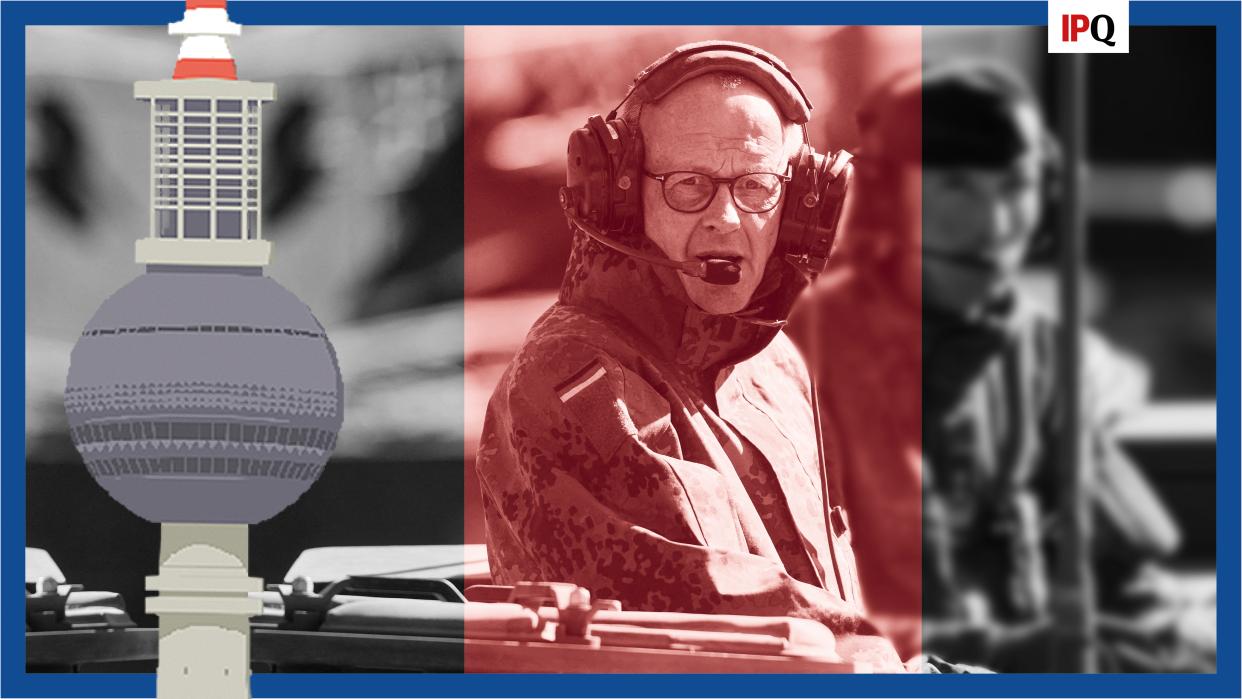
Fifteen years on, German leadership in Europe remains a work in progress (IPQ will soon run a series of articles on the subject). What’s certainly happening is that the country is busy constituting itself as a serious military power after more than three decades of neglect and decline.
It took Russian President Vladimir Putin’s full-scale invasion of Ukraine in 2022 to push German politicians to finally act—and US President Donald Trump’s unpredictability for incoming Christian Democrat (CDU) Chancellor Friedrich Merz to perform a screeching U-turn and, with the help of the Social Democrats (SPD) and the Greens, make massive debt-financed defense spending possible.
With the constitutionally enshrined “debt brake” no longer applicable to defense spending, Berlin is borrowing and spending on an unprecedented scale. This year, Germany will spend approximately €108 billion on defense— €24 billion of which are coming from the €100 billion “special fund” (“Sondervermögen”) the government of former SPD Chancellor Olaf Scholz introduced in response to Putin’s war; it will then run out. In 2027, the figure is supposed to be roughly similar (€93 billion), before jumping to €136 billion in 2028 and €152 billion in 2029.
Since Germany will has also created a special fund of €500 billion to spend on its crumbling infrastructure over the coming 12 years, it will be almost certainly count among only a handful of NATO members to meet the alliance’s new 5-percent-of-GDP spending goal. Only Poland, the Baltic States, Norway, and the United States are spending as big, comparatively speaking. Europe’s traditional leading military (and nuclear) powers, the United Kingdom and France, have nowhere near as much financial firepower and are facing tough choices.
The Next Hegemon?
This situation has led to warnings about Germany becoming “Europe’s next hegemon” (Liana Fix in Foreign Affairs). “Left unchecked, German military dominance might eventually foster division within the continent,” Fix predicted earlier this year. In a similar vein, Sylvie Kauffmann, writing in the Financial Times in June, stated that there was now a “new German military question;” Germany’s European partners should not “be kept in the dark about its new path.”
Looking more closely, however, it appears that Berlin does not have any grand design (if only), never mind a sinister one. It’s more like that those in charge—mostly at the defense ministry led by the SPD’s Boris Pistorius—are scrambling and improvising at high speed to make Germany a credible military force again—credible enough to deter Putin from attacks on NATO or European Union territory. This involves quick decisions and, at times, a highly pragmatic approach that may come across as insensitive.
In some respects, things are going well. Germany’s armed forces are growing again, starting with their infrastructure. Inter alia, the defense ministry plans to build 40 new barracks across the country. In terms of personnel, the Bundeswehr is also expanding, albeit slowly. It received 40,000 applications during the first six months of 2026, an increase of 24 percent. This year, it also sent out 300,000 questionnaires to those turning 18 this year to gauge the interest in its new voluntary service; the 153,000 male recipients are required by law to respond, and 96 percent of them did so by the deadline. As the ministry stated on June 24, it is on track to meet its personnel goals for this year, i.e., somewhere between 186,000 and 190,000 soldiers.
Over time, the Bundeswehr is supposed to scale up to eventually 240,000 soldiers by the late 2030s, in tandem with an “active reserve” of 200,000. Building the latter will be a new and very challenging task (up to now, the Bundeswehr has not formed fighting units solely with reservists, but it plans to do so in the future). It is the real reason why some, particuarly in Merz’ CDU/CSU, are demanding the immediate return of general conscription. However, there is no political majority for such a move, and an ill-judged public debate could potentially blow up the whole project of German rearmament.
Exploding Costs
Another critical point is the exploding costs—the ministry worries about the inflationary effects the spending splurge is potentially creating and about defense companies that are too slow, or fail completely, in creating economies of scale, which would bring down prices. If the German public, which for now supports the effort to make Germany militarily stronger, gets the impression that all that money is being spent for defense companies to maximize their profits, the mood may sour quickly.
And increasing defense industrial capacity and speedy procurement remain problems. The overarching aim is to get what Germany’s military leadership—the inspector general of the armed forces, General Carsten Breuer, the leaders of the army, air force, and navy, and the general staff—tell them they need (and quickly), based on elaborate plans the Bundeswehr has published for the first time in its history, including a military strategy. This aim even trumps arguments for “buying local” (i.e., national) and “supporting German jobs.”
This has led to some tough decisions. On June 24, Pistorius cancelled the F126 project; the six new frigates were supposed to be the German navy’s biggest and most powerful ships, but the project was running late and over budget. Instead, eight MEKO-A200 ships pioneered by the Australian navy will be ordered instead; they’ll be available more quickly and have much-needed anti-submarine warfare capabilities as a feature (which the F126 would have needed to add). The decision came as a blow to German champion Rheinmetall, suspiring, perhaps, to critics who think that German rearmament is all about beefing up that company, which just about ranges among the world’s top 20 defense companies.
The official end of the FCAS project with France and Spain, at least as far as a jointly-built 6th generation fighter jet is concerned, is another example. The project, launched by French President Emmanuel Macron and then German Chancellor Angela Merkel, came from “another era” (i.e., 2017) and was always more of a political project. Its end has opened up new space, Franco-German cooperation is continuing and works well overall. Currently, Berlin and Paris are preparing a reinvigorated common defense project agenda for the Franco-German Council (the regular meeting of government ministers) in July.
The US Is Not Keeping Its Word
The procurement challenges are being compounded by the Trump admiration’s recent moves to withdraw military more capabilities from NATO without previous warning. This contradicts assurance Berlin and other European allies received from Trump administration that this process would be orderly; now it is becoming chaotic. Pistorius alluded to this in his Helmut Schmidt Lecture on June 22. While agreeing that some of the challenges that Germany is facing today are similar to those former SPD Chanceller Schmidt had to deal with in the late 1970s, Pistorius pointed out that back then “the situation was clear on both sides of the Iron Curtain, but particularly so on this side.”
That’s no longer the case. Trump’s abrupt cancellation of the deployment of the US Army’s multi-domain task force (MDTF) with its long-range fires capabilities to Germany is perhaps the biggest headache. The MDFT was supposed to temporarily close an important deterrence gap to be able to respond to a Russian deployment of Iskander rockets from Kaliningrad (which could reach Berlin within a few minutes). There have been more recent abrupt reductions of US contributions to the NATO Force Model, announced in early June. These are affecting fighter aircraft (reduced by a third), destroyers, submarines, and armed reconnaissance. Add to that US Secretary of Defense Peter Hegseth’s recent comments about further reducing the US military footprint in Europe, and it is clear that Germany’s task is becoming ever more difficult and urgent.
To compensate for the MDFT, the German defense ministry is looking into “low cost/long range” options; there is also an originally British-German project to build long-range cruise missiles, with the multinational MBDA (part-owned by Airbus, BEA Systems, and Leonardo) in the lead. It is advancing well. And some believe the dire situation of the US defense industry may open up chances for German or European companies as well. For instance, the production of Tomahawks and Chinook transport helicopters faces severe delays. Trump held a crisis meeting with the CEOs of US defense companies on June 24, pushing for the rapid expansion of US weapons productions, due in part to the Iran war, but it remains unclear whether the US Congress will provide extra funds. For example, Germany’s struggling automobile sector could redirect its spare capacity to producing components of systems that the US and its allies all need, for instance the F-35 fighter jet (which is already happening).
So, the true picture is a far cry from a Germany that is ruthlessly pursuing its military build-up as a national project. Communication matters, however. It would already help if Merz and others would speak less often about the aim of “becoming Europe’s strongest conventional military force,” but instead stress (as Munich Security Conference chair Wolfgang Ischinger suggested earlier this year) that the effort is all about making sure that Europe can effectively defend itself, if need be without the Americans. German ministers and officials should spell this out in public more often. It’s a true reflection of what’s going on.
Henning Hoff is executive editor of INTERNATIONALE POLITIK QUARTERLY.
