In early July, overshadowed by discussions about tax and welfare state reforms, Germany’s ruling coalition of the center-right Christian Democrats (CDU/CSU) and the center-left Social Democrats (SPD) made a largely overlooked shift: According to a paper adopted by the leaders of both governing parties, faster and sector-wide anti-dumping and anti-subsidy measures are needed at European level. That may sound technical, but it marks a real turning point.
As recently as 2024, the government of previous SPD Chancellor Olaf Scholz, against the stated wishes of his coalition partners the Greens and to the applause of the CDU/CSU, then in opposition, opposed European Union duties on imports of Chinese electric cars. This was out of concern that such measures would trigger massive retaliatory actions against German industry’s already faltering exports. Two years on, the current government sees the situation differently and has realized that inaction is accelerating Germany’s rampant deindustrialization, making it irreversible.
No Good Options
Germany and Europe face a dilemma. On the one hand, German policymakers cannot stand idly by and watch deindustrialization take place. People in Germany sense that the industrial base is eroding. Every month, around 10,000 industrial jobs are lost. The main causes are homegrown: high energy prices, dilapidated infrastructure, overregulation, and insufficient private investment in future technologies.
But China’s industrial policy is accelerating this decline. Massive government subsidies are compounded by weak domestic demand. Chinese industrial companies are trying to offload the resulting overcapacity on the global market by offering low prices. According to a recent French study, [TR1] up to 68 percent of German industrial production is at risk from Chinese competition in the medium term. Even if the estimate is an exaggeration, this represents a significant number.
Added to this are the erratic policies of US President Donald Trump, which are detrimental to global economic development. These range from trade policies to energy price increases resulting from the war with Iran.
At the same time, rising unemployment and widespread loss of prosperity are eroding confidence in democracy. Politicians must take action. Yet neither Beijing nor Washington are taking the Europeans’ concerns seriously. They do not believe that a divided Europe, with a hesitant Berlin at the helm, can effectively defend itself.
Concerns about Chinese and American retaliation are justified. It is no secret that Trump is unlikely to shy away from imposing his will by any means necessary. And Beijing, too, might be inclined to take drastic countermeasures very quickly, which would further deepen the current economic crisis. Beijing has shown that it uses economic dependencies as a means of exerting pressure. This applies to export restrictions on chips, on which the German automotive industry relies, as well as to rare earths and other raw materials and intermediate goods.
It is true that Brussels is now doing everything it can to establish alternative sources of supply and reduce dependence on Beijing through diversification. For example, the EU is concluding or renewing trade agreements with the Mercosur countries, Mexico, India, and Indonesia and recently the European Commission also proposed a “diversification instrument.” But all of this takes time, time that Germany does not have if it is to halt deindustrialization.
Precisely because Berlin has hesitated for so long, it is now up to the federal government to support a European course of action that, on the one hand, credibly strengthens Europe’s economic defense capabilities and, on the other, opens up room for negotiations to address deindustrialization through bilateral measures. However, if Beijing and Washington are unwilling to compromise, Europe must be able to defend itself unilaterally and, if necessary, withstand new trade disputes.
Given the constant stream of bad news, the German public’s unease is understandable. Voters rightly expect answers from their political leaders. But all the options available to Berlin and Brussels come at a cost. Either inaction will lead to a decline in prosperity and lasting deindustrialization, or a Europe that stands its ground will become the target of American and Chinese retaliatory measures. The German government should openly acknowledge that there are no good options, in order to explain that we must prepare for temporary trade conflicts with Beijing and Washington. The alternative would be the gradual but irreversible loss of entire industrial sectors. A public that understands why short-term hardships prevent long-term disruptions will support such a strategy. What it will not support is a lack of direction.
Europe: A Profit Machine
To avoid a trade war while still halting deindustrialization, negotiations with China are essential, since about one-third of global industrial production takes place there. But why would Beijing agree to negotiate meaningfully with Europe?
The answer lies in China’s own vulnerability. The country is facing a structural growth crisis: an aging population, a collapsed real estate sector, high debt, and consumer reluctance are leading to lower growth rates and a heavy reliance on exports. This year, exports could account for about half of China’s growth.
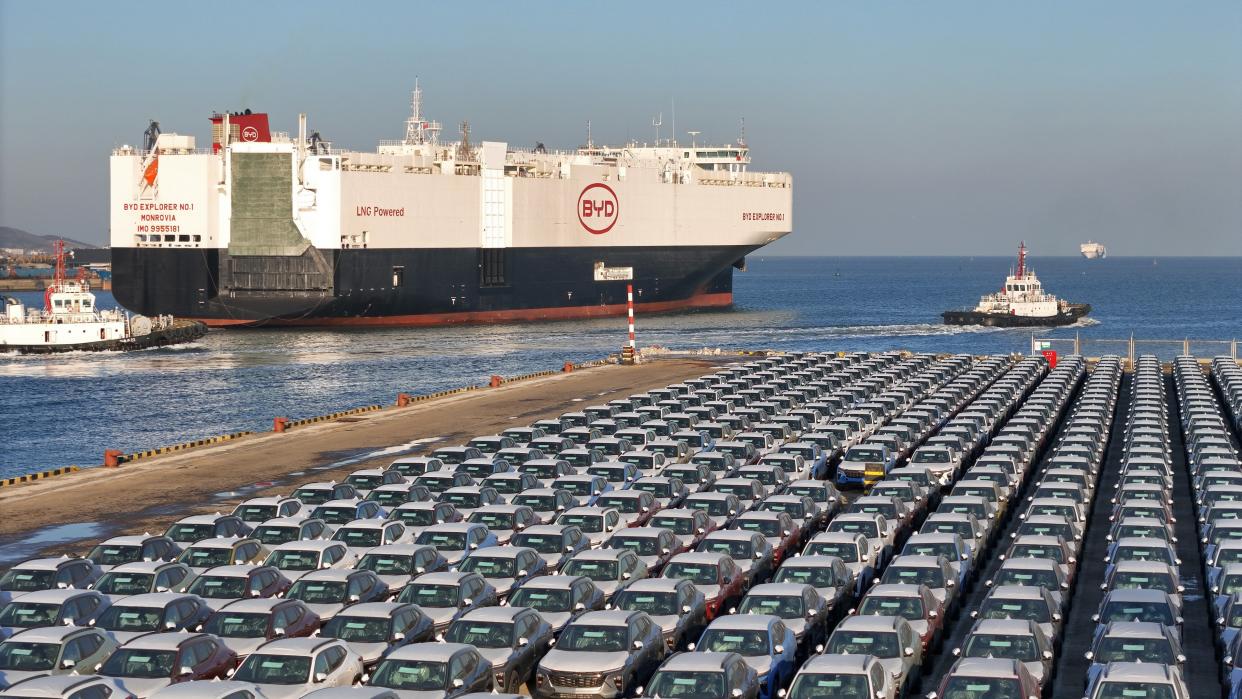
Although the EU accounts for “only” just under 15 percent of Chinese exports, Europe is more than just a large market. That’s because European consumers pay, on average, two and a half times what Chinese companies earn for the same export goods in the rest of the world. For example, before the EU tariffs were introduced, the Chinese electric car manufacturer BYD earned nearly €13,000 on every “Seal U” model it sold in Europe. The profit margin on the same car, sold in China, was only €1,300. Excess capacity and ruinous price wars have caused margins to collapse. According to official Chinese figures, nearly one in four Chinese industrial companies is operating at a loss. For a growing number of Chinese manufacturers, access to foreign markets with strong purchasing power, especially Europe, determines whether they make a profit or a loss.
It would be virtually impossible for China to compensate for a loss of access to the European single market. While Chinese companies could shift to other export markets, comparably high prices can only be achieved in markets with high purchasing power: the United States, Japan, South Korea, or the United Kingdom. Yet these very markets are likely to close themselves off even further as soon as a flood of imports threatens their own industries. The US, in particular, is already doing so. Even China’s partners, including Russia, have recently erected trade barriers against Chinese imports when they threatened their own industries. And even if countries in the Plural South remain open to Chinese goods, they can absorb the volume but cannot pay European prices. The shift in trade away from Europe would thus merely transform a demand shock into an even deeper price shock: Deflation in the Chinese economy would deepen, margins and wages would continue to fall, and the burden of enormous debt would grow.
However, China’s own vulnerability does not automatically make it more willing to compromise. Precisely because Chinese industry must export excess capacity to mitigate the domestic crisis, Beijing’s room for concessions is limited. Yet if Europe shows resolve, China, too, should seek a compromise in its own interest.
Time and Credibility
The key factors are time and credibility. China’s leverage and Europe’s leverage take effect at different rates. China’s most potent weapons—export controls on rare earths, magnets, and other critical intermediate goods—take effect immediately. However, these kinds of export restrictions increase the pressure on Europe to develop alternative sources of supply. This cannot be achieved overnight. But over time, the impact of export controls wanes.
Europe’s strongest leverage, in turn, is access to its own market. While this leverage takes longer to take effect, it holds great promise. After all, it is difficult to see where high-spending markets that could replace Europe might emerge for China. If other markets also close off at the same time, the pressure on Beijing will actually increase over time.
This asymmetry suggests that Beijing would likely take swift and harsh countermeasures if Europe were to close its market. The goal would be to persuade Europe to back down before restrictions have a massive impact on China. This is precisely the pattern Beijing has already demonstrated in its dealings with Washington. In response to Trump’s tariff threats, Beijing imposed immediate, targeted export controls, forcing the US to the negotiating table. Europe, too, has already had this experience: In the Greenland dispute, the mere threat of activating the Anti-Coercion Instrument—Europe’s most powerful trade policy tool—was enough to persuade Washington to exercise restraint.
The strategic task is to use measures that take effect quickly and can be credibly implemented to alter Beijing’s calculations even before a conflict arises. Instead of dithering, as Berlin has done in the past, Europe must realize that it has significantly more leverage over China than is commonly assumed. This is not about confrontation for its own sake. The goal is substantive negotiations. But Europe must be able to make credible threats in order to negotiate effectively—not only with Beijing, but also with Washington.
Tools at Europe’s Disposal
As positive as the German government’s reversal—described above—may be, it comes too late and does not go far enough. Berlin’s call for “sector-wide” anti-dumping and anti-subsidy proceedings is misleading. This is because such proceedings require complex, company-specific calculations and can only be carried out on a highly product-specific basis over extended periods of time.
Nor does Chancellor Friedrich Merz’ idea of a “Plaza Accord 2.0” for revaluing the renminbi help. It assumes a level of bargaining power that Europe has yet to establish and fails to recognize that China can offset any currency revaluation through subsidies.
The mechanism that can achieve what Berlin wants already exists: safeguards. They are WTO-compliant, significantly faster, and can cover entire sectors. For example, in 2018, the EU imposed safeguards in the steel sector, covering about two dozen product categories in a single proceeding. Safeguards could be considered today in the mechanical engineering, aluminum products, and chemical industries.
Since neither Beijing nor Washington currently believes that Europe will use its tools in a crisis—the Greenland incident has so far remained the exception—they are not shying away from trade disputes with the EU. The core problem is decision-making. While in Washington the president can impose tariffs within a matter of days, in Brussels a qualified majority of the 27 member states is required to activate safeguards or the anti-coercion instrument. Because of these hurdles, safeguards are used extremely rarely; the anti-coercion instrument has never even been activated. Germany should therefore propose changing the voting rule to bring it in line with anti-dumping duties. Then, member states would need a qualified majority to prevent the European Commission from using safeguards and the Anti-Coercion Instrument. This measure should be supplemented by an expansion of the Anti-Coercion Instrument, which could then also be used in the future as a response to potential US and Chinese retaliatory measures against European trade defense measures.
Finally, Germany should support the initiative for a solidarity mechanism in Europe. Beijing’s tried-and-true tactic is to target individual countries that advocate trade restrictions. French cognac, Spanish pork, and Lithuanian exports have already been the targets of Chinese retaliation. President Donald Trump is also explicitly threatening Spain because it opposes his stance on the Iran war. A European solidarity mechanism that collectively cushions the costs of American and Chinese countermeasures by, for example, compensating affected companies, would undermine the basis for this tactic.
A combination of these reforms would significantly increase Europe’s trade deterrent against the United States and China.
The Goal: Negotiations
None of this is intended to provoke confrontation, but rather to bring Beijing and Washington to the negotiating table. The channels for this already exist. Just last June, Trade Commissioner Maroš Šefčovič and China’s Minister of Commerce Wang Wentao agreed on a new ministerial platform designed to discuss trade imbalances, export controls, and WTO reforms. Such procedural advances are welcome, but they do not yet constitute breakthroughs. Bargaining power only arises when the other side knows that failure comes at a cost. As long as those costs are absent, every round of negotiations that yields no results serves China and the US, not Europe.
Brussels should therefore make it clear that free access to the European market, European technology, and European research is contingent on specific concessions. These concessions should be feasible for Beijing and Washington, but should substantially address Europe’s economic problems. For example, anyone who demands that Beijing abandon its economic model will fail. However, anyone who demands specific concessions, and threatens to close the single market if they are not granted, can succeed.
Three examples: With regard to export controls on rare earths, Europe could ask for multi-year general licenses for certified European buyers instead of the current short-term individual licenses. This would provide planning certainty without requiring Beijing to change its export control laws. With regard to overcapacity, Europe could call for export quotas and minimum prices for selected goods, enshrined in voluntary restraint agreements. And with regard to Russia, Europe could, as a first step, demand that China prevent the re-export of European dual-use goods through Chinese territory to Russia. Since this demand does not fundamentally call into question Beijing’s partnership with Moscow, it could be acceptable to China.
Externally, the Europeans must signal to Beijing and Washington that they are not seeking a trade war, but rather a balance in which both sides know that escalation would harm both of them. Only if no compromises can be reached that better protect European interests will the EU then act quickly, decisively, and unilaterally.
Germany’s Role in Europe
No country bears as great a responsibility as Germany for advancing such a policy. It is the European Union’s largest economy, with an above-average risk of deindustrialization.
What is needed now is an initiative from Berlin that strengthens the Europe Union’s negotiating power by facilitating the activation of the Anti-Coercion Instrument and the safeguards, introducing a solidarity mechanism, and protecting particularly affected sectors in the short term through safeguards. The German government had the right instinct. Now Berlin must choose the right tools and muster the courage to make the EU both credible and capable of acting.
—Translated from the German by Kate Brown
Tim Rühlig is Senior Analyst for Global China at the European Institute for Security Studies (EUISS).