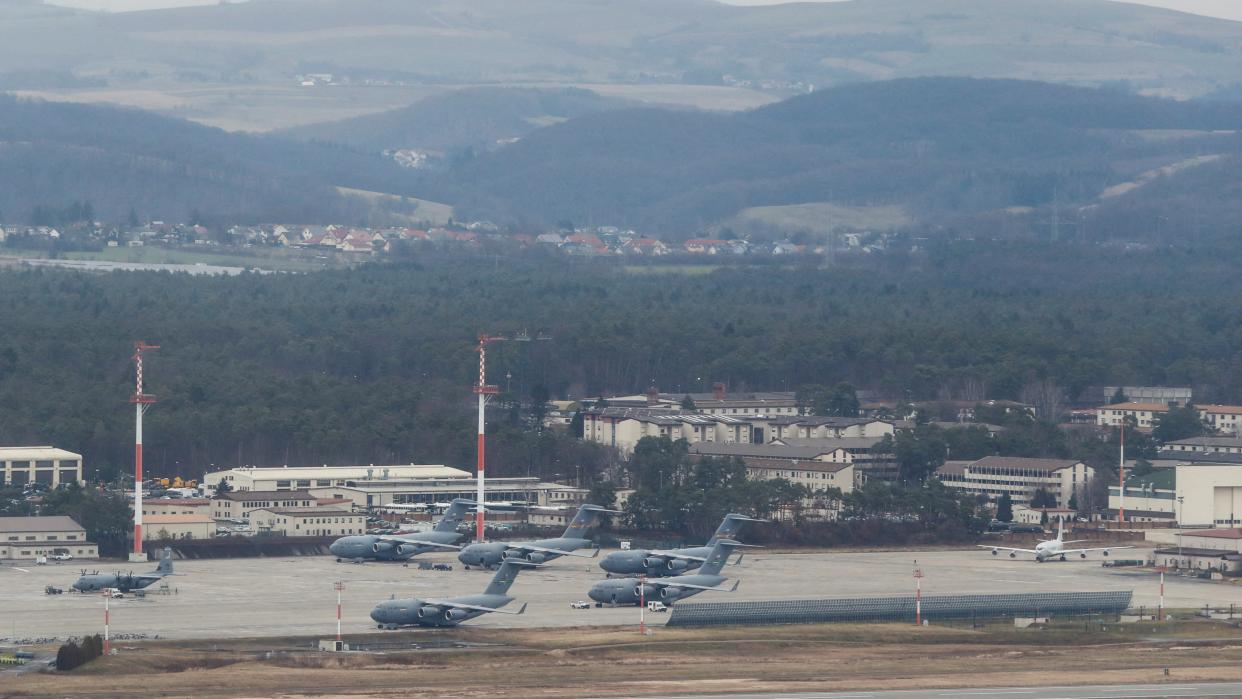
In the weeks leading up to the US military operation against Iran, hundreds of American transport aircraft thronged through Ramstein Air Base, the sprawling military complex at the edge of the Palatinate Forest in southwestern Germany. Flight-tracking data showed Ramstein at the center of a massive strategic air bridge, arching from the continental United States across the Atlantic to Europe and on to bases across the Middle East. By the time hostilities began in late February, the United States had effected the largest military buildup in the Middle East since the 2003 Iraq War, with much of the personnel and materiel having passed through America’s “Global Gateway” in Germany.
It was yet another reminder of the Federal Republic’s central role in the architecture of US global power. From the immediate postwar era to the present, Germany has served as a vital node in the United States’ sprawling military footprint and the diffuse network of political, diplomatic, commercial, financial, and cultural relationships supporting its global reach. Recent geopolitical convulsions and the rise of a peer competitor in Beijing have led many to question the durability of this system and Germany’s role within it. Fluctuations in America’s strategic ambitions—from the Indo-Pacific “pivot” to the reprioritization of the Western Hemisphere—have fueled speculation that Washington will scale back its relationship with Berlin.
In reality, the opposite may be true. As the United States retools for an era of great power competition, it will have strong incentives to draw on Germany’s industrial and financial depth, politico-military power, and geostrategic position in Eurasia to preserve its global position. And the case for reinforcing ties cuts both ways. Facing an irredentist Russia and exogenous economic shocks, Berlin needs US support in addition to a more capable and integrated Europe.
The way forward for the bilateral relationship lies in rebuilding a profitable division of labor, with Washington providing a security and energy backstop, technological dynamism and deep markets for German goods, while Berlin returns to its role as a continental security provider and Europe’s economic engine.
Though there is a clear strategic case for revitalizing bilateral ties in the years ahead, progress is not inevitable. Policymakers on both sides will have to navigate entrenched differences on trade and regulation while gradually rebuilding political trust. Nevertheless, one should not underestimate the centripetal forces pulling the United States and Germany into a closer alignment.
The Making and Breaking of the Partnership
The US-German relationship, once the center of America’s Cold War geopolitical project, has come under strain in recent years. Upon assuming the chancellorship, Friedrich Merz lamented that the US government has become “largely indifferent” to the fate of Europe and its partnership with Germany. For their part, policymakers in Washington have made clear that their focus has shifted east to Asia and the strategic challenges posed by an ascendant China. It is a striking change from just three decades earlier, when President George H.W. Bush mounted a podium in Mainz to declare the United States and the Federal Republic “partners in leadership.” In retrospect, the Cold War seems a golden age of US-German cooperation. But what made this partnership so successful in the first place? And what caused it to fall into a state of disrepair?
The success of the US-German partnership during the Cold War rested on a clear division of labor. Germany’s most important role was that of Europe’s economic engine. Following World War II, Europe lay in ruins. Industrial output had cratered to just 60 percent of prewar levels while poverty and unemployment were endemic. Fearing communist exploitation and the loss of important productive capacities, Washington funneled billions of dollars in financing and capital goods into the continent. The centerpiece of its economic strategy was the revitalization of West Germany.
It was a remarkable success. The West German Wirtschaftswunder heralded a rapid turnaround in Western Europe’s economic fortunes. Between 1950 and 1960, German industrial production nearly tripled while capital-goods production rose by over 220 percent. Germany’s export-driven economy provided millions of jobs for displaced workers across the continent and gave Western Europe the economic means to stand on its own throughout much of the Cold War. The United States benefited by supplying large quantities of industrial imports to West Germany and regaining access to consumer markets across the continent. Later, offset arrangements, by which Bonn recycled its surpluses into US Treasuries and defense purchases, kept the partnership afloat during a series of balance-of-payments crises through the 1960s and 1970s. By the end of the Cold War, the economic relationship had matured from a patron-client dynamic to a deeply institutionalized and mutually advantageous economic co-management.
The division of labor also cut across military and political responsibilities. Germany’s geostrategic position in America’s Cold War strategy was that of a vast defensive glacis. Contrary to the myth of Germany’s post-war pacifism, its reconstructed Bundeswehr represented the backbone of NATO’s forward military presence. From the 1960s to the late 1980s, Bonn fielded a force of nearly half a million men at arms—the single largest NATO contingent in Europe—complemented by a vast arsenal of conventional military equipment.
While the Federal Republic bore the brunt of conventional defense, the US focused on its competitive advantages: providing leadership in NATO, extended nuclear deterrence, and connectivity with a sprawling network of military command and logistical hubs. On political matters in Europe, Washington midwifed Bonn’s return to the global stage and legitimization as a major European power. German leadership in Europe in turn gave the United States entrepot from which to shape the European community’s development in line with American political and economic preferences.
The Cold War relationship was not always smooth sailing. Debates about rearmament in the 1950s, Ostpolitik, and offset arrangements in the 1960s, and extended deterrence and arms control in the Cold War’s final decades were a constant source of friction. Yet the focus on the overriding geopolitical threat posed by Moscow allowed both sides to manage conflict and subordinate secondary issues to first-order strategic priorities.
Inverting the Division of Labor
With the end of the Cold War, consensus around this division of labor dissipated. The US-German relationship suffered a period of strategic drift exacerbated by political mismanagement on both sides. Over the following three decades, the Cold War division of labor was gradually inverted.
In defense, Germany retreated from its role as a security provider in Europe, allowing deep cuts to hollow out the Bundeswehr. Russia’s invasion of Crimea in 2014, and subsequent aggression against Ukraine in 2022, exposed Germany’s military vulnerabilities and accumulated dependencies on others for its security, namely the US and Ukrainian armed forces. This inversion of Germany’s role in European security was facilitated by shortsighted policymaking in Washington, which saw European military self-sufficiency as a threat to America’s position on the continent and its infantilization as a valuable source of leverage in other policy domains.
The economic relationship underwent a similar inversion. German industry had once strengthened Western Europe’s ability to withstand Soviet pressure. But growing dependence on Russian energy—representing 30 percent of Germany’s energy mix in 2022—gave Moscow huge leverage over Europe’s productive core. To their credit, US policymakers as far back as the Reagan administration pushed back on Germany’s gradual erosion of its—and by extension, Europe’s—energy security. This ultimately made little difference as German industrial and political interests alighted on a policy that exposed Europe’s economic engine to external pressure.
In contrast, unrestrained integration with China was a shared miscalculation. Both Washington and Berlin championed China’s incorporation into the global trading order, expecting commercial integration to yield lasting economic gains with negligible risks. Those gains were substantial, but the vulnerabilities emerged unevenly: American manufacturing faced Chinese competition earlier (China Shock 1.0), while German capital goods producers initially profited from China’s industrial expansion.
Over the past several years, however, complementarity has given way to renewed competition as Chinese firms leveraged technology transfers and joint ventures to move up the value chain. Germany’s share of the Chinese market is now rapidly shrinking, while Chinese companies are flooding global markets with low-cost competition (China Shock 2.0). One prominent analysis warns of “plain deindustrialization” as German factories shutter, production lines vanish, and technological innovation migrates away. Germany’s dependence on Chinese markets and exposure to Chinese overcapacity are now seen as among Europe’s most dangerous geopolitical vulnerabilities.
The Logics of Renewal
It is hardly surprising that the US-German relationship is now in disrepair. More than three decades of political, strategic, and economic mismanagement have left it without a clear raison d’être or a coherent division of labor. But the relationship is not doomed. The return of great power competition has disabused both sides of the assumptions and illusions of the post-Cold War era. Facing a more dangerous international environment, they will see increasing value in convergence and collaboration.
The Case for Germany
For the United States, the incentives to deepen ties with Germany fall into four areas: geographic centrality, industrial depth and foreign direct investment, latent military potential, and political influence.
The geostrategic case was apparent in America’s mobilization for war against Iran. Germany has been, and remains, the United States’ most important military command and logistics center west of the first island chain. It hosts around 36,000 active-duty US personnel (the largest concentration after Japan) and 19 major operational hubs. Its importance for US power projection relates to its advantageous geography. From German territory, American power can be organized against the Eurasian heartland, projected southward into the Mediterranean and Middle East, and sustained across Africa, while remaining anchored to the Atlantic lines connecting it to the United States.
Access to this “Eurasian bridgehead” was a crucial component of the United States’ Cold War geopolitics and remains a strategic imperative in an era of sustained great power competition across the vast super-continent. The manifest vulnerability of the US military position in Persian Gulf littoral will provide further impetus to anchor its western defense posture to more defensible terrain in the center of Europe.
Spare industrial capacity and foreign investment are also critical to the United States’ effort to rebuild its capacity to deter multiple peer and near-peer adversaries. Germany offers both. China’s hollowing out of Germany’s traditional high-value manufactured export industries presents a rare opportunity for the United States to draw on readily available infrastructure, human capital, and production lines.
Already, German firms like Rheinmetall and Continental have established programs for transferring workers displaced by the downturn in automotive exports into defense manufacturing. Encouraging such efforts would provide the US with valuable strategic depth in the transatlantic defense-industrial base. The optimal division of labor would marry America’s advantages in innovation with Germany’s network of agile small and medium-sized manufacturers.
Domestically, rebuilding America’s own industrial capacity will require sustained national and foreign investment. Germany has already positioned itself as a key player in this effort: as of 2025, it was the third-largest source of foreign direct investment in the United States at just over $700 billion. That year, the value of these German investments increased by nearly $50 billion, the largest annual increase of any country. These same firms are among the largest foreign sources of employment in the US, providing jobs to over 900,000 Americans. German FDI will be a vital source of strength for US industry as it seeks to rebuild itself and expand production of important defense systems and munitions and other national-security priority goods.
Germany’s latent military potential provides a third structural basis for renewed partnership. The current administration understands that concentrating scarce military assets along in East Asia to contain China requires some deprioritization of Europe. Such a pivot will only prove durable, however, if the United States can transfer greater responsibility for continental security to a European power with both the economic capacity to sustain a large military establishment and a strategic outlook organized around the Russian threat.
France possesses formidable military capabilities but continues to pursue a conception of European autonomy at odds with US preferences; Poland is closely aligned with Washington but, despite an impressive rearmament effort, commands an economy barely one fifth the size of Germany’s. Only the Federal Republic combines the industrial, fiscal, and demographic resources necessary to substitute for a meaningful share of US military power in Europe with an established commitment to defense along the eastern flank.
Berlin has already begun moving in this direction. German defense spending reached roughly 2.4 percent of GDP in 2025, while constitutional reforms exempted defense expenditure above 1 percent of GDP from the “debt brake,” effectively removing the principal fiscal constraint on sustained rearmament. Spending is set to exceed €108 billion in 2026 and rise toward 3.5 percent of GDP by 2029. By then, German defense outlays will surpass the combined total of current British and French defense spending. Berlin is also enhancing its forward presence in the Baltics. It is permanently deploying a brigade to Lithuania on a bilateral basis and by deepening integration between its regional defense command with NATO operations. Washington and Berlin’s broad agreement on transferring greater responsibility for European defense to Europe points to the enduring logic of their Cold War division of labor.
Finally, Washington should not overlook the importance of retaining political influence within European economic decision-making. Germany remains America’s main entrée into the European Union, which in 2025 accounted for roughly $1.6 trillion in US goods and services trade and remains the world’s largest bilateral economic relationship. The United Kingdom’s departure from the EU deprived Washington of its most reliable internal advocate, increasing the value of Germany’s position at the center of European decision-making. As the EU’s largest economy—accounting for nearly 24 percent of the EU’s GDP—Berlin possesses unique influence over its institutions and the bloc’s commercial, industrial and regulatory agenda. While Washington may rightfully bristle at Brussels’ regulatory vise grip, it cannot afford indifference to decisions governing one of its largest markets or relationships which provide it influence over the broader transatlantic space.
The Case for America
The incentives to enhance cooperation cut both ways. For Germany, the loss of Russian energy, export competitiveness, and regional stability has prompted a wholesale reassessment of its national policy. Merz has written that, in the era of great power competition, “Germany must chart its own course.” This does not mean, however, that Germany can afford to go it alone; Europe has a critical role to play in the future of German national policy, but so too does the United States.
The first is access to energy and technological innovation. The loss of Russian energy supplies continues to represent a structural challenge for the German economy. In 2025, industrial energy costs remained nearly 30 percent higher than the pre-war baseline, creating intense downward pressure on output and fueling inflation. US surplus capacity, a product of the 2010s shale revolution, has allowed it to step in as a key supplier of liquified natural gas (LNG): In 2025, American LNG represented 96 percent of German seaborne gas imports, up from just 40 percent the previous year. With US LNG export capacity set to rise over the coming years, and the long timelines and geopolitical complexities involved with establishing new overland suppliers, Germany will continue to rely on the United States as a key part of its diversified energy mix.
A similar logic applies to technology. Germany’s ability to compete in sectors at the technological frontier will depend increasingly on access to the American innovation ecosystem, where capital, compute, software, and research capacity are concentrated at an unmatched scale. In 2025, private AI investment in the United States reached roughly $286 billion, compared with just $3.9 billion in Germany, while American firms controlled around 70 percent of Europe’s cloud infrastructure market. The EU cannot yet furnish either the energy abundance or the technological ecosystem Germany requires, leaving the United States uniquely positioned to supply both.
It will be difficult to reconcile the two regulatory regimes in the short term given deep-seated divergences over data privacy and antitrust controls, among other differences. But full regulatory convergence is not a prerequisite for expanding technological cross-pollination. A more realistic paradigm could combine sector-by-sector mutual recognition where standards deliver similar outcomes (as is the case with telecommunications equipment) with regulatory carve-outs or simplified compliance requirements for US firms operating under similar domestic safeguards.
In addition to its role as a critical supplier of energy and technology, the United States continues to be Germany’s most important national market, accounting for nearly 10 percent of all goods exports every year for the past decade. As Chinese demand for German automobiles, machinery, and electrical equipment has weakened, the US market has become increasingly important to sustaining the export revenues on which Germany’s industrial model depends. The sectors most exposed to Germany’s deteriorating position in China are also among those most dependent on US demand, leaving Germany with no alternative market of comparable scale.
Washington will also continue to occupy a central place in German defense policy even as Berlin assumes a larger share of Europe’s conventional burden. Germany’s expanding role on NATO’s eastern flank is important to mitigating security vulnerabilities, but the sine qua non of deterrence remains America’s extended nuclear guarantee. On the nuclear file, Germany has no credible near-term alternative to the United States: The ascendance of the Rassemblement National in France renders reliance on the force de frappe politically parlous; strategic dislocation from London and chronic underfunding of the British independent deterrent similarly rule it out as a pan-European backstop; an independent German deterrent is neither legally nor politically plausible. There is no easy way for Europe to get out from under the US’s nuclear umbrella without inviting coercive Russian behavior or a potentially calamitous breakdown in deterrence.
Washington also remains the only shop in town when it comes to providing leadership in a strategically divided continent and the key enabling platforms—including intelligence, surveillance and reconnaissance, strategic lift and command-and-control—necessary to sustain modern combat. Thus, even as Washington shifts greater attention toward the Indo-Pacific, Germany’s reliance on America as a nuclear backstop and conventional force mobilizer will endure.
Taken together, these overlapping political, strategic, financial, and industrial incentives provide a robust foundation for a revival of the US-German partnership. The question is whether the two can muster the political will to shape a new division of labor attuned to the changing global order.
An Old Way Forward
The return of great power competition has clarified the stakes for the US-German relationship and strengthened the incentives to deepen cooperation. For Washington, Germany remains too important to US power at home and across Eurasia to be relegated to secondary status. For Berlin, the United States’ importance as a source of economic dynamism and a security backstop will only increase in the coming years.
It is possible to sketch the contours of a third phase in the relationship. It looks much like the first: a clear division of labor, with Washington providing the security backstop, technological dynamism, and deep markets for German goods, and Berlin returning to its role as a continental security provider and Europe’s economic engine. This partial reversion to the mean reflects the enduring competitive advantages of each country endowed by its specific geographic, demographic, cultural, and political characteristics.
This is not to say that the United States and Germany should prepare to fight the last war. The basic strategic premises of the present era bear only a fleeting resemblance to the Cold War. For one, the sources of competition are both more diffuse and concentrated: Beijing today is a stronger challenger than Moscow at its apex, and it stands beside a host of revisionist powers seeking to overturn the foundations of Western strength and prosperity. America and Germany too have changed. The United States is now a global energy superpower and commands the most dynamic technological ecosystem in the world. It possesses the economic foundations for sustained competition but is heavily burdened by fiscal profligacy and strategic overextension. Germany now has powerful allies to its east both willing and able to assist it in securing a geopolitical space for development. Yet it lacks a clear sense of its political role within the maze of European institutions and half-baked geopolitical realignments.
However strong the logics of cooperation may be, policymakers on both sides will have to work hard to establish a more stable modus vivendi on trade and other disputes, while slowly rebuilding political trust. Liana Fix and Paul Stares haveclaimed that leadership in Berlin now views the transatlantic partnership as “dead in the sense that they can no longer rely on Washington as before.” While challenges to US reliability are belied by its substantial forward presence on the continent, Washington must recognize that issues of political trust are subjective and have important systemic consequences. Germany may choose to go its own way with Europe despite the manifest disadvantages and vulnerabilities which would inevitably result from transatlantic decoupling.
Achieving the optimal outcome for both sides thus requires greater attention to clearly conceptualizing and communicating expectations about how the division of labor should be organized. On defense matters, Washington should be transparent about what capabilities Germany should prioritize and provide a reasonable timetable and available resources for helping Berlin achieve its objectives.
Where incompatibilities do arise, both sides should pursue specific arrangements to accommodate each other’s interests. Cold War-era offset agreements provide a useful template for how accommodation can be structured while keeping secondary disputes subordinated to more important geopolitical imperatives. In finetuning such arrangements, policymakers should explore novel linkages across trade, technology, energy, finance, and defense portfolios. This would allow the partnership to leverage its vast interconnectivity to optimize outcomes.
Contrary to the received wisdom, the US-German partnership stands at the precipice of a radical reinvigoration. The return of great power competition has scrambled the logics of international order and, in its wake, provided powerful incentives to double down on close cooperation between Washington and Berlin. Rebuilding the relationship and establishing a new division of labor will require time and careful diplomacy. But as the successful Cold War partnership demonstrates, it is a game well worth the candle.
J.C. Ellis is a doctoral candidate with the Centre for Geopolitics and Wolfson College at the University of Cambridge.