US President Donald Trump was in a fighting mood. He had decided that April 2, 2025, would be “Liberation Day.” For decades, he claimed, his country had been “plundered by nations near and far,” but “it is not going to happen anymore.”
Trump said those fighting words shortly before Easter, and within weeks he had imposed additional tariffs of a gobsmacking 145 percent on most Chinese goods. But by May 2025 , he had cut those duties to 30 percent, and in late October he reduced them further to 20 percent, hailing this compromise with the so-called plunderers as a “massive victory” for the American people.
What changed? What brought Trump, who revels in breaking rules and blowing up deals, back to the table to back down? It was, in large part, China’s export controls on rare earths and permanent magnets. Some of these controls were temporarily halted by a US-China truce, initially until November 2026; US Treasury Secretary Scott Bessent then claimed on September 23 ahead of Trump’s summit meeting with Chinese President Xi Jinping in Washington that the truce had been extended until January 10, 2027. But these controls are never truly cancelled, only delayed—and they might derail Europe’s own efforts to stand up to China.
The Trump Card
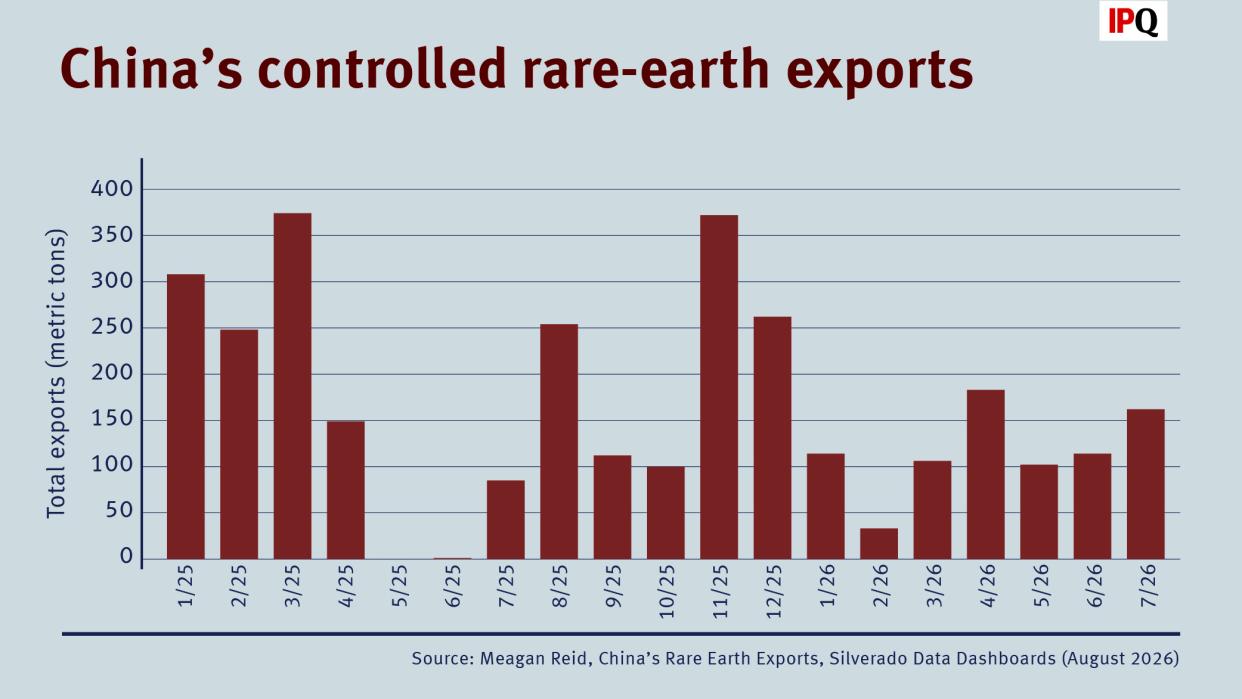
China announced its export controls in two separate steps. Just days after Trump’s April 2025 tariffs, Beijing imposed export restrictions on seven medium or heavy rare earth elements (REEs) and magnets. Among them was the dysprosium used in both guided missiles and electric vehicles, not to mention the F-35 fighter jet. Chinese exports of rare earth permanent magnets fell by about three quarters from March to May 2025.
The effects were immediately felt. Ford shut down US assembly lines for weeks due to the lack of magnets, with CEO Jim Farley admitting, “We can’t make that stuff.” European industry suffered, too, when China deniedlicenses to European Union firms, causing industry to scale back production. Although China began approving more exports under a truce reached in June 2025, these April 2025 export controls remain active, and exports of those rare earth compounds and metals remain well below historical levels. Overall exports of rare earths from China to the US declined 32 percent from January 2025 to July 2026.
The second Chinese move came in October 2025, again in response to US export controls. In late September, Washington widened the reach of its export blacklist, extending restrictions to companies at least 50 percent owned by listed entities. Nexperia, a Dutch chipmaking firm under Chinese ownership, was immediately caught in this expanded web. The Dutch government, reportedly under pressure from Washington, seized control of the firm’s operations in the Netherlands.
China hit back on October 4, blocking Nexperia from exporting products from its Chinese factories and sending European automakers scrambling to find more chips. As well as addressing the Nexperia issue, China addedfive more rare earth elements to its list of controlled products.
Even more important than the added elements was the expanded scope: Foreign firms would now need Chinese government approval to export magnets with merely trace amounts of Chinese-origin materials as well as magnets made with Chinese technologies, even if made outside of China. Applications from military users or for military purposes would generally be denied.
The deal that Trump and Chinese President Xi Jinping reached in Korea a few weeks later (when Europe was not at the table) only delayed the blow of these new economic weapons—Washington has also suspended its expanded restrictions on subsidiaries during negotiations with the CCP. Although the rare earth controls weren’t the only reason Washington stepped back from the brink—the White House also worried about the rising 10-year Treasury yield and the fall in the S&P 500 and US soybean exports—they were arguably the biggest factor.
A Ticking Clock
The clock, in short, is ticking, for Europe and for China’s other trade partners.
Admittedly, China is unlikely to completely choke off exports when the truce with the US expires. Rejecting foreign requests to buy controlled products costs firms money, angers foreign governments, and incentivizes the world to build alternative supply chains, as US firms like NVIDIA who oppose their own governments’ export controls eagerly point out.
Instead, Beijing will delay licenses or shut out particular end users to suit its interests. That’s what it did in January 2026, banning exports of dual-use goods to Japanese military users amid tensions over Taiwan. That’s what it did in July, banning exports of dual-use minerals to 14 European firms, including German defense majors like Rheinmetall, to punish Europe for putting export controls on Chinese entities that had been supporting Russia’s military.
A deal with China is no guarantee of access: Ahead of Trump and Xi’s meeting in Washington on September 24, Beijing reduced exports of minerals to the US to build leverage. Some Chinese firms have refused to export even when they receive licenses, for fear they would run afoul of Chinese sanctions on a US mineral supply chain monitor.
Europe appears to be preparing for the sort of challenge to Chinese practices that could put it in the crosshairs. Top European Commission officials like Commissioner for Prosperity and Industrial Strategy Stéphane Séjourné decry the “China Shock 2.0” and say Europe “can’t be the victim of a predatory strategy that is destroying our industry.” The response from Brussels goes beyond new fees and higher tariffs to include the proposed Industrial Accelerator Act, which would favor European firms and European content to help the EU to build up its clean industrial base. Even the German government, which has long resisted moves that could irritate Beijing, is now ready to consider more action to protect its beleaguered industrial sector.
Can Europe Stand up for Itself?
So just as the Europeans have rightly decided to stand up for their interests vis-à-vis China, Beijing has expanded an arsenal with which to strike perhaps the weakest point in European supply chains, rare earths and magnets. Europe’s vulnerability is clear: China produces 91 percent of the world’s refined rare earths for magnets and 94 percent of sintered permanent magnets, according to 2024 data. Particularly exposed is Europe’s defense industry, as well as clean energy manufacturers who need magnets for wind turbines and electric motors.
Europe has made some progress in building up non-Chinese supply chains in the past 18 months. The Belgian firm Solvay has opened a new rare-earths production line at a facility in La Rochelle, France, one of the largestin the world outside of China. The Canadian company Neo Performance Materials has opened a facility in Estonia that manufactures permanent magnets; the company claims the plant will meet up to 15 percent of EU demand once fully built out. Other, smaller projects are moving closer to completion, too.
But policy documents, like the RESOURCE EU Plan of December 2025, move faster than excavators and cranes. The European Court of Auditors warned in February that many newer projects will “struggle to secure supply for the EU” by the end of this decade. The EU aspires to be able to process 40 percent of the strategic raw materials it needs by 2030. China, meanwhile, has a tool that can cut down supply within days.
Even in the US, which can provide more financing for its own supply chains than can the EU, the situation remains fraught. While it’s encouraging for the Europeans that partners like the US and Japan are concentrating on the rare earth challenge as well, if there were a scramble to access alternative supplies in a crisis, each country would prioritize its own defense industry, not those of its allies.
European Leverage
Europe does have leverage to push back against Chinese practices that undermine its security and prosperity. The EU is a massive, wealthy consumer market; EU member states produce goods that China desperately needs, from aircraft engines to chipmaking machinery. And with measures like the Anti-Coercion Instrument, which allows restrictions on trade, investment, and public procurement in response to bullying by other economies, Brussels already has the legal tools to fight back.
The European response, however, must consider how China could strike Europe with the same weapon that forced the US to back down last year. The rare earth and magnet weakness will bedevil Europe for the rest of this year and for years to come.
Noah Gordon is a senior policy fellow at the European Council on Foreign Relations (ECFR).
