In their recent book How to Win a Trade War, Financial Times columnist Soumaya Keynes and economist Chad Bown from the Peterson Institute for International Economics warn that waging trade wars is generally not a great idea. As the international economy shifts, however, and you find yourself engaged in one, it then hugely matters how you go about it.
In that sense, it’s not all that different from a real war. Ideally, one would only engage in a conflict from a position of strength—when economic growth is decent, your domestic politics are relatively stable, and there’s no danger of another front opening up. Holding real leverage over your opponent would also be of advantage.
By that measure, the best moment for a European confrontation over trade with China was about a decade ago. And a strong case can be made that European governments should have started addressing their China exposure back then: The economic course Chinese President Xi Jinping's has been pursuing ever since taking power in 2012/13 was already clear by then; Beijing had already demonstrated its willingness to weaponize dependencies; and the push to dominate major industrial sectors, made possible by hefty state subsidies and other support, was already underway.
The Worst of Times?
The situation now is far more challenging.
Chinese firms are competing hard with European ones in almost every sector—at home and in third markets. Meanwhile, European exports to China have collapsed.
The wider picture has also turned against Europe. Governments are dealing with volatile energy prices, rising defense budgets to fund the continent’s rearmament as well as Ukraine’s ability to withstand Russia’s continued aggression, and economic pressure from both Washington and Beijing. Years of stalled reforms have left eurozone growth close to zero. Politics within the European Union have become increasingly unstable, with parties on the far right and far left attacking the basic premises of European integration. None of this makes the EU well placed to fight a trade war.
Yet China is not in great shape either. Its manufacturing prowess is undoubtedly formidable, its technological capacity—from robotics to large language AI models—is advancing fast, and its grip on rare earths was enough to make Trump back down from his own trade escalation (see also the article by Noah Gordon in this issue LINK).
The wider Chinese economy is in trouble, though. Growth remains low, prices keep falling, households and firms are reluctant to spend or invest, debt is high, and unemployment is worsening. China never returned to its previous growth trajectory, dented by the property market crash and the shock of the COVID-19 pandemic. All this makes the country more reliant on exports and, particularly, on the European market.
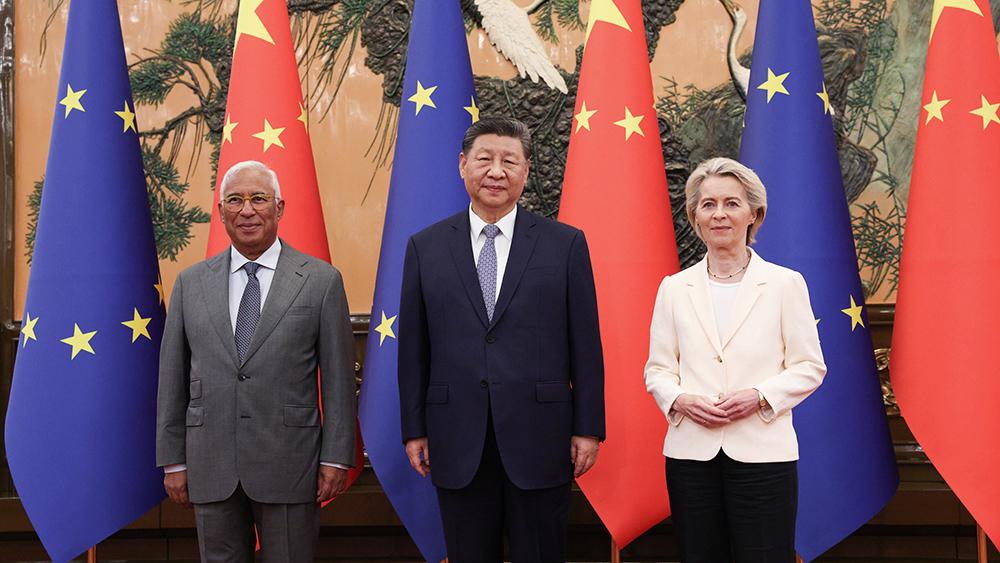
On the one hand this offers the Europeans leverage: The risk of losing access to the largest advanced market that is still broadly open to Chinese products is now far greater than Europe’s exposure to China as an export destination. On the other hand, it makes Beijing more determined to keep it that way. Hence, the stage is set for a showdown between an EU fighting for the survival of its industrial base and a China that sees the European single market as the best outlet for its domestic economic dysfunction.
Step One: The Fight Is Already On
If EU leaders decide at their next summit meeting on October 15-16 that the time has come to finally get serious about dealing with China on trade (and they should), they must start with an honest look at where things stand. For years, European policymakers refused to admit there was a China problem at all. Now that this has changed, the mood in some corners has switched straight to fatalism, from “there is no problem” to “nothing can be done.”
Noone can turn a blind eye to weekly job losses and plant closures anymore, most of them occurring in Germany—in machinery, chemicals, and automotive, the sectors that used to make the Europe-China relationship appear a “win-win,” as Beijing always claimed. Jürgen Matthes of the German Economic Institute (IW) puts the jobs already lost at around 400,000. Therefore, in reality, Europe is already engaged in a trade war with China—it has just done very little so far to fight back.
The European Commission could consider a wide range of measures: safeguards against import surges, more subsidy investigations, procurement instruments applied across a greater variety of sectors, systematic product-safety and security audits, and redesigned national subsidy criteria. The discussion may also lead to a smaller number of member states moving forward to avoid delays. Time is a crucial factor given the speed with which the industries are currently affected.
Overall, the Europeans should avoid single high-profile measures that are vulnerable to extensive pressure and lobbying and instead engage the entire “swarm” of possible EU countermeasures; this would also avoid being tied down in lengthy negotiations about new tools. Additional instruments may be useful at some point, but for now, the EU could simply use what it already has. Not the tools were lacking, but the political will of EU member states.
While some see them as cautionary tales, China’s use of rare earth export controls and the Nexperia crisis have actually strengthened the case for EU action. When a single country controls almost all the production of something, this geographic concentration—or, in good old economic terms, monopoly—is a security and political threat as much as a commercial one. It has forced parts of European industry to temporarily halt production or come close to shutdowns.
By the time EU leaders met in June this year, they had reached a rough consensus. Energy costs and competitiveness indisputably matter, but if the Europeans cannot get on top of their China problem, their economies will take a serious hit even if all the other challenges they face are magically addressed. Otherwise, they would see an even faster decline in living standards, rapid deindustrialization, and the political consequences that come with it—nationalistic voices already on the rise would likely further gain in strength, and the fragmentation of the EU would be a plausible consequence.
Step Two: Define the Strategy
The EU falling apart is not inevitable, however. Europe has more going for it than it tends to realize. It has limited experience of throwing punches, but plenty of experience handling difficult counterparts. Last year's standoff between the United States and China is not a good comparison to the situation the EU finds itself in vis-à-vis Beijing.
Yes, Brussels is readying defensive trade measures and real de-risking plans, but nothing on the scale of the US embargo-like escalation. Even at its most aggressive, the EU will stay far more open to China in the future than the US is now, and all the economic-security measures in the pipeline will stay well short of the levels that Beijing and Washington treat as routine.
The EU must still be ready for a response from China. This includes the most nuclear of options, the cutting of key supply chains to cripple parts of the European economy. While it would be a much harder call for Beijing than the all-out fight it faced with the US, it remains a possibility. The Europeans would then need to be ready to up the stakes.
There would, of course, also be an argument to not wait but to switch into a more offensive mode faster, to get a new negotiating dynamic with China in place. This could include across-the-board tariffs to close a cost gap in which subsidies and an undervalued currency play such a significant role. Beijing could be sent a signal that a far tougher European response is in place if it treats the limited, defensive measures that the EU is preparing in the most exposed sectors as grounds for a full-scale coercive response.
The political calendar is sharpening things on both sides. Ironically, this fall is indeed the least bad moment for the EU to confront China in the foreseeable future.
Important elections are coming up in key EU member states next year—in France, Poland, and Spain. Decision-making at the European level will become even more difficult. Xi has a party congress coming up later next year for which he would prefer a relatively stable EU-China relationship. Fighting back against US President Donald Trump’s capricious and belligerent trade tactics is very different from insisting that the Europeans are not allowed to protect key industries that are in obviously dire straits. Xi risks making the same mistake as Donald Trump, opening too many fronts at the same time.
The Europeans also have to watch for what could be defined as the “Taiwan tactic”: Rather than escalating fully, Beijing may leave its most blood-curdling threats standing while it works to slow down and chip away at the EU's defensive measures, carefully tightening its grip on the European economy.
Indeed, this is the more likely danger: The Europeans may be tempted into accepting a thin deal on Chinese terms to buy time for, for example, the automotive sector, and calling it progress. However, deindustrializing and a deepening of dependencies would then take place everywhere else. The first read on which way this is headed will come after the scheduled Chinese-European talks between EU Trade Commissioner Maros Šefčovič and his counterparts in Beijing, just before the European Council in mid-October. There is a strong prospect that China’s leadership may delay and divide.
Step Three: Be Ready to Bounce Back
Europe must decide in advance what counts as the existential core of its economic defense—the part that will never be subjected to negotiation with the Chinese.
This will mean accepting an initial hit—a first round of Chinese retaliation—and holding ground, before serious “rebalancing” talks with Beijing can even start. Most of the Europeans’ de-risking has to move ahead regardless of what happens in the EU-China negotiations anyway. Diversifying supply chains and closing the security gaps in critical technologies is necessary even if both sides eventually agree that a European decision to protect a handful of prized industries does not give Beijing justification for wrecking the wider European economy.
The pressure on European leaders to deliver on ambitious reforms at home remains high, but European leaders should not be lured into spinning the talks out and hoping for a miraculous change of heart in Beijing. Every day they wait to decide whether they want to fight or fold raises the risk that the first counterblow ends up being lethal.
If the Europeans close ranks, however, and show resolve, the result can be different. Recent experiences show that Trump was not ready for Europeans standing together over Greenland; Russian President Vladimir Putin did not expect four years of “whatever it takes” support for Ukraine when he attacked Kyiv.
Xi assumes Brussels will roll over, and that EU member states can be picked off one by one. However, he is attacking the one thing that really makes the EU a global player and that remains existential for the future of its political system: its economic strength.
If European leaders decide to fight and realize their negotiating power, the effect could be powerful. It will not change Beijing’s overall approach to its economic policies, but in a best-case scenario it could help right-size China’s exports, force more serious moves from the Chinese Communist leadership to foster domestic consumption and help ease the pressure of the spillover of China’s industrial excesses in the rest of the world.
A European market less open to Chinese goods is an opportunity for all those who can adjust their trading links. From clean tech products to technology ecosystems, Brussels could help a broad coalition of countries uncomfortable with their growing lack of choices to have better options. In short, the Europeans have the market power to make monopolies bad again.
Andrew Small is the director of the European Council on Foreign Relations’ (ECFR) Asia program.
Janka Oertel is a distinguished policy fellow with the European Council on Foreign Relations’ (ECFR) European Power program.