
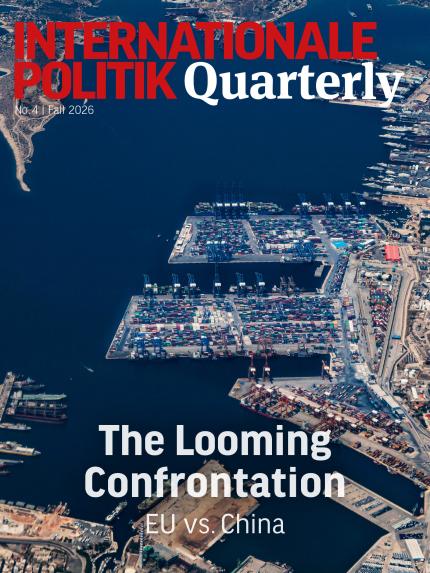
Friedrich Merz started off with promises to be a German chancellor focused on foreign policy. He has had his successes—getting US envoys Steve Witkoff and Jared Kushner to meet Ukrainian President Volodymyr Zelensky in Berlin when what was left of US support for Ukraine seemed close to collapse, and organizing a €90 billion EU loan for Ukraine when the use of frozen Russian assets fell through. Events since the start of the year, however, have been sobering. They have shown how little influence Germany actually has on world affairs. And, that it lacks a coherent, thought-through strategy.
As opposition leader, Merz often criticized his predecessor Olaf Scholz of the Social Democrats (SPD). “The world then was a well-ordered box of building blocks which only needed someone with the right aptitude to get to work with it. The problem was not the system … but the foreign policy dilettantism of the [Scholz] coalition,” wrote Daniel Brössler and Henrike Roßbach in the German daily Süddeutsche Zeitung earlier this months “Now Merz is experiencing how difficult it is in practice to find the balance between values, interests, and morality.”
In this issue, we’re trying to map out where German foreign policy currently stands. Andreas Rinke analyzes Berlin’s “new alliances” while Sarah Bressan and Philipp Rotmann take a closer look at the structural changes the Merz government has set in motion. And Scholz’ former head of the chancellery, Wolfgang Schmidt, Mark Speich, secretary general of the Konrad Adenauer Foundation, and Ralf Fücks, managing director of the Zentrum Liberale Moderne, offer their views on what should inform a future German foreign policy.
Elsewhere in this issue, Joseph de Weck, in his Pariscope column, argues that Europe needs to accept a disrupted world as the new base line. Lucy Ash, in her On the Ground column, writes about the fight over history and memory in Poland, visiting two museums in Gdansk. And John Kampfner, in Quarterly Concerns, explains why regional and local elections in the United Kingdom on May 7 could turn into a disaster for British Prime Minister Keir Starmer.
Henning Hoff is executive editor of INTERNATIONALE POLITIK QUARTERLY.
