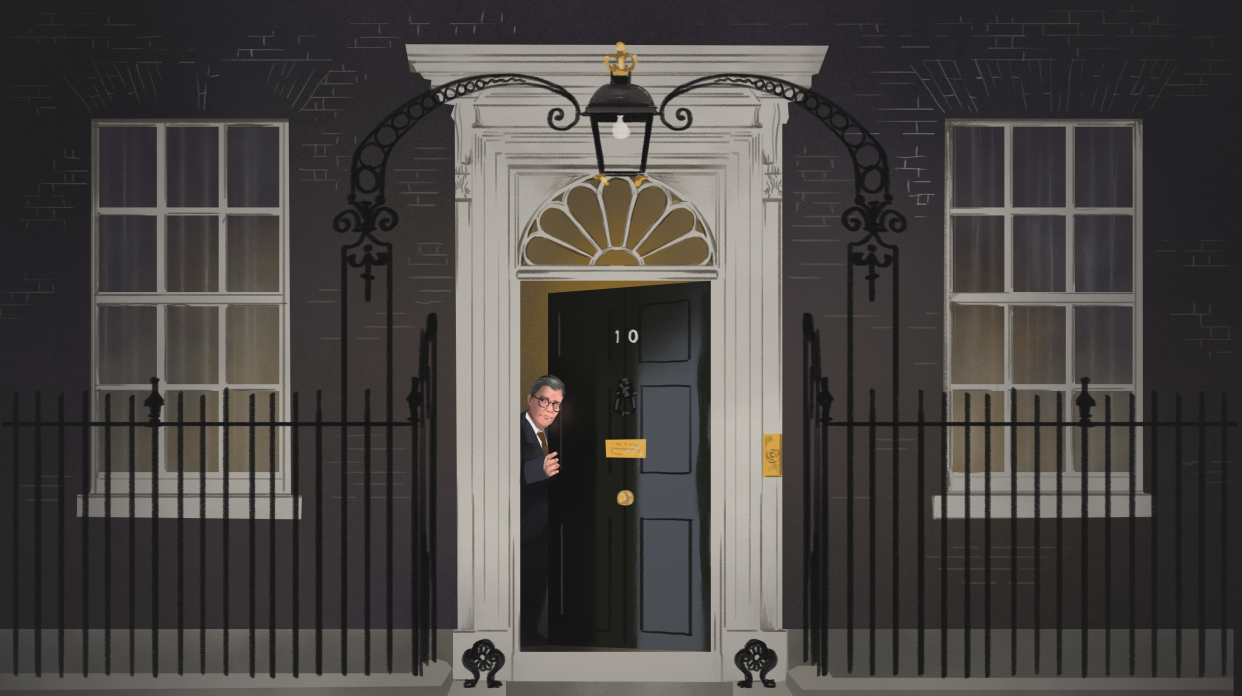
Commentators have taken to comparing British Prime Minister Keir Starmer to his predecessors—and given that the United Kingdom has become like the Italy of old in its political instability, there is no shortage of prime ministers or jibes to choose from.
Like Tony Blair, Starmer is obsessed with fighting his own Labour Party to prove that he isn’t a lefty. Like former Labour Prime Minister Gordon Brown, he expended so much effort getting the top job that by the time he was given the keys to 10 Downing Street all the energy had been sucked out of him. Like former Conservative Prime Minister John Major, he hung around for a good while, but, as was said at the time, he was in office, but not in power.
Even so, it was surprising to see one columnist recently liken Starmer to former Conservative Prime Minister Boris Johnson—taking favors from friends (concert tickets, chic glasses) and appointing friends with dubious pasts (Peter Mandelson, Britain’s now ex-ambassador to Washington and close friend of Jeffrey Epstein) to top jobs. That was a bit mean. Nobody would accuse Starmer of having unruly hair. Or of having charisma (of a certain type that appeals to a certain type). Or of being a clown.
As important regional and local elections loom in the UK, the one comparisons Starmer would appreciate come from abroad—Canada’s Mark Carney. Having taken over from Justin Trudeau, their Liberal Party lagging far behind the ultra-conservatives in the opinion polls, the former governor of the Bank of England called a snap election and won a stunning, if narrow, victory. Carney had one person to thank: Donald Trump. The US president’s threats to take over Greenland, a self-governing Danish territory, and to subsume Canada as the 51st US state galvanized citizens in both countries.
Saying “No” to Trump
Might the same happen to Starmer? Since refusing to send British forces to help with the US-Israeli attack on Iran, the prime minister has been repeatedly denounced by the US president, often in front of other European leaders such as Germany’s Friedrich Merz (who didn’t come to his aid) and Ireland’s Micheál Martin (who did, ever so gently).
Such is the unpopularity of the US and Israeli bombardment of Iran and Lebanon, with the war spreading far and wide across the Middle East, that even the British Conservative leader, Kemi Badenoch, has described Trump’s attacks on the prime minister as “childish.” That is quite a turnaround, given that a few days earlier she attacked Starmer for not being supportive enough of the US-Israeli operation.
Even though it goes against his instincts, Starmer seems to be enjoying showing toughness and leadership. He has long believed, or hoped, that the British public, while not warming to him, would eventually give him grudging respect—in time for the 2029 general election.
Before then, he must jump over a huge imminent hurdle. On May 7, local elections will take place for councils in several areas across England, including all of London, plus for six mayors. In Scotland and Wales, elections are being held for devolved national parliaments.
Heading for Disaster
According to opinion polls and internal focus groups, Starmer’s Labour Party is heading for something between defeat and disaster. The two relevant questions are: How bad will they be, and will this be the point at which his leadership is finally challenged?
The depleted team in Downing Street—several of Starmer’s inner circle have resigned because of scandals, some due to in-fighting, mostly because they’ve simply had enough, and they haven’t all been replaced—have already factored in a major political hangover the next morning.
Aides may well have already written a draft of the prime minister’s speech: “I take full responsibility, I will learn the lessons, I will plough on in the service of the nation.” That is roughly what he said when his party was humiliated in a recent by-election in Gorton and Denton, a constituency which for decades has been a Labour stronghold in the south of Manchester. It came third behind the Greens and the rightwing populist Reform UK.
That result, though not wholly unexpected as the campaign developed, has produced a political earthquake. Labour and the Conservatives (who ended up with less than 2 percent of the vote) are now under attack from the Greens on the left and Reform UK on the right.
Although there are signs that the popularity of Reform UK, personified by its leader Nigel Farage, has peaked and may even be waning, they still have considerable potential to cause damage to both traditional parties at the forthcoming elections and in the general election, which must be held by 2029. It would be foolish to suggest that their chances of making it into government have disappeared.
Courting “Red Wall” Voters
Throughout his journey to power and during his torrid first year in office, Starmer credulously adopted the approach of his chief of staff, Morgan McSweeney, that the most important voters to court were those who once formed the “Red Wall”—the constituencies in northern England who had for generations voted Labour come what may, but voted for Brexit in the 2016 referendum and subsequently for Johnson (when the alternative was the far-left former Labour leader Jeremy Corbyn).
That was always simplistic, a cliché that encompasses working-class no-nonsense northerners who don’t want any of that effete London metropolitanism. Hence migration legislation was introduced that would make even Danish Prime Minister Frederiksen blanche. The all-powerful McSweeney (a Mandelson protégé) has mercifully been forced out.
Late in the day, Starmer appears to be coming to the view—although a battle is still raging among his advisers—that the people they really need are heading for the Greens, with all their left-wing promises to impose a wealth tax, alongside climate measures and social liberalism.
Can Starmer genuflect to the left, while keeping the right sweet? In any case, that’s the plan, for now.
Rivals Getting Ready
Meantime, his rivals are sharpening their knives. Angela Rayner, who had to resign as deputy prime minister over an issue around tax payments for property, is making her intentions increasingly clear with a series of overt criticisms. Labour, she said (without naming Starmer), is “running out of time.”
Her remarks were immediately praised by the other main contender from the left of the party, Andy Burnham. The mayor of Greater Manchester is still furious at being prevented from becoming the Labour candidate in Gorton and Denton. Starmer, who intervened personally to stop him, said he should concentrate on his day job. He knew that had Burnham won that election for Labour—very probably, according to those on the ground—he would have mounted a swift leadership challenge. By keeping him out of the House of Commons, Starmer prevented that from happening. Chances are, however, that after May 7, an elderly Labour MP will announce his/her retirement (on the assumption of a seat in the Lords). Would Starmer risk civil war by stopping Burnham for a second time?
A third candidate, from Labour’s “soft left,” is Ed Miliband, the former leader and now Minister for Energy Security and Net Zero, who has been fighting a rearguard action to ensure that the government doesn’t jettison its environmental credentials.
On the Blairite wing (not that association with Blair is much help anymore) is the Health Secretary, Wes Streeting. He is deemed to have done well in his portfolio, but his closeness to Mandelson and his set has damaged him. Another on the right is the Home Secretary (Interior Minister) Shabana Mahmood, but her ultra-tough line on immigration makes her a divisive figure.
Which leaves several “reliability” candidates. Two are experienced and largely respected—Yvette Cooper, the foreign secretary, and John Healey, the defense secretary. A surprise choice, but one gaining ground behind the scenes, is Healey’s deputy, Al Carns, a high-flying new MP and a former Royal Marines officer (which in the current state of the world gives him broad appeal).
Burnham, Rayner, Miliband, and Sweeting are all calling for faster progress on the so-called “reset” with the European Union, though no contender has so far gone as far as the mayor of London, Sadiq Khan, in calling for the Labour manifesto for the next general election to include a commitment to begin negotiations on rejoining.
Theoretically, any of these could win. The issue is more whether any of them will take the risk and plunge the knife. Unlike the Conservatives, it is extremely hard to unseat a Labour leader. The party’s rule book stipulates that 20 percent of the parliamentary party must not just declare the need for a change but must—from the outset—endorse a single candidate.
If someone does, and gets the required support, it’s game over for Starmer. Even though it’s still early in the political cycle, even though there could be more setback—including more revelations about what Starmer did or did not know about Mandelson’s links with Epstein—this feels like their one and only chance. Labour history is littered with leadership contenders who didn’t summon the courage. This reinforces Starmer’s determination to plod on, quietly confident that he can dodge whatever bricks Trump and everyone else throws at him.
John Kampfner is a regular contributor to The Guardian, Foreign Policy, and DIE ZEIT. His new book Braver New World. The Countries Daring to Do Things Others Won’t will be published on April 16.
