
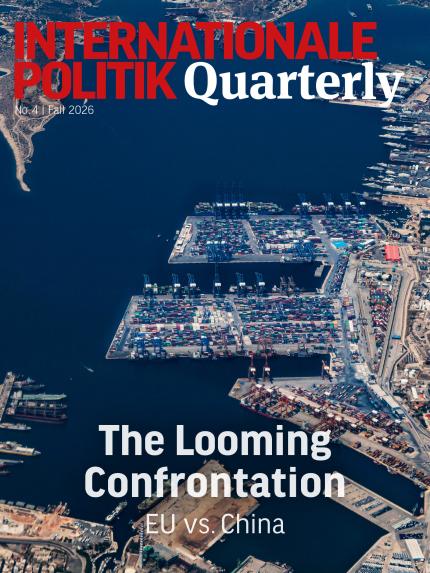
In her “State of the European Union” address earlier this month–the first of her second term–European Commission President Ursula von der Leyen used the term “economic security” only once, and toward the end of her remarkably combative speech.
“Ultimately, this is about enhancing our economic security,” she told the assembled MEPs, having just referred to new trade agreements the EU recently struck with Mexico and Mercosur, the South American trading block consisting of Argentina, Bolivia, Brazil, Paraguay, and Uruguay. And a “historic” deal with India was to be concluded before the end of the year, von der Leyen promised. Building coalitions with “like-minded countries”—with those around the Pacific Rim forming the Comprehensive and Progressive agreement on Trans Pacific-Partnership (CPTPP), of which the United Kingdom is a member, mentioned specifically—to reform the global trading system would open up markets, reduce dependencies, and, indeed, lead to greater economic security.
This is certainly one aspect of it. However, even though she didn’t spell them out, questions about how to safeguard Europe’s future economic wellbeing permeated most of her speech, right from the beginning when she referred to Europeans feeling “difficulties” every day. They felt “the ground shift[ing] beneath them,” von der Leyen said.
It’s an apt metaphor for what is happening to the member states of the European Union, as well as the United Kingdom. Economic coercion, exercised by President Donald Trump’s United States and China’s hyper-mercantilism are threatening to erode Europe’s economic future. Von der Leyen defended the recent agreement with the United States, accepting a 15-percent “base” tariff for EU exports while promising zero tariffs and vast investments in return, as the “best possible deal.” She used the moment, too, however, to warn Washington that the EU’s digital standards would be only set by Europeans.
The fighting talk is well enough, but what the EU really needs is to respond to this new geoeconomic age, structurally and at the policy level. Luuk van Middelaar, the founding director of the Brussels Institute for Geopolitics, and his colleague Hans Kribbe make the case for the EU to establish an Economic Security Council, complete with a European Economic Security Adviser. Such a council would be able to better prepare EU leaders to take into account the often difficult and complicated trade-offs involved in decisions like agreeing to Trump’s tariff diktats. Francesca Ghiretti explains why the EU needs to think in terms of economic statecraft rather than economic security.
In an interview, German MEP Bernd Lange of the center-left Socialists and Democrats (S&D) caucus, who has been chairing the European Parliament’s trade committee for over a decade, argues that EU leaders need to act on a number of fronts, not least when it comes to reducing the still-existing barriers to internal EU trade, especially on services. Emily Benson and Venesa Rugova remind us, however, how hugely difficult an attempt to gain greater technological independence from the United States will prove to be.
Filip Medunić focuses on Germany’s Economic Security Strategy, which is in the making, pointing out that it needs to closely fit the EU’s framework. Jake Benford advocates for closer cooperations between Brussels and London when it comes to economic security. And beyond the cover section, our Paris columnist, Joseph de Weck reflects on the wider implications of Europeans feeling “humiliated.”
With this issue, IPQ is turning five. When we launched, Angela Merkel was still German chancellor; the world has certainly shifted since then. Or perhaps it was just that her seemingly reassurance presence slightly obscured the fundamental changes already under way. We’re looking back to 20 regular issues and one special printed edition for this year’s Munich Security Conference, underpinning our claim to be among Europe’s leading foreign affairs magazines.
We are celebrating, in part, with the introduction of a new feature–British journalist Lucy Ash will regularly report ON THE GROUND. In her first contribution, she takes us to Ukraine and reflects on the messages of defiance that Ukraine’s artists are sending to the world.
Henning Hoff is executive editor of INTERNATIONALE POLITIK QUARTERLY.
