Since the inception of the digital economy, the European Union and the United States have taken divergent approaches to technology development and governance. EU policymaking follows the precautionary principle, which calls for policymakers to preemptively regulate technology until it is proven safe. The US, on the other hand, has followed the “move fast and break things” ethos, favoring rapid diffusion over regulatory restraint. In the digital context, the EU’s precautionary approach reflects difficult lessons learned in 20th century authoritarian regimes that exercised surveillance programs across much of the continent. The US approach, meanwhile, aligns philosophically with the 19th century Manifest Destiny doctrine, which considers US expansion and dominance anointed and inevitable.
This difference manifests in EU and US approaches to balancing civil liberties versus national security in the digital domain. In the EU, data controls, such as the General Data Protection Regulation (GDPR), are primarily a tool to safeguard personal privacy. In the US—ensconced in a Biden era executive order on data flows that the Trump administration has not rescinded—data flows are governed based on national security considerations. Where the EU sees long-term civil rights concerns, the US sees potential security threats.
A New Reality
There is good reason for the EU to be disquieted about its dependencies. While Europe is beginning to ignite the engines of its defense industrial base, the US is embarking on a plan to rewrite the rules of global technology and economic governance. In its July 2025 AI Action Plan, the Trump administration unveiled an ambitious attempt to “flood the zone” with US-made AI exports in a “full-stack approach,” which integrates major elements of the AI supply chain into a single bundle, that could more easily compete with the Chinese telecoms giant Huawei’s full stack.
This AI push comes alongside accelerated efforts to move away from post-World War II institutions like the World Trade Organization (WTO) and toward what United States Trade Representative Jamieson Greer recently described as the “Turnberry system,” in reference to the US-EU summit in Scotland that produced the contours of a US-EU trade deal. The post-WTO system the US envisions would favor bilateral and plurilateral deals that afford the US maximum negotiating leverage to extract substantial concessions from trading partners.
These trade negotiations are also increasingly entangled with security policy, which surfaced over the summer when the Trump administration sought to tie European arms acquisitions to tariff reductions. European countries were concerned with the abrupt—although ultimately reversed—US decision to withhold intelligence from Ukraine and remain worried about a potential future in which the US asks technology companies to sever services.
Recent precedent illustrates the concrete possibility of digital service disruption. In 2022, following Russia’s full-scale invasion of Ukraine, the Biden administration directed US tech companies to cut email and cloud access of Amsterdam Trade Bank, a Dutch entity that was violating Russia sanctions. Although the bank could have pursued services from alternative providers, the interruption spooked investors, triggering the bank’s collapse. While broad agreement on Russian misconduct rendered these service cuts largely uncontroversial, future cases may not be so clear-cut.
European Limitations
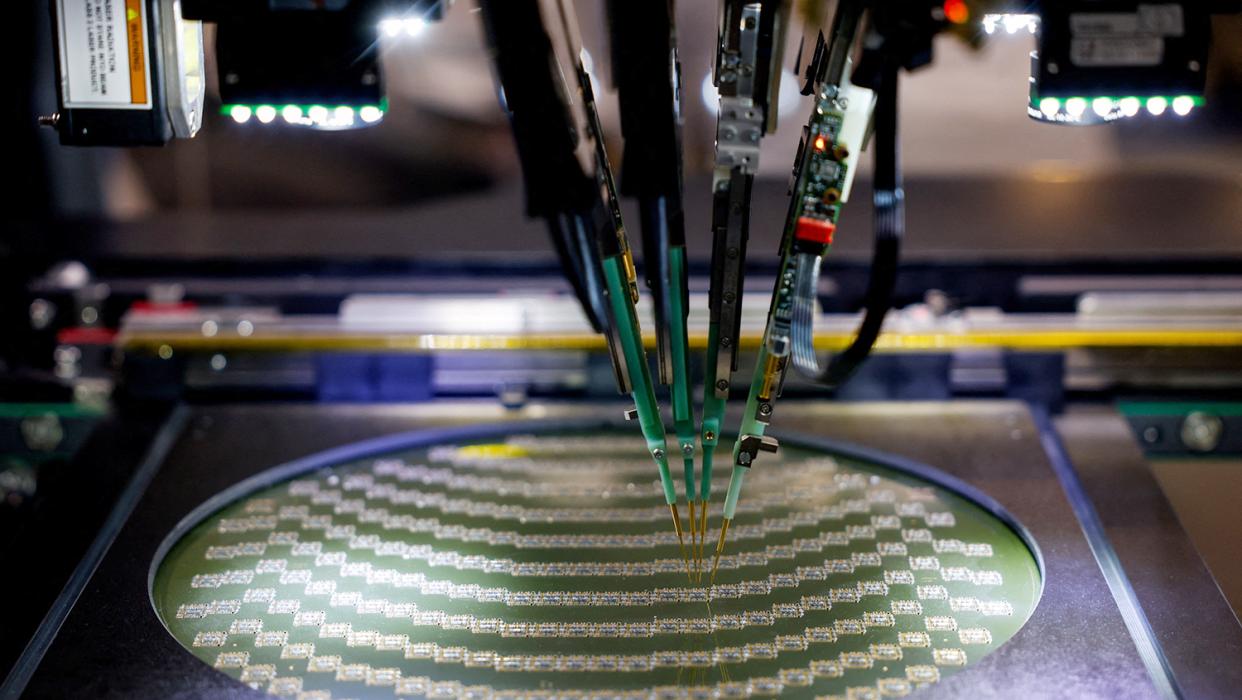
Against the purported aim of strategic autonomy, the EU faces the stark reality that it has become reliant on foreign powers that view technological supremacy as a core extension of geopolitical power. Europe holds a leading position in just one of eight key areas within the generative AI value chain: semiconductor manufacturing equipment. Dutch ASML’s dominant position in extreme ultraviolet (EUV) lithography equipment demonstrates that European companies can achieve global dominance in critical technologies and solidify their role in the tech stack, thus affording sovereign entities with tremendous chokepoint capabilities.
Despite competitive positions in select technology segments such as semiconductor manufacturing equipment and tooling, and some large European companies and innovative startups providing foundation models, AI applications, and AI services, these advantages mask serious structural weaknesses. Europe’s advanced tech sector is only one-fifth the size of America’s, with AI spending at $2.6 billion compared to $8.7 billion in the US. This gap creates downstream effects since greenfield investments can be prohibitively costly. To achieve scale, it is easier for countries and companies to build on existing tech stacks. Previous European attempts to invest in alternatives to US platforms, including a Franco-German project to create a European search engine to rival Google, and the Gaia-X project to develop an alternative European cloud ecosystem, have failed to make a dent in US market dominance.
Today, over 80 percent of Europe’s digital infrastructure and technologies are imported, and European companies have less than 5 percent of global market share across four critical technology infrastructure layers: raw materials, AI chip design, AI chip manufacturing, and cloud computing.
European Efforts to Mitigate Risk
Facing new geopolitical realities—from the brief pause in the US provision of intelligence to Ukraine to longer-term fears about overreliance on US military hardware—momentum has grown around the EuroStack initiative. Leveraging capital investment and technology-focused industrial policies, this proposal envisions a sovereign European technology framework designed to strengthen autonomy in the development, deployment, and governance of critical digital infrastructure.
Complementing this initiative, the EU’s AI Continent Action Plan, launched in April 2025, allocates €20 billion to triple data center capacity over five to seven years. The plan aims to establish a comprehensive infrastructure network of 13 large-scale AI “gigafactories” equipped with over 100,000 processors to support AI model development across startups, industry, and research institutions.
By contrast, Microsoft, Amazon, and Google are projected to spend a combined $255 billion on data center capital expenditures in 2025 alone. Against this backdrop, the scale of Europe’s current efforts appears modest, raising questions about whether the initiative can realistically deliver on its ambitions.
Rising demand will also strain Europe’s ability to secure parts, components, and labor. These supply chain pressures are worsened by limited institutional financing and energy access, stemming from Europe’s lack of capital union. Europe’s relatively small venture capital market also impacts investment levels, adding additional price pressure to tech stack buildout. OpenAI CEO Sam Altman recently said markets were “overexcited” about AI, which accounts for over one-third of the value of the S&P 500 stock market index. An AI bubble collapse could further constrain transatlantic AI spending.
Real-world Concerns Confront Potentially Unrealistic Goals
Building a fully independent suite of technologies in a hyper-globalized world will face significant obstacles. A key consideration for the EU in developing indigenous technological capacity will be mitigating its vulnerability to trade risks stemming from US-China tensions. Following the implementation of US tariffs that at one point reached over 145 percent on imports from China, the EU was caught in the crossfire that resulted in supply cutoffs needed to maintain production in critical sectors.
Although the US likewise recognized in this exchange its own limited visibility into critical supply chains, an immediate step for the EU is to scale up supply chain transparency tools that can illuminate systemic risk exposure to trade and policy disruptions. Defense primes, original equipment manufacturers, and advanced technology producers are becoming increasingly sophisticated in their ability to pinpoint granular chokepoint risks, in addition to more macro factors that could destabilize commerce. While the US has led government efforts to quantify risk in supply chains, allied governments should build similar capabilities that would provide clarity in times of crisis.
Beyond supply chain traceability, mobilizing private capital to drive technology buildout will be key. The US and EU alike are confronted with how to compel the private sector to price in risk. With a low appetite for major spending packages, the US will increasingly look to market forces to finance the next chapter of trade and technology policy, centered largely on demand-side inducements, such as restrictions on the use of Chinese parts and components in supply chains.
In Europe, policy discussions on advanced AI and defense tech have evolved on parallel tracks. However, given the trajectory of defense industrial base revitalization in Europe, national security will inevitably become increasingly intertwined with advanced technologies. The next stage is to extend this dialogue into the broader technology sphere, using it as an additional avenue for hedging risk.
Infrastructure and Geopolitical Power
The EU’s pursuit of technological sovereignty through initiatives like EuroStack and the AI Continent Action Plan represents a politically necessary task that faces formidable challenge in an era where digital infrastructure has become inseparable from geopolitical power. While Europe has some leverage over parts of the tech stack, its disadvantages in AI spending, risk capital, and critical supply chain dependencies create significant headwinds for achieving autonomy.
The continent’s success will ultimately depend on its ability to leverage private capital, enhance supply chain transparency, and integrate defense and technology policies. As both the US and China continue to weaponize technology for geopolitical advantage, Europe’s need to balance sovereignty with pragmatic interdependence may become not just necessary for its own security, but a stabilizing force in an increasingly fragmented world.
Emily Benson is Head of Strategy at Minerva Technology Futures and a senior associate (non-resident) with the Europe, Russia, and Eurasia Program at the Center for Strategic and International Studies (CSIS).
Venesa Rugova is a Senior Analyst at Minerva Technology Futures.