Trade is no longer separate from questions of war and peace. In the geoeconomic age defined by Chinese President Xi Jinping, Russian President Vladimir Putin, and US President Donald Trump, with a global scramble for markets, technology, and critical materials unfolding, almost every economic decision carries strategic weight.
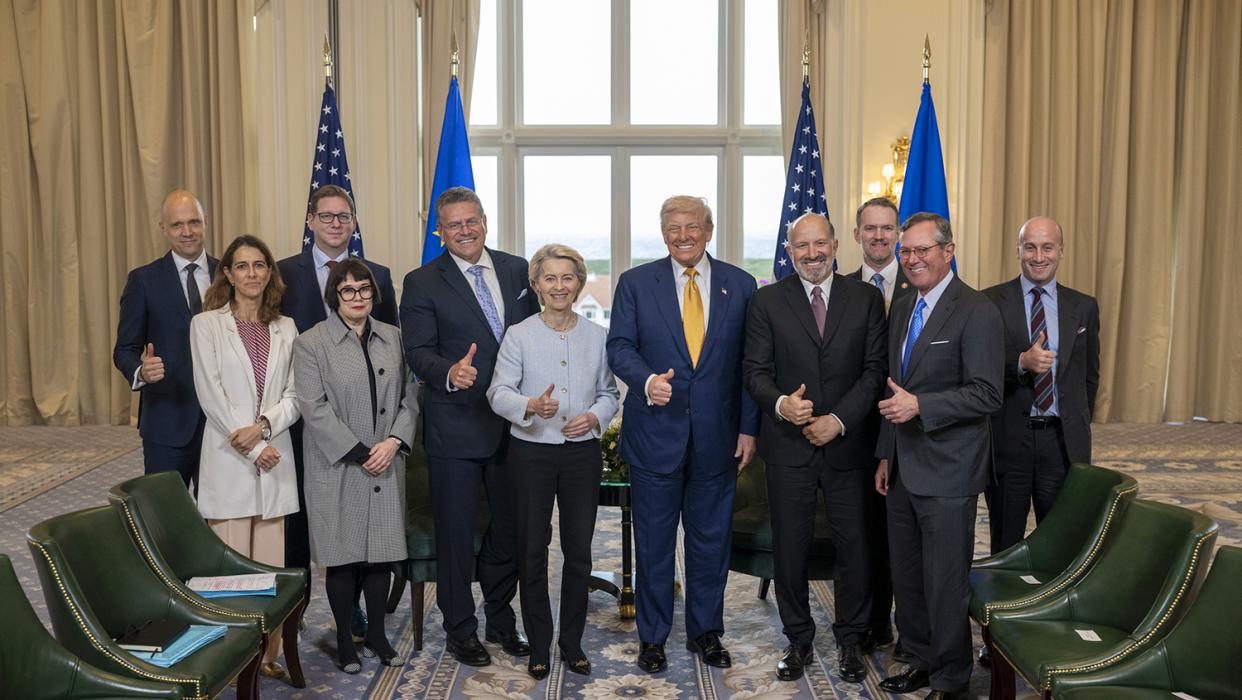
The events of summer 2025 illustrated this new reality starkly. The European Union agreed to new trade tariffs imposed by the US administration as the price for keeping America involved in supporting Ukraine and NATO. Although the EU’s top trade officials drove the talks, was this even a negotiation? And if security was the EU’s main concern, then who should have articulated its interests and made the final trade-off? Currently such questions remain unanswered. Last month, European Commission President Ursula von der Leyen even denied a trade-off had been made at all.
As the post-1945 order is collapsing, governments across Europe feel the need to adjust their decision-making mechanisms. In Germany, the National Security Council currently being set up in the chancellery will deal with “cross-cutting issues of national security, at the intersection of internal, external, economic, and digital security” (as Chancellor Friedrich Merz put it). From Copenhagen to Paris and Warsaw, policymakers are seeking to integrate commerce and statecraft.
Structural Deficits
The European Union, however, is structurally ill-equipped to deal with such new dilemmas and remains in denial. The EU’s siloed institutions, its trust in firm legal frameworks and depoliticizing instincts have been major assets for the post-1989 age of globalization and reliable US security guarantees. But they do not enable the bloc to navigate today’s geoeconomic waters.
Strategic dilemmas tend be dealt with in Brussels in an off-the-cuff or even negligent manner. They are discussed in informal phone calls between the upper echelons of the European Commission and a handful of EU ambassadors or top advisers to national leaders in the large member states. Such improvised decision-making may have been justifiable in coping with the early geoeconomic shocks of recent years. Nobody had foreseen the COVID-19 supply-chain disruptions or the energy fall-out from Russia’s full-scale invasion of Ukraine in 2022. But this way of taking strategic decisions is no longer fit for purpose.
Change is urgent and daunting, but we believe it is possible. There is no need for a full overhaul of the EU institutional framework or treaty change; a small but targeted change could inject a new sense of urgency and better equip the EU for the age of geoeconomics.
Doing Nothing Is Irresponsible
Defending the continent’s freedoms, sovereignty, and even survival—in an external environment in which economic intimidation and blackmail are everyday political tools—is a new mission for the EU. While it should leave defense and hard security mainly to national governments and NATO, the EU is the prime actor for the broader issue of economic security. Much of Europe’s formidable economic power lies in the EU single market. Harnessing this power for foreign and security goals inevitably involves EU decision-making. Such decisions cannot be taken by Berlin or Paris alone.
The consequences of failing to recalibrate will be major. First, EU institutions and bureaucracies set up for economic policymaking and market regulation, such as the European Commission and most sectoral EU Council groups, will end up shaping and deciding EU foreign and security policy. This risks leading to poor decisions, strategically unbalanced and tone-deaf policies, and serious misunderstandings with third countries, who do not conduct their foreign diplomacy in the language of market regulation.
Take the EU Deforestation Regulation: Dozens of trading partners, from emerging economies to G20 states, have denounced this legislation as coercive and further evidence of the EU’s heavy-handed attempt to export its norms. It reflects a broader pattern: The European Commission tends to pursue regulatory goals with tunnel vision, paying limited attention to how such policies affect diplomacy and long-term partnerships. On such technical files, its interlocutors within the European Parliament and the EU Council of ministers tend to be domain experts too. There is currently no strategic body assessing broader context, weighing costs and benefits, and deciding priorities.
Second, this misalignment (or mission creep) could pull the EU into a crisis of legitimacy, inviting a long-term political backlash. Technical expertise, economic knowhow, and political neutrality form the core of the European Commission’s narrative of legitimacy. This “Weberian” narrative might suffice when it acts in its narrow role of market regulator or guardian of the treaty. However, when the institution strays into the wider sphere of geopolitics and starts making trade-offs that are deeply political, this story no longer holds.
For instance, how to deal with US Big Tech and assess whether the social media platform X is infringing the EU’s Digital Services Act (DSA)? Viewed from a law enforcement perspective, little can be said against giving this job to digital regulation specialists in the European Commission’s Directorate General (DG) Connect. Except that the issue has the potential to entirely derail the EU’s relationship with the United States, even now that X’s owner Elon Musk is no longer in the White House. When, in response to such enforcement decisions, the US threatens to leave NATO—as Vice President JD Vance has alluded to—the old narrative has evidently become absurd. Stronger democratic legitimacy is needed in these kinds of decisions.
What the New EU Economic Security Council Could Look Like
Trade-offs between economic and security interests should not be so easily swept under the carpet. They are choices that must be made at the highest level of executive power, which must then be held to account.
This is why a new European Economic Security Council (EESC) for the EU should bring key actors from both the economic and the security spheres together under one roof, from the leaders’ level down to working level. This will give the new body the political authority and legitimacy to steer strategic trade-offs, as well as the expertise to inform and guide decision-making.
What should it look like? Just as the National Security Council in Washington, the gold standard in the field, is steered by the US president’s national security advisor, the EESC would need someone at its helm—an EU economic security adviser. With this person as a focal point, dedicated expertise, agency, and responsibility would be injected into the system. The adviser should be appointed by the European Council and report to its president. It is possible to fill this role at the political level (as was done with the EU Brexit task force led by Michel Barnier), but we believe it is more appropriately done at the level of a senior civil servant, chief of staff, or senior diplomat, as was customary, until now, in the US.
The EU’s economic security adviser would be supported by a task force of initially around 20 staff that would help prepare and execute the work, with its institutional home in the Council Secretariat. The task force’s job would be to offer a reservoir of economic and foreign policy expertise—bringing in geostrategic risk and foresight analysis with contingency planning. As Europe is confronted with partners making seemingly erratic moves, it is important to cultivate a capacity to discover patterns in the chaos, looking beyond the homo-economicus mindset.
Strategy is decided at the top political level. The EESC would therefore include the 27 heads of state of government—as decision-makers of last resort—and be chaired by the president of the European Council. The presidents of the European Commission, the European Central Bank (ECB), the European Investment Bank (EIB) and the Eurogroup, together with the High Representative for Foreign Policy and Security Affairs, would all participate and ensure the economic, financial, and foreign policy spheres were represented.
At ambassadors’ level, the 27 permanent representatives to the EU would provide an ongoing horizontal presence. This body would not be too dissimilar from their regular meeting (in Brussels parlance, COREPER-II), except that it would be chaired by the economic security adviser and be attended by senior civil servants representing the same EU institutions as convened for the leaders’ level meetings.
Finally, a “working level” would bring together the same institutional actors with 27 national economic security coordinators, chaired by the adviser. Their role would be to detect and assess the geostrategic relevance of upcoming EU proposals at an early stage, so that these do not get lost in the Brussels policy-making soup. Coordinators would be appointed from within their national economic security structures—in the case of Germany, presumably from the new NSC. If some member states do not possess such structures, the establishment of an EESC would provide a timely incentive to create them and foster a common strategic culture.
In some cases, the EESC would only codify informal practices and strategic conversations that are already taking place among officials, for instance on Russia sanctions or US tariffs. In other cases, injecting strategic urgency into deeply technical debates would not happen without the new body.
Take the creation of the digital euro, a subject of ongoing discussions in Brussels and Frankfurt. The move would have significant economic and financial repercussions, which is why the European Central Bank has to give the final green light. At the same time, the issue is clearly geopolitical. Are we comfortable depending on international financial and payments infrastructures with the US as gatekeeper? How do we assess the risks of China developing its own rival financial infrastructure? The case for or against the digital euro depends in part on these questions, which need a strategic forum in order to be addressed properly.
Becoming a “Strategic Actor”
In a world shaped by geoeconomic power politics, the EESC would give Europe the capacity to anticipate challenges and act decisively by alerting, guiding, and steering. Its authority is political not legal.
Historically, there has been resistance to the EU becoming a “strategic actor,” in particular among national governments, for fear of a Brussels power grab. Some of that reservation still exists. However, as the EU’s legal-economic core has an ever-greater impact on Europe’s security, the EU taking a bigger strategic role is simply inevitable. If the EU is to keep its core economic, market and regulatory competences, there are really only two options.
Either we agree to live with crucial strategic decisions being made by increasingly powerful Brussels officials operating in a political vacuum, that is to say, largely invisibly, unaccountably, and beyond the purview of the EU’s member states, parliaments, and the public. Or we insist those strategic trade-offs are driven to the surface inside a new governance layout, where they can be analyzed, debated, and judged by European officials and politicians dispatched by voters to do precisely that. The third option, a European Union that simply does not do geoeconomic trade-offs, is no longer available.
There may be different solutions to the institutional conundrum the EU faces. But the challenge is real and needs addressing, sooner rather than later. Sticking to the status quo merely leaves Europe at the mercy of more robust players, keen to decide our continent’s future for us.
N.B. The full report and proposal for an EU Economic Security Council can be found here.
Hans Kribbe is Senior Fellow for Geostrategy at the Brussels Institute for Geopolitics (BIG).
Luuk van Middelaar is Founding Director of the Brussels Institute for Geopolitics (BIG).