In January, Canadian Prime Minister Mark Carney called on middle powers to acknowledge what he termed a geopolitical “rupture,” cease individually accommodating the two rival great powers, and instead join forces to “create a third path with impact.” This path, he suggested, could be pursued in coalitions whose depth reflects the values countries share and should involve both joint investments in greater resilience as well as efforts to work on an international order that is “better, stronger, [and] more just.”
Nine months on, some middle powers seem truly ready to explore new ways of working together. But what they are constructing has little to do with the “third path with impact” Carney envisaged. The actions leaders have taken and the views they have expressed since January suggest an emerging middle power consensus around the less ambitious components of the path that Carney described: cooperation on more limited goals, conducted in narrower cooperation formats, and focused on matters where great powers gladly cede space. New public opinion data also indicates that many people in the Global South see opportunities in what Carney described as a “rupture.”
A “Rupture” Mostly for the West
Middle powers, Carney argued, were facing a global environment marked by growing great power coercion and thedismantling of formerly stabilizing international rules and institutions. Yet, public opinion data from middle power societies collected for the Munich Security Conference suggest that this worry about a “rupture” is exclusive to the West.
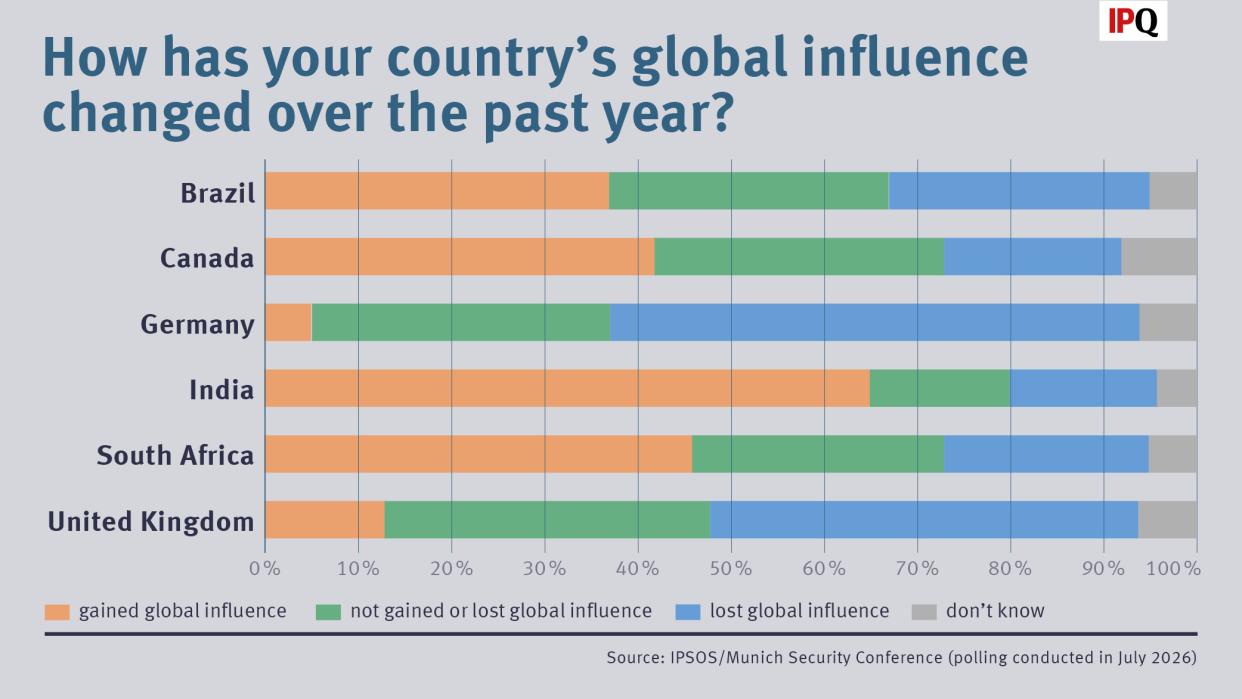
In fact, most of the respondents in the Global South rate their countries as having more influence now than they had a year ago, the point at which the effects of Donald Trump’s second presidency—the source of Carney’s “rupture”—had already become undeniable. In Brazil, India, Indonesia, South Africa, and Turkey, more respondents believe their country has gained influence over the past year than believe their country has lost influence. By contrast, the Europeans surveyed—in France, Germany, Italy, and the United Kingdom—say in relative or even absolute majorities that their countries have lost influence over the course of that year.
But while middle powers disagree on whether current developments represent an opportunity or a cause for concern, Carney’s ideas for how to shape this emerging world are far less contentious among them. Broad agreement, however, has meant following the path of least resistance and ambition.
Working on What?
In his speech, Carney invoked both the more limited aim of jointly increasing middle powers’ leeway vis-à-vis bullying great powers and a more far-reaching goal of jointly working on an improved international order. It is the first goal that has resonated most strongly.
Over the past few months, countries have increased cooperation to help each other boost critical capabilities and reduce risky dependencies. In the realm of security alone, numerous partnerships have flourished, as Gulf states have forged drone partnerships with Ukraine, India has struck a deal with Germany on building a new generation of conventional submarines, and the EU has signed new bilateral security and defense partnerships with Norway, Ghana, and 10 other states.
To date, however, few middle power governments seem willing to pursue the second goal formulated by Carney, aimed at global order-building. For many governments in the Global South, observers have argued, the focus is not on jointly building order but on improving their skills to better navigate the chaos. In the West, middle power leaders may keephighlighting the importance of strengthening international rules and investing in the global problem-solving architecture. But they have not yet shown much action to match these lofty commitments.
The Relevance of Shared Values
On the possible modes of middle power cooperation, too, many countries prefer the less ambitious format. When Carney spoke of partnerships whose “depth reflects our values,” the Canadian prime minister referred to both narrower, issue-specific forms of middle power collaboration, and a barely defined, deeper form of cooperation among countries that share liberal values.
There is evidence of growing support in Western middle powers for this narrower, more fluid type of partnership—the “variable geometry” to which Carney referred. While respondents in Germany, Italy, and the UK still prefer collaborating with democracies, a sizeable share of them believe their country should work with as many states as possible, even if they are not all democratic. In Canada and Japan, a relative majority even prefers this type of cooperation.
But whereas Westerners seem to have warmed to the fluid type of cooperation that many leaders in the Global South already practice, there is no indication that the opposite is happening as well: that democratic middle powers from the Global South have become more eager to enter into stronger commitments with their democratic peers.
Having long sought highly flexible modes of cooperation, many remain wary of the deeply institutionalized partnerships Western countries have formed among themselves. While the growing overlap on “variable geometry” may lower the bar for middle power collaboration, it also caps what cooperation can achieve. Joint capacity-building in sensitive areas, collaboration that offers real deterrence, and ambitious investments in elements of order clearly demand a much closer type of cooperation.
A Lack of Counterbalancing
Finally, when it comes to counterbalancing the great powers, bold approaches by middle powers are similarly thin on the ground. A third path with impact, Carney signaled in his speech, is difficult to reconcile with middle powers’ current policies of accommodating the great powers. Yet, few middle powers seem to regard boldly counterbalancing the US and China as a viable option.
There has been limited pushback against the measures the US administration has adopted since Trump’s return to office in early 2025—let alone one that was collective. Accommodation has also often come at the expense of forging deeper middle power ties. For instance, when European governments declined to explicitly criticize the US’ violation of Venezuela’s sovereignty, their concerns about angering Trump clearly outweighed their concerns about alienating Venezuela’s worried neighbors.
Interestingly, in all the countries surveyed, except Brazil, more people seem to disapprove of this deferential approach than approve of it. In Germany, Italy, and the UK, absolute majorities find their government’s approach overly accommodating. In Canada, France, India, Indonesia, Japan, Turkey, and South Africa, those who describe their government’s policies vis-à-vis the US as “too accommodating” outnumber those who either find it “about right” or who find it “too confrontational.” Brazil is the only country where more people find their government’s approach to the US “too confrontational.”
While Carney spoke of building a “third path with impact,” the only type of roadbuilding project middle powers currently seem to agree on is that of helping one another improve their own roads. While a smaller group of countries, mostly Western democracies, claim to have an appetite for more far-reaching efforts—forging deeper coalitions to engage in actual order-building—their leaders have still offered little in the way of action. What middle powers thus seem ready to build is a web of many individual roads that stay close to the great powers’ routes and have little to offer to the wider world of travelers. Thanks to cooperation among them, however, the roads being built are much more plentiful, far better paved, and increasingly well connected.
This type of middle power cooperation is not without its merits. By engaging in it, countries are already decreasing their exposure to great power coercion, while increasing their bargaining leverage vis-à-vis Washington and Beijing. By jointly boosting their ability to navigate an orderless world, middle powers are also creating the conditions to define more far-reaching future projects.
As their roads grow more robust, more numerous, and better connected, they may well dare to venture farther from the great powers' routes. And as more states get used to building alongside each other, the smaller the step toward building something they share becomes. What countries are building now may be far from a “third path with impact.” But states’ ambitions may grow as they become better builders.
Sophie Eisentraut is head of research and publications at the Munich Security Conference (MSC). The article draws on the Munich Security Brief “Third Path or Middling Way? The Possibilities and Constraints of Middle Power Cooperation.”
