
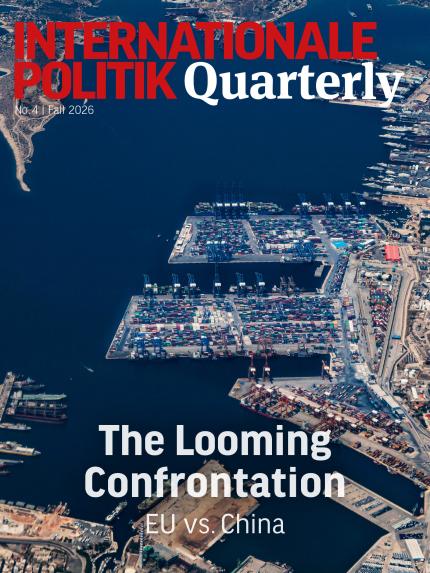
Today’s world is all about geoeconomics: Economic relationships are instrumentalized to advance strategic interests. Trade, technology, and finance are viewed through a geopolitical power lens, blurring the line between security and economic interests.
The two main players in the arena are the United States and China. Washington spearheaded modern geoeconomics, through its centrality in financial, information, and technology networks, and the economic heft of its huge market. Beijing has developed strategies for domestic innovation and is investing in strategic assets such as ports and specialized technology companies to hedge against critical choke points and geopolitical pressure.
Both the US and China each other as their biggest geopolitical rivals. Japan, Taiwan, the European Union, the United Kingdom have themselves become players over time. Others navigate the global economic order by increasingly resorting to geoeconomic policies, such as the Gulf States, Indonesia, and India, but also Australia and Russia.
The drivers of the geoeconomic age are the previous era of globalization and what political scientists are calling the ensuing “securitization” of economic relationships, while fragmentation is the consequence of exploiting chokepoints in interdependent global trade, finance, and technology value chains for advancing strategic security goals.
Trade
Whereas in 1990 the share of trade in global gross domestic product (GDP) stood at 38 percent, by 2023 it had risen to 59 percent. This trade globalization has been driven by market-liberalization policies and the ascendance of China as the top exporting nation of today. After 1985, the US moved from trade competition with Japan into a position of unprecedented hegemony with the collapse of the Soviet Union and Japan’s economic stagnation during the lost decade of the 1990s. Economic gains could now take priority over security considerations.
Washington pushed trade integration on the international stage as its new foreign policy paradigm. The decade resulted in the granting of Permanent Normal Trade Relations (PNTR) to China despite concerns over its economic model and China’s accession to the World Trade Organization (WTO) in December 2001.
China’s ascendance in global trade was rapid. While its exports of goods accounted for a meager 1.8 percent of global exports in 1990, it had grown almost 10-fold to 17.3 percent by 2024 (including Hong Kong). Traditional export nations have lost global share since 1990, with Germany losing about 5 percent and the US about 3 percent. Japan decreased from 11 to 3 percent of global exports. This has resulted in China now being the world’s biggest exporter of manufactured goods, dominating personal computer manufacturing, battery cells, shipbuilding, and electric vehicles.
Over the same period, the US trade deficit grew 11-fold to almost $1 trillion. If its services exports were not positive, it would be even higher. The total goods deficit was around $1.2 trillion in 2024. In contrast, China’s goods surplus stood at nearly $1 trillion in 2024. The country accounts for 32 percent of global manufacturing, but only 12 percent of global consumption.
The United States sees its economic dominance threatened by China’s export-oriented trade and investmentpolicy. Beijing manages its own market access restrictively and heavily supports its own industry. Despite its unprecedented growth in the past two decades, it still claims “developing country” status at the WTO. The thinking in Washington is that the global economic rules need to adapt to the global economic realities.
The US frustration with international trade developments and the functioning of its rules has resulted in it pursuing so-called securitization policies. Also, since 2016, Washington has disengaged from the WTO’s appellate body, the organization’s dispute settlement mechanism, and blocked the appointment of new members since 2019.
US President Donald Trump’s first term initiated the move from free trade to “managed trade,” with the aim of resetting the trade balance of the US with the rest of the world. The expansion of the use of Sections 301(unfair trade practices) and 232 (national security effects on US) tariffs and the extensive use of IEEPA (emergency national security threats) authorities have thus become geoeconomic tools.
Former US President Joe Biden was a relief to Europeans, but he left China tariffs mostly in place and only suspended steel and aluminum tariffs against Europe. This shows how profound the concern about US import dependence and Chinese trade dependence is across the political parties. Trump’s second term has again sought to use trade as a blunt coercive tool for all kind of objectives, although its erratic policy is creating contradicting outcomes.
For its part, China has seen trade as strategic from the beginning and does not seem to be considering major changes in its foreign economic model. Globally, trade restrictions have risen over the past decade: 12 percent of total global imports faced restrictions in 2024, up from 2 percent a decade earlier.
The result of the geoeconomic approach to trade policy is trade fragmentation: countries are focusing more on strategic interests and less on economic advantages only. Trade fragmentation along geopolitical lines has increased. This, in turn, is giving rise to new opportunities: for countries that facilitate trade between rival factions, such as Mexico or Vietnam, or for new trade agreements, such as EU-MERCOSUR. Still, fragmentation affects high-value commerce, especially in high-end technology and critical raw materials with long-term effects. This trend is likely to continue, especially as bipartisan resistance against Chinese trade rerouting is growing in Washington.
Technology
What the US-China trade war sometimes overshadows is that technological leadership is more central than ever to geopolitical competition. The US and China compete for the most advanced technology, but again Europe, Japan, and others are deeply intertwined in this global tech-race. Technological globalization is characterized by the specialization of producers in certain countries and competitive cost advantages in others. The former has created multi-country value chains that push the boundaries of technological innovation, such as in the semiconductor supply chain. The latter has surged with increasing trade globalization that has offered companies the possibility to produce where costs are lowest and margins highest. An example is Apple’s seminal decision to the move production, but not the design, of its iPhone to China under Tim Cook from 1998 on.
Technology securitization has followed trade securitization. Concerns over choke points and technology leakage have placed the US and China in opposite camps of the innovation system. Under President Xi Jinping, the 2015 Made in China 2025 policy identified an array of sectors and technologies in which China wants to reduce foreign dependence. China’s rise in technology manufacturing is therefore not only an economic interest, but also a strategic security interest. The US perceives this policy as a geopolitical threat. Both sides have since doubled down on security-driven economic policy.
In Washington, the consensus on containing China’s technological advancement is bipartisan, in contrast to most other policy areas. Starting with the Obama administration, Washington has implemented reforms to US export controls and investment screening to better cover emerging technologies, such as high-end semiconductors. Other countries have been pressured or convinced to join the US controls. A main concern has been the Dutch company ASML, which produces the most advanced machines for semiconductor manufacturing. However, even beyond semiconductors, technology has become a security concern. In 2025, the US banned Chinese connected vehicles and components, creating massive headaches for car companies such as Volkswagen that rely on global value chains, including with China.
The resulting fragmentation is increasingly placing a strain on global value chains. For example, the outgoing Biden administration issued a wide-ranging export control rule on AI technology in January 2025, that was to come into force in May. It would have divided the world into different categories of countries, determining who does and does not have access. While the Trump administration has since rescinded the rule and announced a simpler approach, it will inevitably exclude countries the US considers adversarial from buying cutting edge AI chips, most notably China.
This directly affects European companies’ China business, because US export controls are extraterritorial. A byproduct of this fragmentation are lock-in effects of US-led or Chinese tech-ecosystems. In the digital realm, only China and the US have their own technological stacks, with complementing hardware and software, although China is still lagging behind the US. Security considerations are thereby creating fragmented technology spheres in which dominant players capture more and more market share within integrated ecosystems.
Finance
In finance, the centralization of global financial flows through a few big global banks created a gradual globalization starting in the early 1970s. In 1973 the financial messaging organization Society for Worldwide Interbank Financial Communication (SWIFT) was founded. Deregulation in the 1980s reduced interstate banking restrictions in the US, as did deregulation in Europe in the 1990s, soon followed by Latin America, Eastern Europe, and Asia. Progress in information networks sped up global finance, increasing global trade spurred cross-border transactions, and credit cards spread across the globe.
At the height of US power, and in the wake of the terrorist attacks of 9/11, the securitization of global finance became a new paradigm. SWIFT could no longer resist US pressure to share its data for tracking down terrorists. Financial sanctions became an important tool in US foreign policy.
Economic integration with the world and growth in China have led to increases in foreign direct investments in the EU and the US. Usually a measure of economic success, Chinese investment has become a core security consideration. Extensive growth in Chinese foreign direct investment (FDI) stocks and a prioritization of strategic investments in specialized companies have led governments to increase their scrutiny of FDI. The US reformed its screening mechanism in 2018 and the EU introduced its own instrument in 2019.
Alongside global finance securitization, states are using financial assets increasingly for strategic purposes, further blurring the line between economic gains and security considerations. The Gulf states hold vast amounts of assets all over North America, Europe, and Asia, hedging against geopolitical pressure, and countries like China, Japan, and Germany hold huge amounts of US dollars in reserves from their exports, which support US debt financing, and thereby maintains a geopolitical balance beneficial to both sides.
The first signs of fragmentation are starting to appear in global finance. BRICS countries are constantly flirting with reducing the share of the US dollar in trade, and several member countries operate parallel mechanisms to traditional financial messaging and clearing systems, such as Russia’s SPFS, China’s CIPS, and India’s SFMS. Especially after the exclusion of several Russian banks from SWIFT in 2022, through EU sanctions over its war in Ukraine , some of these mechanisms began to receive increased attention as possible alternatives to Western-dominated financial systems. While these efforts have so far not changed the fundamental power of the dollar, one consequence of the continued securitization of global finance is the rising interest in alternative systems among states opposed to US and more recently EU financial sanctions.
Interdependence
The result of this globalization in trade, technology, and finance is interdependence. Economies are so intertwined that almost no sector can function without foreign inputs, and supply chains operate on just-in-time delivery, something that became very visible during the COVID-19 pandemic.
But interdependence is not only the stickiness of global economic relationships, it has also become a geoeconomic objective that many states see as a hedge against economic coercion by others. Japan calls it “strategic indispensability“ and Europe is debating its position in global value chains as both a source of vulnerabilities but also as a strength.
Interdependence therefore makes de-risking more difficult but also shields against certain geoeconomic pressure from others. It is not likely that economic relationships will broadly de-couple, at least in the medium term, so managing interdependence will be the most important challenge for states in the coming years.
The Economic-Security Nexus
The major implications of this geoeconomic age are the economic-security nexus and managing interdependence. Economic security has emerged as a concept and a mix of policy measures to protect against risks and to strengthen one’s own position. The G7 wants to “coordinate” its “approach to economic resilience and economic security.” The EU adopted its Economic Security Strategy in 2023. Japan has a Minister for Economic Security, the US equates economic security with national security, and for China economic security is the “basis” of national security.
Germany is going to produce its own economic security strategy over the next couple of months. It will be more important than ever to get this exercise right and bridge the gap between analysis and action. Geoeconomic tendencies will only increase, with the “rules-based” order of the past decades now unraveling.
The strategy needs to provide clarity on serious trade-offs. How to reconcile trade openness with geopolitical developments and protect leading capabilities through export controls? How to combine legal clarity with security considerations and process speed for foreign direct investment? How to support strategic industries, through an ecosystem and value chain approach, that takes business realities into account?
In the future, such a strategy will need continuous adaptation of economic security instruments to geopolitical developments, such as security measures for AI data centers. It will also need to make the case for in-house analysis on geoeconomic data, such as in Japan or the United Kingdom.
The debate about the need for more trade and the risks emanating from dependences is not mutually exclusive, but rather one side of the same coin. Forging a vision for economic security at home, advancing the thinking in the EU, and looking for collaboration where it makes sense with the US, Japan, other countries should be the top priority for German foreign economic policy.
Filip Medunić is Research Fellow for Geoeconomics at the German Council on Foreign Relations (DGAP) in Berlin.
