Amidst a fragmented global landscape, both India and the European Union find themselves on volatile ground. From securing supply chains, furthering democratic principles, and accessing critical raw materials to procuring smart-tech capacities and charting a resilient future, the European partnership with India has remained powerful, but at the same time it lacks purpose.
Historically, India and the EU have concurred on numerous global issues, such as a joint commitment to multilateralism, fostering the United Nation’s sustainable development goals (SDGs), and reinforcing a rules-based order. Despite the relationship steadily growing since 1962 with India becoming a strategic partner of the EU in 2004, the two sides have unfortunately scored low on matching ambitions with concrete policy outcomes.
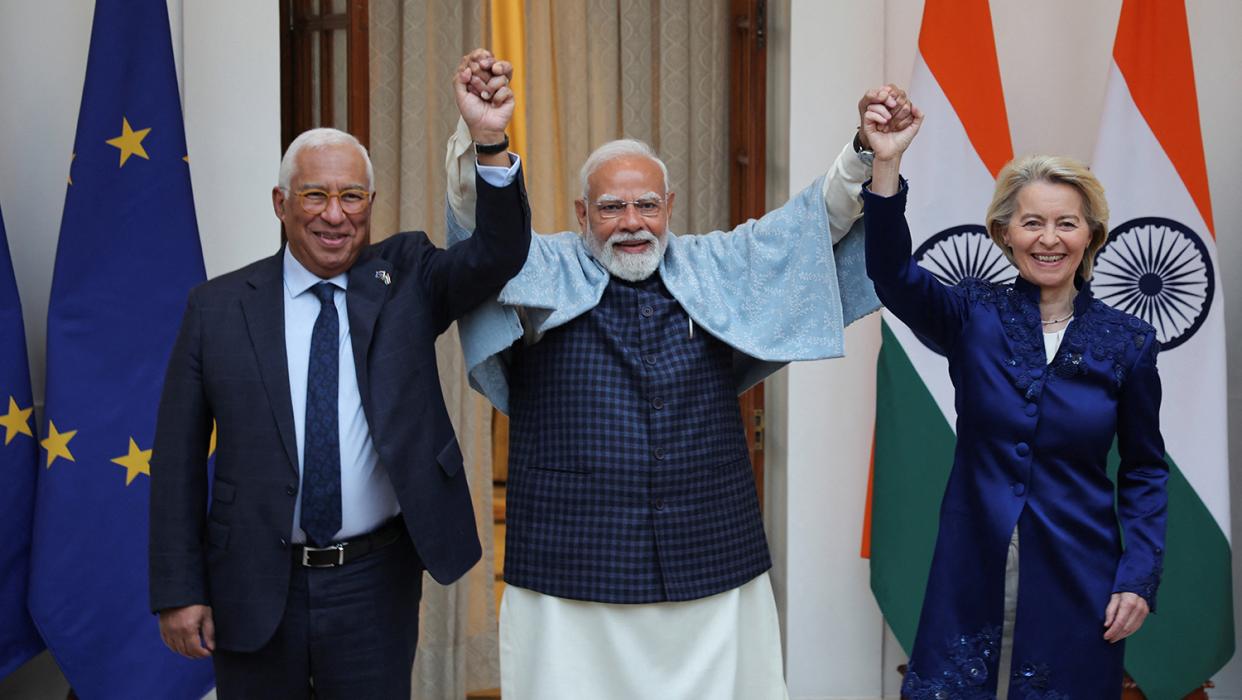
Nevertheless, the strategic steps taken recently reflect an attempt at damage control as well as a shared willingness to face up to the geopolitical realities. The February 2025 visit of the College of the European Commissioners to India resulted in a string of engagements between the two. In 2026, the fact that European Commission President Ursula von der Leyen and European Council President António Costa were the chief guests at India’s 77th Republic Day celebrations garnered much international attention. Using this as an opportunity to also hold the 16th EU-India Summit in New Delhi, the two sides managed to break 13 years of deadlock and finalize the “mother of all deals,” the EU-India Free Trade Agreement (FTA).
By salvaging what Valeria Santi of the Brussels Institute for Geopolitics described as an “underperforming” partnership, Brussels has gradually understood that maintaining its external credibility is crucial to ensure long-term prosperity. Moreover, New Delhi is equally eager to deepen engagement with Europe in its bid to build multi-vector alliances and, in effect, strengthen strategic autonomy.
Mutual Expectations
The rise of India’s new economic diplomacy, which is spotlighting development, has certainly leveraged its position on the global stage. With its development cooperation model organically inclined toward sustainable development, India has been contributing significantly to co-creation and securing global public goods. Further, India’s GDP target of achieving $30-40 trillion by 2047 shows that it has aspirations of becoming a Viksit Bharat (“a developed nation”), accompanied by the even bigger objectives of attaining self-reliance and prosperity for its 1.4 billion people. In fact, during its G20 presidency in 2023, New Delhi’s initiative of gathering voices from the Global South was focused precisely on putting development at the core of international politics.
At the same time, Europe’s colonial legacy has evidently impacted its relations with India and the bigger countries of the Global South, making it more transactional than transformative in character. This has resulted in a partnership of convenience. Several countries of the Global South, though heavily dependent on EU aid, often view Brussels as “self-serving and post-colonial” negating the very rhetoric of equal partnerships.
Engulfed in multiple geopolitical and geoeconomic realities arising out of Russia’s war against Ukraine as well as the souring of transatlantic relations, Europe has adopted realism. What appeared to be a sense of contentment revolving around its long-enjoyed political, economic, and environmental clout was actually geopolitical tone deafness to the real issues faced by the Global South. With shrinking budgets, weaponized supply chains, and multilateral institutions gradually losing ground, the EU is now compelled to prioritize purposeful partnerships with like-minded countries, including India, to address an uncertain future.
A Two-Pronged Relationship
India’s engagement with the EU and vice versa is two-pronged.
First, New Delhi’s association with Brussels goes beyond economics. As a regional generator of international norms, the EU’s regulatory mechanisms and data standards appeal to India’s maturing tech industry. India’s vibrant start-up ecosystem has grown by leaps and bounds. As of March 2026, around 2.23 million start-ups had blossomed in the country since the Startup Initiative was established a decade ago. Pertinently, these young start-ups work closely in key strategic areas such as agri-tech, digital financial inclusion, artificial intelligence, blockchain, robotics, semiconductors, quantum computing, and space technologies. Collaborating with the EU would certainly open up a plethora of new markets thus driving transparency, universal standards, and capital inflows. Keeping in mind its new competitiveness agenda, the EU is searching keenly for new partners to diversify its partnerships and gradually de-risk from China.
Second, the strategic calculations of both India and the EU hinge strongly upon Beijing’s assertiveness and Washington’s impulsiveness. Here, building a robust European bridge is useful for India’s geopolitical calculus. Yet, New Delhi’s close ties with Russia makes the Europeans uneasy. Due to its neutral position on the war in Ukraine and steady purchase of Russian oil, the Europeans have called out India’s “moral ambiguity“ on the issue. Nonetheless, India’s close ties with Russia should be understood from a historical perspective; and their relevance may vary over time given New Delhi’s current strategic calculations pivot strongly on new economic diplomacy. For the EU, this should be a lever to build a robust partnership for larger global good and deliver real impacts.
Development Possibilities, Global Potentials
With its growing ambitions to be a geopolitical actor, the EU is now moving away from a “donor-recipient relationship” to “partnerships of equals” between Brussels and developing countries. In this sense, the EU and India can possibly work together in three ways to create institutions and establish mechanisms that are resilient, rules-based, and support a multipolar global architecture.
First, fostering a comprehensive connectivity agenda is pivotal. Pooling additional capital to meet the SDG financing gap, especially climate adaptation, is a dire need for the Global South. By creating a business case for adaptation, the EU and India should push for investments in areas such as green technologies that offer opportunities to achieve both profit and purpose by aligning financial incentives with environmental and social objectives.
Here, taking real actions, such as removing implementation bottlenecks, addressing issues of digital trade fragmentation, regulatory conflicts, and the lack of a joint political will, through the EU-India Trade and Technology Council (TTC) is key. Also, the FTA has been finalized, yet protectionist frictions, for instance over the Carbon Border Adjustment Mechanism (CBAM), need to be tackled, keeping in mind the market interests of both parties.
Second, promoting cooperation in third countries can possibly help in redefining the essence of partnerships in current times. Although the EU is struggling to channel resources for its home-grown initiatives, including the Green Deal and Global Gateway, this is an opportune moment for Brussels to spotlight the quality finance it has to offer for development projects that have a high impact.
And triangular cooperation between the EU and India in a third country can help in establishing resilient supply chains and robust trade mechanisms. Both India and the EU are strong development providers that can potentially mobilize resources and quality finance to third parties in a structured manner for the SDGs. It is important for the EU and India to create a common strategy on development, based on mutual respect and shared gains. Here, securing strategic autonomy, enhancing local competitiveness, and a vision of development diplomacy should be prioritized. This can also be treated as a template for bridging the North-South divide in a fragmented world.
Third, the case for supporting the cause of an effective global governance is easy to make. The current international financial architecture is outdated and requires urgent revision. India’s participation via the G20 and BRICS+ stirred the conversation on fair financing to mitigate the economic crisis. To address the urgent sustainability financing needs in the countries of the Global South, the EU must work toward reforming the global financial institutions by increasing the Global South’s access to international financial markets, addressing issues of debt burdens, and tapping into alternative sources of sustainable financing.
With multilateralism suffering a freefall and geopolitical conflicts across the globe left unaddressed, the EU should work together with India on providing responses. Building good faith and sustained political will is key; it should be advanced by both the EU and India.
Swati Prabhu is a fellow with the Centre for New Economic Diplomacy at Observer Research Foundation (ORF) in Kolkata, specializing, inter alia, in EU-India relations.
