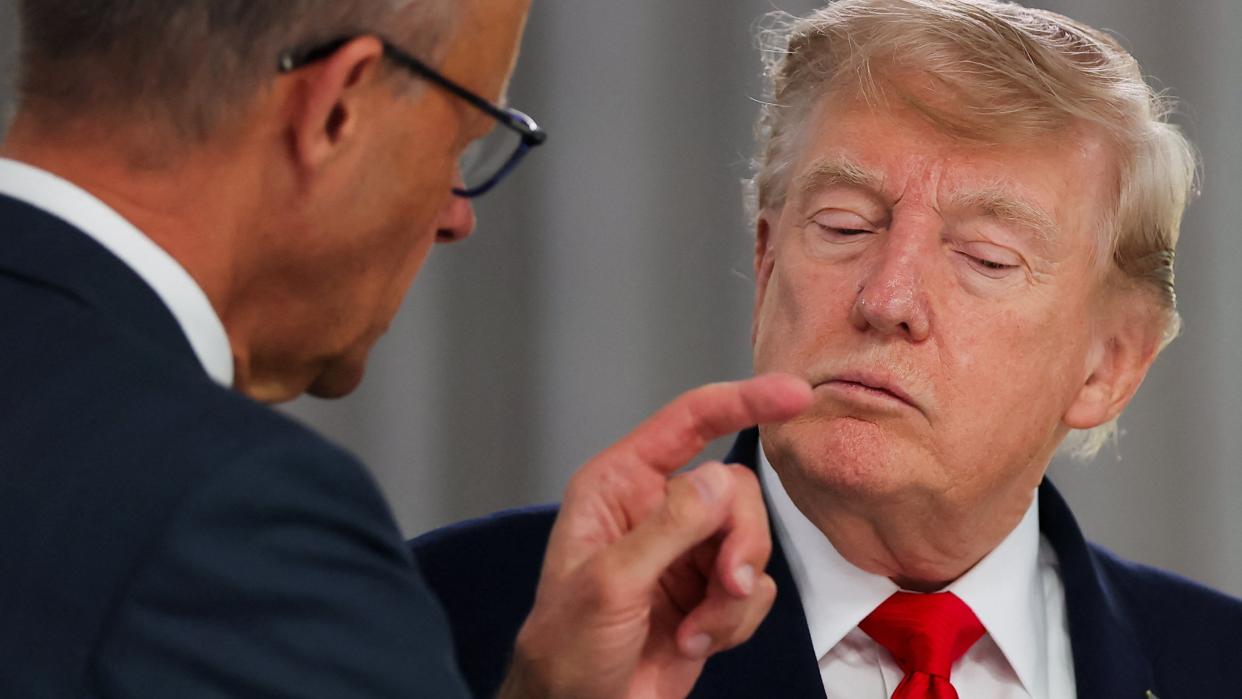
The strategic approach of US President Donald Trump’s second term can be defined by one word: escalation. Through punitive tariffs, the withdrawal of American troops from European bases, and—perhaps most strikingly—repeated threats to annex Greenland, Trump has not only subverted an international system the United States built, but also weakened a relationship once seen as central to both sides of the Atlantic.
A Values-Based Verdict
There are growing concerns in Europe about the Trump administration’s disregard for the principles foundational to the liberal international order and how that is impacting the transatlantic relationship. In 2025, German Chancellor Friedrich Merz questioned whether the United States would “still stand by our side as it did after 1945,” describing an “epochal rupture” in transatlantic relations. While the relationship itself may persist, for many, transatlanticism as an ideology may well be a remnant of a bygone era.
While understanding this decline through the language of values provides a clear explanation for the alliance souring, it risks obscuring a legacy of illiberal actions perpetrated with the endorsement of European powers. Failing to acknowledge European acquiescence with past anti-democratic regime changes or unauthorized military operations fails to account for the nuances of a geopolitical environment in which illiberal behavior on the part of the US is viewed as distinctly objectionable. In not telling the whole story, there is the danger of overlooking what makes this chapter truly different.
A Romantic Story
The story of transatlanticism is nothing if not romantic—and trite. In the aftermath of World War II and the beginning of the Cold War, Europe once again lay in ruins. While international reconstructive efforts would constitute a far more integrated project than after World War I, the fate of the world would be caught in a dramatic struggle between freedom, and its natural enemy, communism.
Amidst stark geopolitical divisions, the United States would emerge as the principal architect of a new world order, championing a system defined not only by free-market capitalism, but also by the promotion of democracy and its associated values: political liberty, human rights, and the rule of law. In the words of former NATO Secretary General Lord George Robertson, “Atlanticism has never been a concept based on geography, but on shared values.” These principles would define the strategic and diplomatic relationship between the United States and Europe. The establishment of the North Atlantic Treaty Association in 1949 would enshrine it. And, as the story goes, transatlanticism was born.
But despite this shared tradition, Washington’s actions in recent years have invited far more than mild criticism from its European counterparts. While leaders have sought to maintain relations with an increasingly unpredictable White House, public opinion has continued to deteriorate.
Negative perceptions of the United States can be traced back to the first Trump administration, but attitudes today indicate an even greater departure from the norm. Although public attitudes recovered somewhat under US President Joe Biden (2021–25), since Trump’s 2024 re-election, they have continued to decline again, reaching new lows.
According to polling conducted by European Council on Foreign Relations (ECFR), as of late 2024, 22 percent of Europeans viewed the United States as a close and reliable friend. By May 2026, that figure had fallen by more than half, with only around 10 percent describing the United States as their country’s ally.
The New Normal
To better understand what does—and does not—make this chapter different, we must look to the story of the present. Domestically, the Trump administration has been accused of undermining liberal democratic norms in several ways. Its hardline immigration policies have facilitated the expedited removal of undocumented immigrants and, in some reported cases, individuals later found to have legal status. The White House’s continued efforts to challenge election outcomes and to cast doubt on the legitimacy of US electoral institutions have further weakened public confidence in democratic governance.
Internationally, Trump’s rhetoric has repeatedly challenged two foundational principles of the liberal international order: respect for territorial sovereignty and the sanctity of alliances. In 2025, the administration suspended all military aid to Ukraine in an effort to force peace negotiations, halting the delivery of crucial assistance to a country fighting against Putin’s brutal campaign; it has repeated this pattern in recent weeks. In early 2026, Trump triggered a diplomatic crisis by voicing his intention to annex Greenland, an autonomous territory of Denmark whose inhabitants are EU citizens.
A Culture Shift
While Trump’s hostile posture toward Europe has undoubtedly intensified resentment, questions about whether the continent and the United States can restore their former friendship extend beyond the rhetoric of any one administration. A shift this dramatic cannot occur overnight, nor can it be attributed to any single provocation. Rather, many analysts attribute these grievances to a broader cultural and political shift: the belief Washington has abandoned the values it once championed.
Once a “great liberator,” the US has not only reneged on its obligations to its allies but has also appeared to act in contradiction to the values of liberal democracy. Written in these romantic terms, this “sense of abandonment can feel personal,” as Bertrand Benoit, the Wall Street Journal’s Berlin bureau chief, put it in an essay in late 2025—like the betrayal of a once-close friend.
An Illiberal Tradition
While these developments may suggest a departure from a values-based order, attributing today’s transatlantic tensions solely to Washington’s abandonment of liberal principles tells only part of the story. After all, the transatlantic relationship has survived numerous instances in which the United States violated such values.
In 1953, the CIA orchestrated the overthrow of Iran’s democratically elected Prime Minister Mohammad Mossadegh, restoring the Shah to power. Two of Washington’s most prominent European partners, the United Kingdom and France, supported the operation, sharing American concerns that Mossadegh’s nationalization of Iran’s oil industry could strengthen Soviet influence in the region. Similar patterns emerged across Latin America, where the United States supported right-wing military regimes in the name of containing communism. In Chile, the US backed the 1973 coup led by Augusto Pinochet, ousting the democratically-elected government of Salvador Allende, a known Marxist. Lasting until 1990, Pinochet’s dictatorship became synonymous with widespread political repression and human rights abuses.
Few episodes better illustrate the United States’ willingness to compromise liberal norms than the 2003 invasion of Iraq, launched without broad authorization from the United Nations Security Council. The subsequent human rights abuses at Abu Ghraib prison further exposed violations not only of international consensus but also of the individual rights central to liberal democratic principles.
This is not to say that opinion in Europe was unanimous, or that these events did not provoke widespread public opposition. While British Prime Minister Tony Blair sent thousands of troops to assist in the invasion, French President Jacques Chirac condemned the action. Despite this, majorities in several of Europe’s largest countries—including the UK, France, Germany, Italy, and Spain—continued to express broadly favorable views of the American people.
Although these illiberal episodes generated significant criticism within Europe, they did little to fundamentally weaken the transatlantic alliance. Since 1945, European governments largely remained committed to their American partner, subordinating liberal ideals to strategic objectives. While public opinion may have fluctuated—especially amid America’s wars in the Middle East—such episodes rarely prompted serious discussions about the end of transatlanticism itself. Contemporary European resentment, therefore, cannot be explained entirely through the language of shared values. In fact, strategic necessity may provide a more realistic explanation for its former durability.
What’s Different?
So, what has changed in a relationship that former NATO Secretary General Jens Stoltenberg once described as “strong enough to withstand changing political winds”? Has Donald Trump’s strategy of escalation merely amplified longstanding American departures from liberal principles? Has Europe’s evolving position within the international order made those same departures increasingly difficult to accept? While these questions are valuable, they miss the forest for the trees. Understanding the relationship’s deterioration solely through the actions of one administration overlooks a crucial turning point—one that stands above the rest: the Russo-Ukrainian War.
In a 2022 speech before the United Nations General Assembly, French President Emmanuel Macron stated that Russia's full-scale invasion of Ukraine “is undermining the only possible world order, is undermining peace.” The deadliest conflict to occur on European soil since 1945, the war has not only renewed the salience of a rules-based system but has also highlighted gaps in the European defense capabilities. Trump’s cessation of aid to Ukraine is not merely a matter of values, but of concrete strategic concerns. It is these concrete strategic concerns that led Chancellor Merz to proclaim that the post-war international order “no longer exists.”
At Face Value
In many ways, Europe's changing attitude toward the United States is ultimately a story about values—but more importantly, about the strategic necessity of those values. Russia’s assault on Ukrainian sovereignty has renewed the importance of multilateral cooperation and reinforced the centrality of liberal principles to European security. Whereas earlier departures from shared values could often be justified in the name of strategic necessity, the erosion of those same values now threatens Europe’s strategic position itself.
While understanding the transatlantic relationship through values may not tell us much about the principles Europe and the United States advance abroad, it can tell us something important about what they seek to preserve at home. Perhaps, then, the story we tell ourselves about transatlanticism matters less for what it says than for what its gaps reveal.
Colette Wilson is an undergraduate at Stanford University studying political science. She completed an editorial internship for Internationale Politik Quarterly in summer 2026.