While it is extremely doubtful that US President Donald Trump uses the term “global governance”—or has even heard of the term at all— the historic fact that the United States is critically important when it comes to underpinning collective responses to global problems cannot be underestimated.
Admittedly, Washington supported post-war global governance initiatives partly out of self-interest—to bolster its global leadership role— rather than out of simple benevolence. US unilateral actions (like the US-led invasion of Iraq in 2003) sometimes undermined the very norms and institutions the United States seemed otherwise committed to.
Nevertheless, the US had until now seemed broadly committed to perpetuating the international order it helped to create, fund, and defend after 1945. As US scholar John Eikenberry wrote, the US benefitted from sitting atop a “sprawling international order, organized around economic openness, multilateral institutions, security cooperation, and democratic solidarity” in which the US “became the first citizen of this order, providing hegemonic leadership.”
From hosting the UN headquarters in New York to providing substantial funding to its various bodies, including through USAID. From (at least on occasion) using US hard power to defend the norms governing world order. To providing moral valuation, even if inconsistently, to the notion of a stable world order, the global order we understood to exist was defined by US power and norms.
The End of the Old Order
This is now ending abruptly due to the “America First” ideology. We had a foretaste during Trump’s first presidency, when US commitment to the liberal world order suddenly became shakier than at any point since 1945. But during Trump’s first administration, his apparent unpreparedness for the presidency meant that he had plenty of harsh words for ungrateful international institutions and free-riding foreigners, but was lighter on concrete actions.
Not so this time around. We have never seen a similar wholesale retreat in the post-war era from the US’s global governance contributions. For instance, somewhat forgotten because of Vice President JD Vance’s infamous speech at the Munich Security Conference, just 10 days earlier, President Trump signed an US executive order on February 4 entitled: “Withdrawing the United States from and Ending Funding to Certain United Nations Organizations and Reviewing United States Support to All International Organizations.”
This executive order singled out the UN Human Rights Council (UNHRC); the UN Educational, Scientific, and Cultural Organization (UNESCO); and the UN Relief and Works Agency for Palestine Refugees in the Near East (UNRWA) for their apparent criticism of Israel. Alongside the closure of USAID, the withdrawal from the World Health Organization (WHO), and for a second time from the Paris climate agreement, showed that key pillars of the international order seemed to be crumbling. The United States had been the single most load-bearing pillar of them all.
China’s Moment
What comes next is a matter of great anxiety, uncertainty, and in some anti-US circles, excitement. There is a great imperative to think through the scenarios that now follow, about what a world of “global governance minus one” involves.
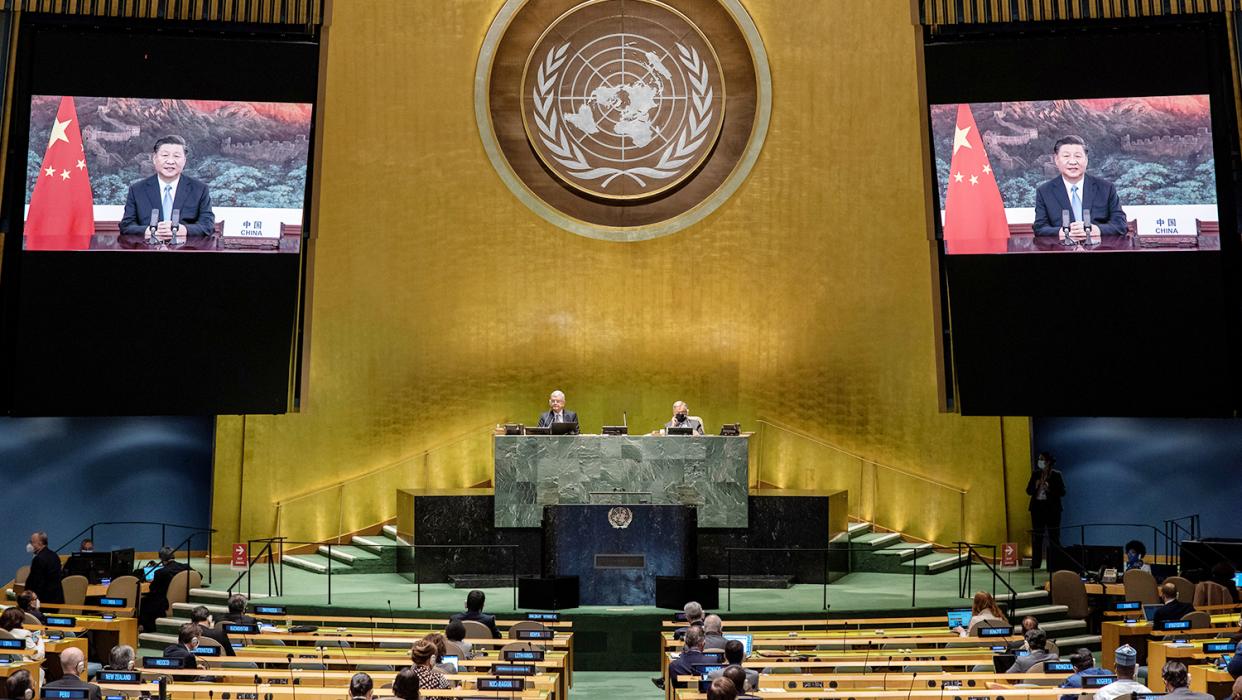
This is clearly China’s moment to win big. Its ministry of foreign affairs wasted no time in issuing propaganda videos to portray the US as a self-interested, bullying, and unreliable superpower in reaction to Trump’s tariffs policy undermining the free trading system. Chinese President Xi Jinping, meanwhile, is mainly concerned with making direct gains for China at the US’ expense, notably on his three-country tour of South East Asia in April.
There is no expectation that China will replace the United States as a global governance provider, however, despite Xi also having authored a three-part foreign policy concept expressing China’s aspiration in this regard. So far, its Global Civilization Initiative (GCI), Global Security Initiative (GSI), and Global Development Initiative (GDI) —each of which could herald a more explicit role for China as a global goods provider—are far from matched by commensurate action.
So far, Xi’s initiatives seem more directed at his domestic audiences, and are still very new, with the GSI only launched in 2022. As Chinese Foreign Minister Wang Yi noted at this year’s Munich Security Conference just a day after Vance’s speech, China is very committed to both the UN system and its role as a stabilizing international force.
This could change over time, as China becomes more involved in regional and global international affairs. As former Australian prime minister and China expert Kevin Rudd has written in his book on Xi Jinping’s ideology, in a chapter on Beijing’s behavior in the UN system, China is still in the early stages of shaping existing institutions (such as UN peacekeeping operations) to reflect its norms.
The Great Global Rebalancing
More importantly, the reshaping of global governance cannot be reduced to US-China competition, even if China’s reaction to the US global retreat is a crucial factor. There is clamor right across the diverse regions and nations of the Global South for a more equitable system of global governance in which their voices are heard and whereby their involvement shifts from being recipients of assistance to having a seat at the table.
I have written about this broader phenomenon in “Westlessness: The Great Global Rebalancing,” and there are three important aspects to consider. First, the rebalance in world affairs involves the wider world moving beyond not only a US-led but a Western-defined international order for the first time in centuries. No one state, not even China, can harness this clamor.
To that end, the rapid expansion of the BRICS club, and its upcoming summit in Rio on July 6-7, features an ambitious global governance agenda, including such policy themes as climate change and the energy transition, global public health, and governance in technology. It is unlikely that the BRICS countries can take on the full mantle of global governance, but these are unprecedented times, and vacuums opening in global leadership mean the BRICS members have a golden opportunity to exploit this.
The most powerful non-Western countries, notably among them India, are staking out their own leadership credentials among the Global South countries. When India held the G20 presidency in 2023 it successfully lobbied for the African Union to join the G20. India is keenly aware of what a post-colonial experience would have entailed in the last century’s Western-dominated international order, with a view to shepherding in a vastly different future.
Global governance is evolving along different lines: involving greater inclusivity for countries that were once passive participants in existing structures, alongside the rise of new initiatives intended to challenge and fill the vacuums being created by a US in self-induced retreat. What emerges remains to be seen.
Bleak Short-Term Outlook
In the short term, the prognosis for addressing global problems is bleak. The United States still represents about 25 percent of the world economy, so its retreat from its global governance roles removes a huge chunk of resources and know-how. This fact, alongside the heightening of US-China rivalry, plus the now European-lead stand against Russia’s invasion of Ukraine, means that global-level responses to world problems are unlikely.
We are likelier heading toward a world of regional and issue-specific responses to collective problems. The challenge for multilateral institutions in a multipolar world is having to operate across major geopolitical fractures, and they will often fail to do so (the UN Security Council being the prime example).
In the long term, states of all kinds will continue to find accommodations with each other to solve their common problems, even without the US being involved. With the greater empowerment of parts of the non-Western world than before, this may even become a far more globally representative world, even if it is one that lacks a single leader.
It is possible some established global institutions and initiatives will not survive this rapid transition in world affairs, or they will re-emerge much modified. This will take time to reveal itself. To end with an analogy is appropriate: We have set sail from the shores of a US-led post-1945 world order, a comfortable place certainly for the Western world to have been anchored. Mid-voyage, and plunged into fog, we are yet to see the facing shoreline or even know confidently that we are sailing in the right direction.
Samir Puri is the director of the Global Governance and Security Centre at Chatham House in London.