
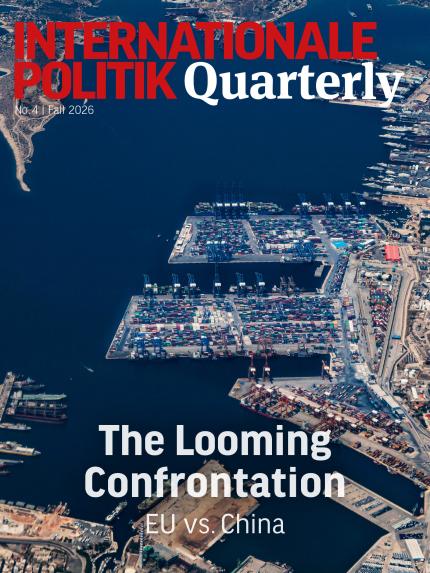
“Weaponized interdependence is an unanticipated byproduct of the grand era of globalization that is drawing to a close.” This observation is made by Henri Farell and Abraham Newman in a recent Foreign Affairs article, expanding on their seminal book Underground Empire. How America Weaponized the World Economy. Indeed, the age of strategic globalization has begun, and Europe cannot afford to sit it out.
For the better part of three decades, globalization behaved with the predictability of a clock. Trade reliably outpaced GDP growth, supply chains stitched continents together, and governments, in advanced and developing economies alike, staked national fortunes on ever-deeper integration.
Those dynamics are changing. The shift has not been abrupt; the warning signs have been accumulating for years in the increase of trade barriers, the clustering of supply chains, and the increasingly transactional nature of geopolitics. The cumulative effect is unmistakable. A new kind of globalization is taking shape; one governed less by efficiency than by strategic preference. And its dividends are being distributed differently.
Whether this produces plain fragmentation or a re-engineered globalization anchored in security and preferential partnerships remains undecided. But the latter seems more likely and perhaps more desirable.
A New System
Production, meanwhile, is concentrating in a narrowing group of countries, and trade agreements are becoming smaller, sharper, and more businesslike. China is the most conspicuous hub in this new system, but hardly the only one. Instead of dense, multipolar supply networks, today’s trade resembles a hub-and-spoke schematic: a few dominant players surrounded by increasingly dependent partners.
This asymmetry exposes smaller and mid-sized economies to pressure and strategic vulnerability as exemplified by the pain China’s rare earths export restrictions have caused to those who have been subject to them. The United States, long skeptical of traditional trade deals, is crafting a fresh style of economic diplomacy. Its recent arrangements on critical minerals with Australia and Japan, among others, look more like hurried commercial contracts than bulky interstate treaties.
However, economic liberalization is not dead; it has merely become more selective. The Comprehensive and Progressive Agreement for Trans-Pacific Partnership (CPTPP) proves as much. Born in the midst of globalization’s fracturing, and from the rubble of Washington’s withdrawal from the original Trans-Pacific Partnership (TPP), the CPTPP—founded in 2018 by Australia, Brunei, Canada, Chile, Japan, Malaysia, Mexico, New Zealand, Peru, Singapore, and Vietnam—is defying the inertia of higher and more widespread barriers.
Membership has expanded, to include the United Kingdom in 2024, and commitments have deepened while high standards have been preserved. At a time when many global institutions are creaking, the CPTPP has quietly become one of the most ambitious trade-governance systems around, with more applicants in the queue, including China.
EU, Take Note
For a large regional bloc like the European Union, the implications are significant. CPTPP’s evolution underlines what has long been obvious: modern trade agreements are now tools for managing economic rivalry and vulnerability in an era of concentrated power and the willingness to wield it. Issues such as supply-chain resilience, data security, and investment screening have moved to the heart of trade and economic diplomacy.
The EU prides itself on being a rule-maker rather than a rule-taker, more recently perhaps also a decision-maker rather than a decision-taker. Yet the past five years have forced Brussels into crisis-management mode, even as the center of economic and geopolitical gravity has moved to the Indo-Pacific.
A structured partnership between the EU and the CPTPP would amplify the weight of countries that see themselves squeezed between the United States and China and bolster their resilience. Together, the EU and CPTPP member states account for roughly 32 percent of global GDP and represent 37 percent of world trade. But capitalizing on this will require speed in a system not known for it. The UK took more than three years to complete accession to the CPTPP; the EU teaming up with the CPTPP may require a different mode, but such a process would likely take even longer.
A Missing Roadmap
In November 2025, the EU and the CPTPP launched a Trade and Investment Dialogue promising “results-oriented cooperation.” Its priorities are sensible: trade diversification, digital trade, trade and investment facilitation, supply chain resilience, and global trade environment (including World Trade Organization reform).
Yet the Joint Ministerial Statement provides no roadmap for turning goodwill into action. Beyond affirming the value of continued discussions, it offers few clues as to the next steps. The Track 1 and Track 1.5 dialogues that are taking place will hopefully lead to a clearer path forward. After all, for an EU whose global relevance, and ultimately resilience, rests on openness and scale, letting this opportunity languish would be a costly mistake.
EU member states’ chronic anxieties about standards, agriculture, and ratification politics become even more acute for region-to-region deals, as the tortuous process of reaching an EU-Mercosur agreement shows. If Mercosur is strategically important in Brussels’ view, an agreement with the CPTPP may actually prove foundational to Europe’s geopolitical heft.
Spanning Continents
The CPTPP illustrates the advantage of belonging to a trade architecture that spans continents. For the UK, accession after Brexit was not merely about market access but about strategic positioning: a bet on diversified partnerships and recognition that the Indo-Pacific may power much of the world’s growth in the future. Whether the gamble yields large economic rewards remains to be seen, but the UK has secured the distinction of being the sole European seat at the table, for now.
Most importantly, the CPTPP may help the EU confront one of its defining dilemmas: How to preserve the openness that has driven its prosperity while operating in a more combative world that increasingly sidelines it.
Globalization is not collapsing; it is reorganizing. Europe must decide what part it intends to play in the reorganization. The next phase of globalization is already being shaped by China and the US. Neither the EU nor the CPTPP can exert decisive influence alone; together, they might.
Francesca Ghiretti is IPQ’s Geoeconomic Front Lines columnist. She is director of the RAND Europe China Initiative and a research leader at RAND Europe.
