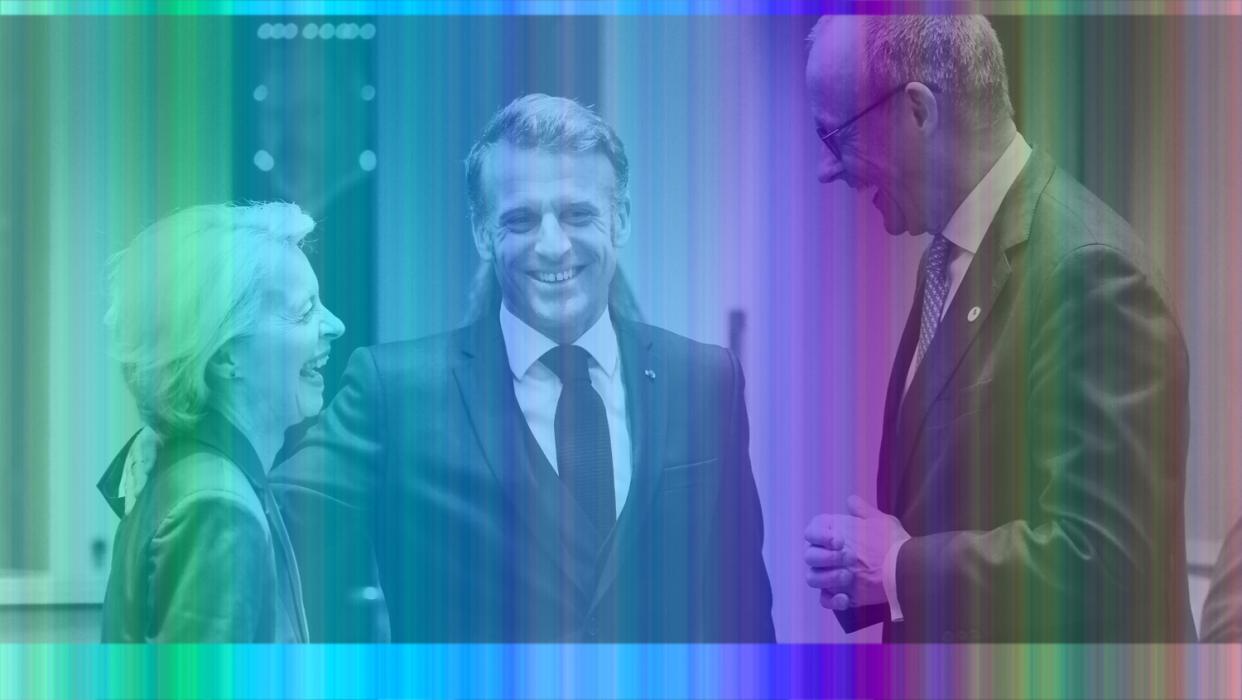
It is a truth universally acknowledged that a European foreign economic policy, however nobly conceived in Brussels, must be in want of Franco-German engagement.
The Franco-German non-paper on “Strengthening European resilience, addressing global macroeconomic imbalances and market distorting practices” supplies exactly that.
Brussels has been warning about European dependencies on China, and the macroeconomic imbalances that come with them, for at least three years—arguably, much longer. These warnings produced real policy: investigations, new instruments, and a steady stream of measures. And yet, what they still lacked was weight. Beijing has learned that the power of the European Commission, even where it is in the driving seat (trade is an EU competence), is limited unless the capitals stand behind it. And no capitals transmit that signal like Paris and Berlin do.
The nudge came at the European Council in June, when leaders discussed China while talking of “global macroeconomic imbalances.” The backing arrived in October, with the non-paper. The paper marks a pivotal moment for the EU's resilience and competitiveness agenda, and for Europe’s positioning vis-à-vis China.
The closest precedent perhaps was when France, Germany, and Italy asked the European Commission to adopt a European form of investment screening in 2017. That letter was short on detail, too. Yet, it set in motion what became the EU's Foreign Direct Investment (FDI) screening framework—arguably the first fundamental step the EU took to establish an economic security agenda.
What the Paper Asks For
Three points in the non-paper stand out.
First, France and Germany call for more ex-officio trade defense instrument (TDI) investigations and, more interestingly, for a broader approach to disruption across whole sectors rather than product by product. It names sectors already under strain: chemicals, plastics/PET, and plug-in hybrid vehicles, but it can be applied to wider sectors. Case-by-case investigations are slow; a sector-wide overcapacity build-up is not. A sectoral lens may finally begin to match the scale of the problem.
The second point is basically calling for an Economic Statecraft Instrument or something like a strong Anti-Coercion Instrument, that makes the European Commission able to draw on a wide range of trade remedies and tools. A credible tool allowing a “decisive and systematic” response, up to an immediate cut-off (a so-called kill switch) from the European internal market if needed, activated by reversed qualified majority. In essence, Paris and Berlin are advancing a call to empower the EU to practice economic statecraft rather than just talk about it.
The third point is an inventory of retaliations. Mapping in advance what the EU could deploy, and where it is exposed, shortens reaction times. It also makes deterrence credible, because the options are on the table before a crisis rather than improvised during one.
What It Means for China
Stripped to its core, the paper says the Europeans must de-risk vis-à-vis China, level the playing field, unilaterally, and protect themselves if the required actions trigger retaliation. And the paper says so in true European fashion: without mentioning China once.
There are real obstacles. The paper mixes multiple goals, and information-sharing among member states remains patchy, which makes sector-wide assessments harder than they should be.
More serious is what has happened in parallel, i.e., the Irish government’s proposal (Dublin currently holds the rotating EU presidency) to cut the proposed European budget for 2028 to 2034, after pressure from Berlin. It would weaken the competitiveness agenda advanced by Mario Draghi’s 2023 report and undercut point 6 of the non-paper itself, on strengthening the EU’s industrial base. Paris and Berlin cannot ask for an industrial policy with teeth while agreeing to starve it of funds. Add to that, the fact that EU member states will likely be reluctant to give the European Commission real economic statecraft powers, and the danger that the initiative unravels is clearly there.
For now, however, it is clearly having an effect. Last week, European Commissioner for Trade and Economic Security, Maroš Šefčovič, went to Beijing to negotiate with his counterpart, Wang Wentao. The meeting ended with a rare Ministerial Joint Statement and some initial achievements, reducing Chinese hybrid vehicle exports to the EU.
So, does this all mean that the EU-China relationship is changing its trajectory? No. Or better, not entirely. If anything, the non-paper and the messaging in the months that preceded Šefčovič’s visit provided solid ground to prove to Beijing that this time the requests were not coming from Brussels; indeed, the EU member states are not happy with the huge imbalances in EU-China trade, and they are ready to do something about it—and that something could be costlier to China than reaching an agreement.
What to Watch Next
The coming months will show whether the Franco-German accord holds and if other member states will get behind it. First comes the European Council meeting on October 15–16, where the proposal for a “kill switch” will be paid particular attention. Then there is the December European Council, where DiversifyEU and the points advanced in the non-paper are due to be tabled to be approved or not. The customary videocall between EU and Chinese leaders in January 2027 and the next EU-China summit in March will then show how Beijing reads the new tone.
In Jane Austen’s world, an engagement is only the beginning; the real test is whether the match survives contact with the family. The same is true here. Paris and Berlin have given Brussels the backing it lacked. Now the other capitals, and the budget, must follow.
Francesca Ghiretti is IPQ’s Geoeconomic Front Lines columnist and director of the Economic Security and Resilience Initiative at RAND Europe.
