
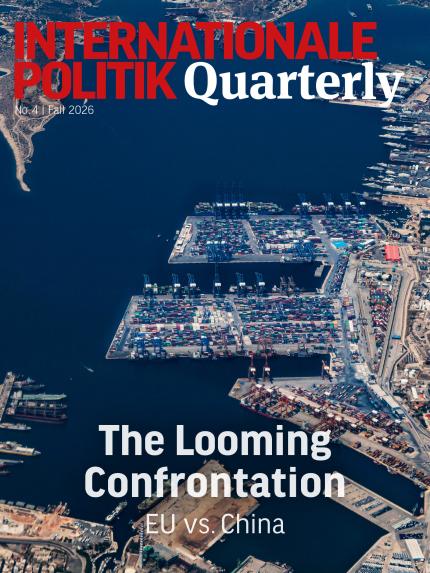
When European countries are thinking about addressing the China challenge, two different goals are often presented: de-risking and economic imbalances.
Now, the two are not disconnected. It goes without saying that had the European Union more widely de-risked from China, it would be easier to defend or advance European interests. But the issue, as it presented itself most recently to European leaders at the European Council meeting on June 17-18, is a different one: We are talking about entering into a trade contest with China before the EU is resilient.
However, when considering measures, the Europeans must do so with a clear idea of what they would like to get out of applying them.
A Trade War to De-Risk
If the EU starts a trade war with China to buy time, i.e. in order to de-risk, then the objective won’t be to win the confrontation, but to survive it long enough to reduce dependence.
The measures should be judged by whether they create breathing room—namely protecting the sectors where Chinese leverage is most acute, slowing the hollowing-out of strategic industries, and shielding the very capabilities (supply-chain mapping, alternative suppliers, domestic production) that de-risking requires.
Success looks like a more resilient EU at the end of the process, even if the headline imbalance has barely moved.
European companies may emerge more resilient, but not necessarily more competitive. This framing accepts short-term pain as the price of long-term autonomy and demands that the time bought is used. Barriers that buy three years of breathing room are worthless if Brussels and EU member states spend those years deliberating rather than building. If the EU can use the new barriers to negotiate a better bilateral position, say, on export licenses, then deploying trade restrictions for de-risking may be worth it.
The dangers are twofold, however: China's new countermeasures, designed precisely to make de-risking unworkable; and barriers built to tackle imbalances rather than de-risking proving hard to use as a negotiating lever, failing to turn the time bought into more resilience.
A Trade War to Address Imbalances
If, on the other hand, the EU starts a trade war to fix economic imbalances, the objective is fundamentally different. It is about correcting market distortions (overcapacity, subsidies, dumping) and restoring fairer terms of competition. This may not raise resilience by itself, but it aims to create fairer competitive ground for European enterprises.
Here, success is measured in trade flows, market access and prices, not in dependence. Rebalancing may even deepen the economic relationship with China, but on fairer terms.
Economic rebalancing is the instinct behind one of the most consequential measures now under discussion: a proposed new instrument, a European equivalent of the United States’ Section 301. Unlike traditional WTO-compatible safeguards, the instrument would allow Brussels to respond directly to systemic distortions rather than requiring proof of injury sector by sector, and could target industries such as chemicals, machinery, semiconductors, batteries and clean technology while maintaining restrictions as long as the underlying imbalance persists.
It is a rebalancing tool by design, built to address the drivers of the negative spillovers of overcapacity rather than its symptoms. That is its strength against China’s industrial model. But it also illustrates the trap at the heart of this effort: an instrument optimized to correct imbalances does not automatically translate into one optimized to buy time for de-risking
This is the crux: The two goals require different strategies, different timelines, and above all, different metrics of success. Pursued together without sequencing, they can actively undermine one another.
De-risking before rebalancing builds the resilience needed to sustain pressure, but it takes a long time, time during which imbalances persist. Rebalancing before de-risking risks a confrontation Europe is not yet equipped to win; but if rebalancing is a matter of economic survival, Europeans may have no choice. Then, they should design it with a clear idea of what is the desired and achievable outcome we are aiming for that is not trying to change China's economic system.
The first question Brussels must answer, therefore, is not how to fight —pressing though that is—but what for.
Chinese Countermeasures
The United States seems to no longer be committed to an agenda to rebalance China. This is making collective action more difficult. And Beijing is no longer merely accumulating leverage through market share but is increasingly willing and able to deploy it where it hurts.
Beijing is ready to use tools designed not only to match and counter Western economic measures, but to prevent the type of de-risking that would make the Europeans stronger in the case of disputes with China (and others). Over the years, there have been several pivotal moments; the most recent turning point came in April, with two State Council decrees.
The first elevates supply chains to the level of national security, enabling authorities to scrutinize and intervene in corporate decisions that affect China-facing value chains, including diversification away from Chinese suppliers. The second enables Beijing to counter what it defines as “unjustifiable extraterritorial jurisdiction,” including by prohibiting entities in China from complying with foreign sanctions and export controls.
At its most basic, de-risking involves three steps: Mapping supply chains, making compliance decisions, and shifting exposure. China’s new framework touches all three. Information gathering can be treated as an unauthorized investigation. Compliance with Western rules can trigger liability in China. And attempts to relocate production can be framed as undermining national security.
Taken together, these are not simply countermeasures. They are about locking the exits, constraining the ability to de-risk rather than responding to it.
Europe’s De-risking Dilemma
This is where the Europeans are most vulnerable. The EU may finally be ready to confront China’s distortions, but the resilience needed to sustain that effort is weakening by the day. And that means de-risking before rebalancing may have just become an even more difficult option for Europe.
By targeting supply chain transparency and compliance itself, Beijing is raising the cost not only of acting, but of knowing how to act. If mapping supply chains risks regulatory scrutiny, the very first step of de-risking becomes constrained. If compliance with EU (or US) rules triggers penalties in China, implementation becomes legally hazardous. And if diversification is interpreted as a security risk, relocation becomes politically charged.
In other words, de-risking from China is no longer just costly. It risks becoming operationally and legally unworkable. Increasingly weakening Europeans’ resilience and ability to confront China.
Early signals point in this direction. In mid-May, China used its anti-extraterritoriality framework to instruct domestic entities not to cooperate with an EU anti-subsidy investigation into Nuctech, effectively limiting access to critical supply chain information. The implication is clear: Even investigative steps that stand at the basis of the EU’s rules-based and World Trade Organization (WTO)-compliant approach can be contested.
The new instrument throws this dilemma into sharp relief. It is well-suited for its stated purpose as a rebalancing tool: It can keep tariffs on Chinese chemicals or batteries in place for as long as the structural imbalance persists, without the EU having to win a sector-by-sector injury case each time.
But seen in relation to China’s April decrees, its limits become clear. The instrument does nothing, in itself, to ease the mapping, compliance, and relocation steps that de-risking depends on, and those are precisely the steps Beijing is now criminalizing. Worse, because it is designed around the persistence of an imbalance rather than a negotiable endpoint, it offers Brussels little to trade: It is hard to convert “we will keep tariffs until your growth model changes” into the kind of bilateral bargain, over export licences, say, that could actually buy de-risking room.
An instrument that looks muscular on rebalancing may, on the de-risking ledger, simply provoke countermeasures while delivering none of the breathing space. That is fine if rebalancing is the ultimate goal, but if there needs to be space for de-risking, too, then it should be designed accordingly.
Don’t Turn into a Scapegoat
China is a big challenge for European economies, and numerous works have proven that. Facing that challenge is a priority. That much should be clear.
However, the EU has a series of internal challenges that will not be solved either by rebalancing the economic relationship with China nor by de-risking.
One example is innovation. Of the top 10 most innovative global countries four are EU member states (Sweden, Finland, the Netherlands. and Denmark) plus Switzerland and the United Kingdom. Innovation is not a European problem, but scale is. And in 2026, European integration hasn’t advanced far enough to allow for that scale.
And that is only one example.
Swift Action Required
For policymakers, and especially European leaders, this yields several certainties.
First, economic statecraft has become reciprocal and escalatory by design. China will not passively accept Europe’s de-risking; it will actively push back to prevent it.
Second, accelerating European resilience is now an immediate imperative. The EU can no longer kick the can down the road, as true for critical minerals as for chemicals and active pharmaceutical ingredients.
Third, solving the China challenge will not automatically resolve Europe’s competitiveness challenge. Both need addressing.
Fourth, if China continues on this trajectory (and the signs point to acceleration), Europe’s resilience and leverage will only erode further. Waiting for “better times” is not a serious option. If China obstacles EU’s de-risking, adopting barriers to bring China to the negotiating table to enable EU’s de-risking may be a way to approach it.
Fifth, for both de-risking and rebalancing, keep investing in collective action. The search for a common strategy should not become an obstacle, nor an excuse for delay masking an unwillingness to act alone, if necessary, but nor should it be abandoned. While the China challenge cuts across national interests differently, many economies, advanced and developing alike, face a version of it.
For Europe, de-risking must remain the first strategic aim. But as China’s countermeasures evolve, it will become harder to implement in practice. Brussels and Europe’s capitals need to recognize this, prepare, and act accordingly. It is no longer acceptable for national interests to fail to come together in advancing the European interest.
Francesca Ghiretti is IPQ’s Geoeconomic Front Lines columnist.
