The best time to prevent a crisis is before it happens. But which crisis, and how long do we have?
For Europe, the high-stakes choices keep piling up. Will the US-Israeli attacks on Iran lead to sustained high oil and gas prices? If so, is inflation the biggest threat or should policymakers worry more about the logistical challenges of refilling fuel reserves and preparing for next winter? What about finance—is a falling dollar going to upset the global currency equilibrium, or will the greenback bounce back and weaken the euro’s purchasing power? If money is an issue, should Europe stock up on cheap goods from China, or accept near-term costs from shoring up its own manufacturing sector in hopes of future gain? And what about climate change? Aging populations? Common defense?
National leaders recognize that the European Union needs to invest more and take better advantage of its single market, and there seems to be growing consensus that further integration will be necessary. When it comes to specifics, however, picking which red lines to cross is still a hard decision. Moving forward on multiple fronts will be harder still.
Crossing Red Lines?
When the leaders talk about “competitiveness,” they acknowledge the very real need to increase productivity through innovation, investment, and adaptation. They have asked the European Commission for a single market roadmap and gathered in February with Mario Draghi and Enrico Letta, two former Italian prime ministers who wrote two key 2024 reports on how the EU can improve. What they have not yet done is say which of their national red lines they are willing to cross. Joint debt, common supervision, and business law are all on the table, but deals on any are far from certain.
With the United States in disarray, the need to act together is clear. This gives European politicians a push toward consensus instead of clinging to self-serving differentiation. About the only silver lining to the Trump administration’s unpredictable trade war is its insistence on treating Europe like a bloc when it comes to industrial policy, not just the traditional Brussels responsibilities of trade. Washington’s latest salvo takes specific digs at German cars and Irish pharmaceuticals while lashing out broadly at Europe’s persistent trade surplus. “The European Union maintains this surplus despite very high energy prices and regulatory obstacles that inhibit economic growth,” the office of the US Trade Representative, Jamieson Greer, stated on March 11.
Competitive and Growing
All that high-quality exporting reflects Europe’s core strengths as a continent with strong fundamentals like education, health care, and rule of law. Yet the lack of growth is, indeed, a problem: EU gross domestic product grew by just 1.5 percent in 2025, with the eurozone notching up only 1.4 percent. This beats recession, but it is not enough to sustain current standards of living, let alone provide for all the needs of the future.
So, growth is one of the looming crises. Yet there are no clear solutions, only tradeoffs, many of them rooted in Europe’s persistent dependence on imported fossil fuels.
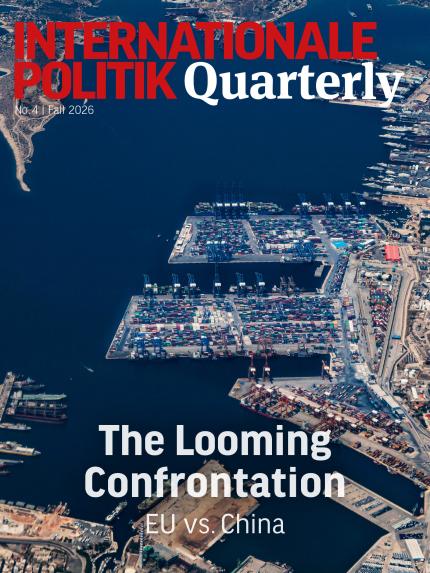
The best way to become less dependent on transported oil and gas is to speed up the transition to renewable energy. But doing that affordably probably means turning to the Chinese supply chain, which in turn puts Chinese manufacturers in a stronger position. As the 2024 Draghi report says, Chinese competition—backed by substantial government support—represents a threat to the EU’s flagship clean tech and automotive industries.
That has pushed the EU to roll out plans for an Industrial Accelerator Act, a bid to dole out subsidies on a bigger and better scale than past patchwork protectionism. Tradeoffs were on full display even before the proposal went public—an early leaked draft got blasted for being too euro-centric at the cost of alienating trading partners and cross-border opportunities. After a few weeks of delay, the European Commission put forward a starting compromise that allows trading partners like the United Kingdom and Japan to have the same access as EU member states to key public investment.
The new plan’s broader approach does a better job of prioritizing a friendly supply chain over trying for the impossible goal of full independence. Trade scholars at Bruegel call this strategy “Made with Europe” instead of “Made in Europe,” and the plan pairs it with preferences for low-carbon investments. The accelerator act aims to boost manufacturing’s share of the EU economy to 20 percent by 2035—yet many manufacturers are unconvinced.
VDA, the trade association for German automotive companies, slammed the plan as yet another attempt to force change through regulation instead of more materials partnerships and free trade agreements. The car makers are not interested in local content requirements or special treatment for small electric vehicles. They would rather cast their supply chains more widely and look for new customers, so Europe can counter US President Donald Trump’s criticisms of too much exporting with even more exports.
Push and Pull
It is easier to say “no” than take a risk on something new. Unfortunately, Europe will have to start taking a few risks on its way to new achievements, and part of doing that will be gaining confidence in how to pick which risks to take.
Too often, European choices are framed as a binary tradeoff between safety and risk, like a switch that toggles between bank deposits paying 0.5 percent per year and a pile of scratch-off lottery tickets. Discomfort with risk too often means not engaging with the many options in play. To get the EU where it needs to go, politicians are going to have to be bolder about taking measured risks, so voters do not get fed up and vote in extremist change for change’s sake.
So far, the European Parliament is not making the tough choices on where to push forward, as legislators stall on letting key trade deals advance. When it comes to the deal with Washington, lawmakers can be forgiven for wanting to stall because of the Trump administration’s erratic and lawsuit-prone trade moves. Yet the European Parliament also delayed the EU-Mercosur trade agreement, which is already 25 years in the making. This is short-sighted—while the pact has not won over agricultural powerhouses like France and Poland, it creates a free trade area of 720 million people at a time when the EU needs non-US trading partners more than ever. The European Commission is moving ahead on a provisional basis, but ongoing political uncertainty is an extra burden.
Voters seem ready for governments to roll up their sleeves and get to work. After years of narratives, according to which citizens were sick and tired of the status quo and ready to take a chance on populism, national storylines have swerved toward the practical.
In Denmark, Prime Minister Mette Frederiksen called a snap election, which was held on March 24, to cement her centrist coalition, after building support in her handling of the showdown with Trump over Greenland. She won—but now faces tricky coalition negotiations. Meanwhile in the Netherlands, liberal Prime Minister Rob Jetten took office in February, after his party’s surprise win in October elections. Greece, the eurozone’s former fiscal catastrophe, is now outperforming its peers and has seen its finance minister, Kyriakos Pierrakakis, take charge of the Eurogroup.
Even in polarized big countries, pragmatists seem at least tied with their populist rivals. Polls in France appear split roughly 50-50 between the far-right Rassemblement National (RN) and the centrist parties. In Germany, Chancellor Friedrich Merz’ popularity has been falling domestically, as voters in Baden-Württemberg narrowly chose the incumbent Greens over his center-right Christian Democrats (CDU) and put the far-right Alternative für Deutschland (AfD) in a robust third. This suggests that voters are open to a progressive alternative and not just taking refuge in nationalism.
Hope and Headwinds
For all of the challenges ahead, the EU economy so far has shown remarkable resilience. It has pulled through the COVID-19 pandemic, weaned itself off Russian gas, and weathered the Trump administration’s tariff tantrums. Up until the attacks on Iran, inflation seemed well contained, and leaders were at least trying to figure out a productive way to do business with China. While the war in Ukraine has dragged into its fifth year, the EU has so far been steadfast in providing regular financial support, and the SAFE program has opened the doors to jointly financed defense investments.
Still, many national barriers remain, from Poland’s internal conflict over accepting the EU loans to Luxembourg’s stalwart opposition to joint financial-market oversight. It will not be enough for leaders to agree to big changes in principle—the big goals will have to evolve into concrete plans without getting too watered down in the process.
The hardest thing may be deciding where to start. Yet crises keep coming, even if it’s not clear yet which ones in which order. Europe is stronger together than any of its members on their own. It is time to put more faith in the future of the single market, despite the comforts of the status quo. Even if leaders don’t yet know which challenge will escalate first, they know enough to prepare.
Rebecca Christie is IPQ’s Brussels columnist and a senior fellow at Bruegel, the economic think tank.