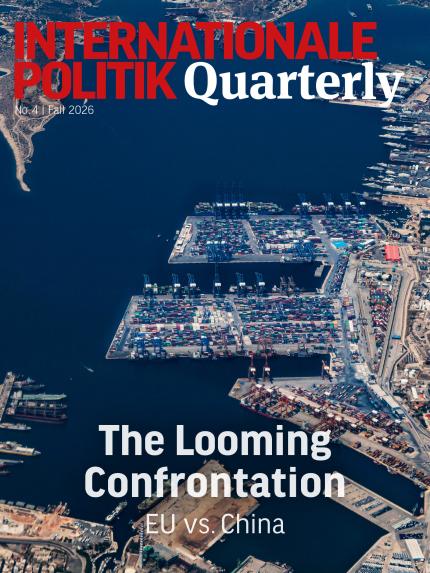
Europe received two warnings in 2025 delivered in Munich. The first was US Vice President JD Vance’s speech at the Munich Security Conference which underlined the risks to European security. The second was about the future of European industrial competitiveness, and it arrived with Chinese license plates. At the Internationale Automobilausstellung (IAA), the famous German automobile show, 14 Chinese carmakers and around 100 Chinese suppliers filled the halls—double the numbers of 2024.
While European carmakers are visibly fighting back, innovating faster, cutting costs and jobs, Chinese electric vehicle (EV) firms have already recovered their market share in the European Union’s market despite the tariffs raised last year. In July 2025 alone, they exported three quarters of a million vehicles worldwide, at an annual pace of nine million. In China’s luxury segment, German icons are slipping fast: Mercedes sales fell 14 percent, BMW 15.5 percent, and Audi 10.2 percent in a single year.
Volkswagen, Audi, Ford, and Daimler Truck shed 90,000 jobs in the past year; Bosch, Continental, Schaeffler, and ZF another 25,000. And from ThyssenKrupp to Philips to Nokia, the picture looks equally grim across the European Union. Not all of this is China-related, but the imbalances and competitive pressure from China are playing a key role in shaping Europe’s economic future. Trade, investment, and innovation figures tell a similar story: In August 2025, China bumped Germany off the Top 10 list of most innovative nations. German and European exports to China are in free fall, while imports from China continue to rise.
This is not just about a trade fair or symbolic changes anymore. Chinese cars, the rapid reversal in industrial and innovation fortunes, and trade relations stand for a systemic challenge sending shockwaves and producing turbulence. China’s rise hollowed out American manufacturing. Europe was cushioned, its exports of machinery, chemicals, and cars buoyed by Chinese demand. This time, Europe stands directly in the line of fire. The overlap between China’s growing strengths and Europe’s industrial core is bringing a new era of competition and collision for Europe-China relations. The political adjustments in Europe might, however, be as profound and challenging as the populist-nationalist turn in the United States over the past decade, driven by the China shock.
Brute-Force Development
The source of this challenge lies in China’s political economy. After the global financial crisis, Beijing step by step distanced itself from any semblance of convergence with the West. Instead, President Xi Jinping has steered the country onto a path centered on security-driven state-led industrial mobilization.
This model rejects the idea that household consumption and services should anchor and secure long-term growth. Instead, it relies on directing capital into manufacturing, advanced technologies, and strategic industries. Banks funnel cheap loans to state-anointed firms. Local governments sustain production even when demand falters. Private investors, blocked from property speculation and consumer internet ventures, are nudged into industrial projects. The outcome is predictable: production on a scale never-seen before, consumption suppressed. Also, there is a focus on effective competition on a global scale, not micro-level efficiency and macro-level productivity.
Beijing calls this approach a “new type of all-of-nation system.” A more accurate description is brute-force development by innovation and production at any cost. China tolerates inefficiency and collapsing margins as the price for building capacity and climbing technology ladders. In this system, profitability matters less than survival. The Chinese Communist Party’s (CCP) calculus is geopolitical as much as economic: Dependence on foreign inputs must shrink, Chinese champions must expand, and strategic resilience must rise.
Two Chinas
On the surface, we see a slowing giant weighed down by debt and demographics. Growth has slowed, debt has soared, and demographics are turning sharply against it. Local governments are weighed down by liabilities, households face weak social protection, and consumption remains unusually low relative to GDP. The property sector, once a pillar of growth and household wealth, has entered prolonged decline imposed intentionally by a crackdown on that sector.
And yet, China’s industrial machine continues to deliver. Entire ecosystems have been built within a decade. Electric vehicles, solar panels, and batteries dominate global markets. Shipbuilding orders flow disproportionately to China’s state-owned shipbuilding monopoly. Robotics, once peripheral, is now an area of serious competition. Even in machine tools, the foundation of industrial capacity, China has moved from being a net importer to a net exporter.
This tension—macro weakness paired with engineering success—is at the heart of the new risks. China may look unstable from a financial and increasingly even societal perspective, but its companies are able to compete globally because profitability is not a constraint. Technological advances, subsidies, state credit, and sheer scale keep them alive. For European competitors, this is the worst of both worlds: A slowing Chinese market no longer delivers high margins for European investors and exporters but also generates rivals that can survive without profits and continue to expand in distorted conditions.
A Growing Shadow of Industrial Might
This did not happen overnight. A decade ago, Beijing launched Made in China 2025, a program that openly declared the ambition to dominate future industries. Ten priority sectors were identified: energy, semiconductors, automation, new materials, aerospace, medtech, and others. The plan mobilized 1 to 2 percent of GDP annually in subsidies, credit, and tax breaks. More importantly, it signaled a transition from fragmented industrial policy to a massive, centralized push.
The label “MIC2025” disappeared after international pressure, but the strategy remained. Today it has been folded into Xi’s concept of “new productive forces,” which emphasizes intelligent, green, and high-quality industry across the board. The Central Science and Technology Commission, created in 2023, now directs science and technology policy directly from the CCP center. Huawei has become the model “spider in the web,” orchestrating ecosystems from semiconductors to artificial intelligence (AI). Substantial funds are flowing into robotics, AI, and biotech, seen as strategic pillars for the next decade.
The results are uneven but impressive. Import dependence has been reduced dramatically in many areas. Chinese suppliers dominate their home market and increasingly push abroad. In areas like semiconductors, biopharma, and high-end medtech, weaknesses remain, but even there the trade balance with Europe is shifting. The broader trajectory is clear: China is not waiting for market forces to deliver competitiveness, and where it cannot overcome European quality, it can outcompete through razor thin margins.
Overcapacity Machine
China’s political economy runs on output. In sector after sector, supply outpaces domestic demand. Factories continue to run because local governments fear layoffs more than losses in a system that prioritizes stability above all. Banks keep lending because political directives matter more than balance sheets. Investors channel funds into manufacturing because property and consumer tech have been closed off and China’s closed capital account makes it hard to pursue returns overseas. The result is chronic overcapacity, sustained year after year.
The Chinese term neijuan—which means “involution” or excessive, ruinous competition—captures the domestic side of this dynamic. Companies compete to grow market share, whatever the cost if possible, but to simply avoid death where necessary. Prices fall, output rises, and productivity gains are offset by waste. In Europe, involution takes another form: cheap imports undercutting firms that cannot match prices distorted by subsidies as they are legally required to maximize shareholder value. Firms may keep selling but at shrinking margins, which is not sustainable, but can wreck a lot of havoc before reaching its limits.
China’s leadership does not see this as failure but as a management challenge. Profitability and return on investment are irrelevant, the industrial base must continuously expand. Overcapacity is not a bug, but a feature. From Beijing’s perspective, exporting deflation is a way to gain market share abroad, while maintaining social stability at home, even at the cost of what liberal markets see as grossly inefficient allocation of capital.
For Europe, the spillover is unavoidable. Excess Chinese output pours into foreign markets, depressing prices globally, which subsidized Chinese firms can endure where market-bound private European companies cannot. Europe’s single market becomes a release valve for China’s distortions. Steel, shipbuilding, solar panels, and aluminum were early casualties. Today, the wave is moving into advanced areas: electric vehicles, batteries, industrial machinery, IT equipment, medical devices, and chemicals. In the coming years, electrolyzers, new materials, and advanced pharmaceuticals may follow.
The pattern is unmistakable. Every time China directs resources into a sector, global prices fall, margins collapse, and foreign competitors are forced to retreat and leave their market share to Chinese competitors. This is not the cyclical overcapacity of old industries. It is structural, embedded in China’s new model of development.
Sectoral Pressure
The impact is already visible in Europe’s core industries. The German machinery sector, long regarded as impregnable, now sees Chinese competitors closing in. At trade shows in Beijing and Shanghai, European exhibitors report that Chinese companies are rapidly catching up on quality; and the European brands find themselves frequently outpriced by local rivals. In machine tools, Chinese exports now exceed imports. In robotics, domestic suppliers already command nearly half the home market, and Beijing is aiming for 70 percent. The sector’s comfortable lead is shrinking rapidly, and aside from the cutting edge, they are losing market share in key cash-cow lines of business.
Chemicals face a double squeeze: high energy costs in Europe and subsidized competition from China. Chinese producers benefit from scale, cheaper inputs, and state support, especially as most are state-owned. Exports of basic chemicals and intermediates are growing, undermining European firms’ profitability at a moment when they are also adapting to stricter climate regulations.
Medtech and pharmaceuticals show similar trends. Chinese firms, supported by procurement policies and enormous patient data pools, are building capabilities in diagnostics, imaging, and biotech. European firms still dominate the absolute high-end, but their margins are under pressure, innovation cycles are in overdrive in China, and its trade deficit is narrowing.
China accounting for nearly one third of global manufacturing value added also creates “virtuous cycles” in key industries. Industrial upgrading policies drive resources to manufacturers to upgrade their production. That guarantees demand for industrial machinery and robotics plus IT hardware and software providers to implement smart manufacturing systems that further boost production.
Automotive Frontline
No industry illustrates the new dynamic more clearly than automotive and its value chain. For decades, Europe’s premium carmakers dominated the Chinese market, even under joint venture restrictions. They supplied engines, technology, and brand prestige. Today, the tables are turning. Chinese firms control 90 percent of the EV market at home. Foreign brands are squeezed by brutal price wars fought by over 100 Chinese EV makers whose losses or low margins are sustained by local subsidies. As consolidation looms, it may be foreign players that lose most, lacking the state support their Chinese rivals enjoy.
At home in Europe, the same firms are facing direct assault. Chinese EVs are arriving not only cheaper but often more advanced in digital integration and battery performance. Start-ups such as Xiaomi, which once made phones and appliances, now set speed records on German tracks. Established giants like BYD scale production across multiple continents simultaneously in highly verticalized supply chains. For Europe’s automakers, maintaining market share is the current goal. But left unchecked by European policy intervention to level the playing field, some European firms may face existential crises competing with China’s very economic model and the business models of Chinese firms adapting to that system.
Third-Market Battlegrounds
The story does not end in Europe. China is also reshaping competition in third markets, where European firms once had strong positions. In Africa, Latin America, and Southeast Asia, Chinese companies arrive with a full package: cheap products, state-backed financing, infrastructure support, and diplomatic engagement. European firms lack this kind of “one-stop-shop” dynamic, as building such a model would run contrary to EU rules and norms.
Chinese electric vehicles are now being sold in Brazil, South Africa, Indonesia, and Thailand at prices European firms cannot match. Solar panels dominate projects across Africa and the Middle East. Battery producers are setting up plants in Southeast Asia to secure supply chains and access local markets. In telecommunications, Chinese equipment forms the backbone of 5G networks across much of the Global South.
This global reach matters. It is not just about sales lost in faraway markets. It is about the erosion of Europe’s economies of scale in those sectors, as well as its ability to set standards, shape ecosystems, and maintain influence in emerging industries. If Chinese firms dominate digital infrastructure and green technologies in the Global South, they will set the terms of the global digital and green transitions. European firms, squeezed at home and outpaced abroad, risk losing not just markets but relevance.
China’s Price Vortex
China’s rise impacted US industry and jobs in ways American society and politics are still contending with. Europe was spared the worst because its strengths were complementary to China’s needs. German machinery, French chemicals, Italian luxury goods, Dutch high-tech, Scandinavian telecoms, and European medtech and pharmaceuticals all found ready buyers in China’s growth boom. The losses in European steelmaking, Italian and Spanish shipbuilding, and the impact of Chinese construction firms outbidding infrastructure procurement in Central and Eastern Europe all had negative impacts. But lower consumer prices, cheaper inputs, and lower costs were net benefits, at least in the short run.
Today, the sectors China is targeting are precisely those that European economies rely on: automotive, machinery, chemicals, medtech, advanced materials, and more. The competition is no longer about low-end manufacturing. It is about who leads in the industries that define advanced economies.
European firms are increasingly caught in China’s “price vortex” where its economic model churns global market and spiraling prices and loss-making engulf competitors, plunging them downward in a race to the bottom dynamic.
The immediate risk is disruption, followed by erosion and displacement. Even when European firms keep market share, they do so at prices set in distorted markets. Profitability falls, investment slows, and competitiveness weakens over time. Suppliers across Europe, particularly SMEs, feel the pressure as their multinational customers lose ground in China and at home. The social consequences could be profound. Stronger welfare systems may cushion job losses, but prolonged industrial decline would fuel political discontent and erode the very social safety net that made the first China shock more tolerable for Europe.
Europe’s Strategic Dilemma
Europe cannot expect China to change course. Xi Jinping has declared his model superior, not flawed. Overcapacity and distortion are deliberate outcomes of brute-force development. That leaves Europe with difficult choices.
One option is to remain open, trusting in adaptation and resilience. The strength of Europe’s firms, combined with its social model, could in theory absorb the shock and perhaps outlast Beijing’s model, which is likely to be unsustainable in the long term. But this risks too many losses before adaptation pays off, assuming it ever does. Key industries could be hollowed out in the meantime.
Another option is to shield and support aggressively. Trade defense instruments, anti-subsidy tools, procurement reciprocity mechanisms, and investment screening could slow the inflow of distorted competition. The EU’s most strategic sectors might receive state support to rebuild and preserve capacity. But this approach carries immense risks, from simple failure to retaliation, including via China’s weaponization of rare earth dependencies, from higher costs to a further fragmentation of the global economy. Protection may buy time, but it cannot substitute for competitiveness.
A third path is to balance: defend the single market where distortions are clearest, support industries where Europe must maintain capability, and push for fair competition in third markets through alliances and new trade agreements, and faster ones that tolerate imperfection to get them in place now rather than later. This approach requires coordination, resources, and political will. It also risks half-measures if consensus proves weak—which is likely.
None of the options are cost-free. Staying open risks decline. Shielding risks confrontation. Balancing risks ineffectiveness. The choice is not between good and bad but about who bears the costs.
The Franco-German Dimension
Any European strategy must reckon with internal divergences. Many EU member states will prioritize Chinese investment, specific export opportunities, and reliable supply chains over painful hardball trade policy. While France and Germany share an interest in preserving industrial capacity, they diverge on tactics. France favors strategic autonomy and state support. Germany, with its export-oriented economy, is more cautious about confrontation but increasingly alarmed by the direct assault on its machinery and automotive sectors.
Yet without Franco-German alignment, Europe cannot act at scale. The divergence on trade defense measures in the automotive sector illustrates the challenge. The machinery sector is next in line. German producers face Chinese competition head-on, and their survival is not just a national interest but a European one. If Europe fails to defend its machinery base, its entire industrial ecosystem is at risk.
What Europe cannot afford is drift. A reactive approach, waiting for crises before acting, will ensure the worst outcomes. Industrial erosion will continue, third-market influence will shrink, and political fallout will grow. A proactive approach, by contrast, allows Europe to shape its own trajectory, even if it cannot eliminate the challenge. But taking the time to develop precisely calibrated options will mean they come into force too late.
Implementing Draghi
Eleven percent. That’s the share of recommendations in the “Draghi report on competitiveness” the EU had been able to tackle more than one year after the report was published. That’s a recipe for failure. The EU needs not just a strategy for geoeconomic survival but rapid action, as China will continue its brute-force development and the US is reassembling the foundations of its power from energy to finance to rare earths.
To do so, Europe must continue to build on its own strengths: EU scale, conditional openness, rule-shaping, and a hyper-focus on innovation, talent, and education. Those strengths need reinforcement and a much higher degree of political energy and speed of responses across the continent.
Europe’s industrial support cannot simply mimic China’s approach. Its advantage could lie in a smarter policy mix: competitive allocation of funding, strategic use of public procurement to create early markets, and targeted backing in areas where scaling up is essential. Such measures must be evidence-based, transparent, and strictly time-limited. They should avoid capture by special interests and be subject to regular evaluation. Successful industrial policy in Europe is not about shielding firms from competition, but about shaping the framework conditions in which competition can drive innovation and efficiency.
A European strategy would have to build on a more complete single market—similar to China seeking to unify its market further. It would invest in Europe’s own productivity—through financing models, regulatory reform, and integration of market—so that European firms can compete on quality and innovation. It would support strategic industries not by shielding them indefinitely but by helping them invest, innovate, and scale. And it would require coalitions beyond like-minded countries to shape new markets and resilient supply chains.
A Narrowing Window
The shocks and turbulence emanating from China’s economic policies are already reverberating through Europe’s factories, boardrooms, and communities from Ludwigshafen to Wolfsburg, Lyon to Milan. The question is no longer whether the Europeans will feel the shockwaves, but how they choose to absorb and respond to them. The competition between Europe and China is about a clash of economic models and structures. One side pursues scale through state mobilization, tolerating inefficiency and losses to build capacity. The other depends on profitability, rules, and shareholder responsibility.
Europe still has choices. It can act proactively, defend its market, invest in innovation, support its industries, and engage globally. Or it can drift, hoping that adaptation will suffice. The window for action is narrowing, and the lesson is simple: Europe cannot rely on China or the United States to change. It must rely on itself.
Jacob Gunter is head of the Economy and Industry program at the Mercator Institute for China Studies (MERICS).
Mikko Huotari is director of the Mercator Institute for China Studies (MERICS).