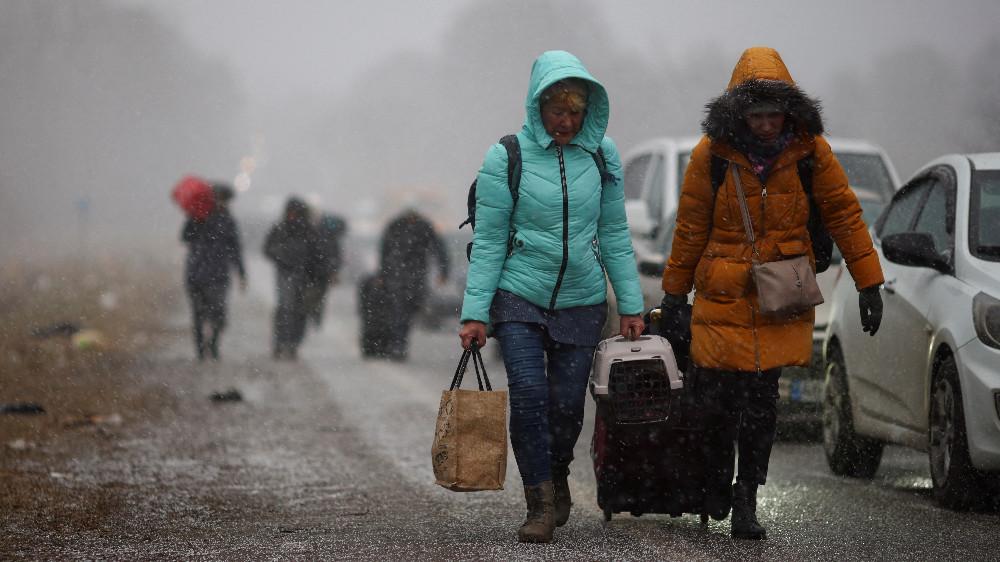
Russian President Vladimir Putin's war machine is not only advancing on three fronts, bringing death and devastation to Ukraine, it is also attacking the entire free world and civilized humanity as a whole, head-on, with its military assault on a peaceful democratic country.
The nightmare in which we now find ourselves is particularly bitter because it was foreseeable—and avoidable—a long time ago. The catastrophe that has, first and foremost, befallen Ukrainians but which, indirectly, also affects Europe as a whole, reveals an epochal failure on the part of the West.
Ever since the violent annexation of Crimea eight years ago, and the occupation of parts of the Donbass by Russian hybrid forces, there could be no doubt about the aggressive character of the Putin regime and its neo-imperial ambitions. Although there is now no shortage of commentators who supposedly knew better all along, too few voices spoke up early on to warn of the full scale of this threat and to call for appropriate preventive countermeasures. Nor is there a shortage of politicians who are beating their chests because they wish they had recognized that they were too naive in regard to Putin.
Founded on Illusions
The politicians were not only naive, they actively turned away from more substantial insight that had been available for a long time. Western governments, especially Western European governments, clung for dear life to the grand political delusion that Putin's Russia was, despite everything, a potential security partner, only temporarily at sea, that could be reintegrated into constructive cooperation through persistent “dialogue.” The concept of the Minsk agreements and the “Normandy format” was based, not least, on this illusion. Putin has always regarded negotiations as only a tactical means of buying time, which he needed to prepare for even more brutal aggression.
In Syria, the West stood idly by as Putin's air force destroyed a country's livelihood through targeted bombardments of its civilian population and civilian infrastructure at the front line. At the same time, Moscow used the Syrian war as a testing and development ground for increasing its military technological clout. But Western politicians and the public quickly lost interest in these genocidal actions. We mistakenly believed that these events, in the already bloody and confusing Middle East, were really none of our business, here in the safe West. But with a view to Syria, it was already possible at that time to guess what might be in store for Ukraine—and what now actually awaits it.
Inadequate Response
The West accepted the establishment of terrorist regimes, which practice systematic torture, in the illegal "people's republics" of Donetsk and Luhansk. They also accepted the brutal crushing of the Belarusian opposition and the de facto incorporation of Belarus into the Russian Federation, under the direction of Moscow.
None of these actions could persuade the European Union to impose tougher sanctions on the Kremlin regime or to take precautions against foreseeable further aggression. Meanwhile, Putin drove his country toward a totalitarian dictatorship by expanding his authoritarian state structure and enmeshing the public, who are vital to his ability to carry out his monstrous warlike projects.
Even in recent months, when Putin massed his invasion forces on the Ukrainian border and made ultimations to NATO, the fulfillment of which would have amounted to abandoning itself, the West proved incapable of responding adequately. Instead of immediately imposing harsh punitive measures, it was considered sufficient to inform Putin that measures would only be carried out in the event that he openly attacked Ukraine.
Such announcements do not impress the Kremlin autocrat, nor do patient attempts at persuasion. He is only impressed by painful counterblows he actually feels. This means that the first tough sanctions against the aggressor should have been imposed immediately, instead of waiting until the Russian army and air force began their devastation of Ukraine.
After all, even the massing of invading forces on the border of a neighboring state, and the corresponding threats of belligerent force, were a blatant violation of the UN Charter and international law.
Disastrous Miscalculation
Ukraine's military defense capability should also have been massively strengthened by the delivery of state-of-the-art weapons systems—particularly in air defense and coastal protection. What the United States in particular and, to a lesser extent, some European states did on this front was not enough. Germany, however, stubbornly refused to do anything of the sort. The German government remained trapped in the erroneous maxim that supporting Ukraine with weapons would only "add fuel to the fire."
However, the idea that Putin could be appeased by depriving his victim of the means to defend themselves—along with NATO protection—has long since proved to be a fatal miscalculation. The policy that followed this perverse logic has produced the exact opposite of what was intended. This late realization was made clear in the actions of both Germany and the European Union this weekend.
Putin has proclaimed the "demilitarization" and "denazification" of Ukraine as the goal of his criminal war of aggression. In plain language, this means the smashing of the Ukrainian state, the installation of a puppet government in Kyiv and proceeding with murderous repression against the representatives and defenders of free Ukraine.
That Putin uses the language of anti-Nazism and the "Great Patriotic War" against the Nazi occupation of the Soviet Union in World War 2, is the height of demagogic perversion—coming from the mouth of an autocrat who finances and ideologically arms right-wing extremists and neo-Nazis in Western Europe, and who copies Hitler's methods in his bellicose aggression.
Delusion and Arbitrariness
We are Ukraine. Putin is already threatening to attack anyone who stands in the way of his criminal campaign. In doing so, he is increasingly drifting into the delusional world of his fantasies of omnipotence—and we must now finally reckon with all he can throw at us, including an attack on NATO countries. And much more: He will not rest until he has completely destroyed the existing international order and replaced it with a situation in which no law applies except the law of the strongest; in which there are no longer any values, norms, and rules that set limits to the arbitrariness of his criminal rule.
Putin does not want "security guarantees" and certainly not peace. He wants war, because it is what his rule is based on. In order to thwart him, the West must now make him feel the full weight of its power. Putin's Russia must be completely isolated both politically and economically, its access to the international financial system must be cut off, all trade relations must be suspended if possible and talks with the Russian regime, at a higher level, may only take place on the condition that it immediately ceases its war against Ukraine. Until this happens, Ukraine needs a massive supply of military equipment from the West for its self-defense. The announcement by the European Union on Sunday that it would send such equipment, including fighter jets, is a good start.
It is time for Western democracies to have a radical rethink. We need to finally understand that we are once again dealing with at least one enemy who is determined to destroy us and whom we must contain, with all our might, if our democratic freedoms are to have any future.
Richard Herzinger, a former columnist with German newspapers including DIE ZEIT und Die Welt, now writes at https://herzinger.org.