The situation in the Middle East has become dire—and with it the imperative for Europe to act has grown.
Fortunately, there’s no need for the European Union “Aspides” naval mission to charge into a conflict with the Houthis over the Bab el-Mandeb or join the US blockade of Iranian ports. With Iran and the United States locked in a mutually damaging stalemate, a measured push from the Europeans at the center of gravity—the Strait of Hormuz—could tip the parties toward a settlement.
Exploiting Iran’s demonstrable fear of pulling Europe into the war, France and the United Kingdom could launch their long-planned maritime mission to the Strait, without exposing crews to intolerable risk. Indeed, British and French vessels have already provided vital assistance in the demining of the Strait—in the face of explicit Iranian threats—without incurring reprisals.
Deploying their vessels as a “fleet-in-being”—a classic naval posture with latent, lethal potential—the Franco-British-led mission would confound Tehran. Unlike its mounting attacks on American ships, regime strikes on a non-belligerent European fleet incur a different risk: It would propel the Europeans into full partnership with the United States, which would be a disaster for Tehran’s core strategy of isolating Washington.
Instead of supporting the US Navy, Paris and London could instead act in measured solidarity with their Gulf state partners, including the beleaguered Saudis, who are braving the perils of Hormuz. As crossings continue, and as Iran’s revenue dries up from the dwindling oil outside the blockade, pressure will build within the divided regime to negotiate an end to the standoff. The Europeans will be regarded as a credible partner for both the US and Iran, able to mediate without appearing to be forcing Tehran to capitulate.
A Formidable Protagonist
For the Iranian regime, Europe is a formidable protagonist: both a principled critic and loyal ally of the US; a strategic partner of Gulf states, devoted to preserving the rules-based order; and a non-belligerent maritime power with assets and experience directly relevant to opening the Strait. Threatening European states—as Iran did recently in the case of Bulgaria over its permission for US use of its Bezmer air base—swiftly raises the specter of NATO engagement. Allied intervention in the Gulf, or even individual state participation in the US blockade, would shatter the regime’s framing of the conflict as a heroic, bilateral struggle against a trapped American aggressor.
So anxious is Tehran about Europe that mere condemnation of Iranian attacks on ships in the Strait has drawn stern warnings from regime officials. In May, Deputy Foreign Minister Kazem Gharibabadi fulminated against “any [European] deployment … around the Strait.” Asserting Iran’s unilateral authority over the Strait “in times of peace or war,” Gharibabadi thundered, “the presence of French and British warships … will be met with a decisive and immediate response from the armed forces of the Islamic Republic of Iran.”
Shrugging off the threat, on July 3, Paris and London announced an agreement with Oman to ensure that its sovereign waters are safe for navigation. This marked a breakthrough with Gulf states, which had hesitated to partner so visibly with the Europeans. French, German, and British vessels soon launched, including the Royal Fleet’s Lyme Bay, a “specialist mine-hunting” ship with ”diving/explosive ordnance disposal experts” aboard. In an under-reported operation that took place during July and August, French and British divers aided Oman in the perilous, painstaking “milestone” of removing Iranian sea mines from the southern transit routes in the Strait.
Despite Gharibabadi’s renewed “serious warning” that France and the United Kingdom “bear responsibility for the consequences of their adventurism [on behalf of Oman],” the two European powers didn’t suffer any attacks for their demining role. And rather than punish Oman, Iranian diplomats restarted Hormuz management talks with Muscat, which the Revolutionary Guard had halted.
Unwilling to back up his prior threats, Gharibabadi has now issued a new one: "If the [latest] agreement [with Oman] becomes binding, no military vessel will be allowed through the Strait of Hormuz . . . No military vessels whatsoever.” Blatantly contrary to international law, this blanket prohibition violates even Iran’s own, restrictive innocent passage interpretation of the rules governing the Strait, which grants all ships, including warships, right of traversal.
The implications go beyond tolls. If the ban on military vessels goes forward, the naval forces of Iraq, Kuwait, Bahrain, and Qatar “would lose access to the sea.” Despite having its own territorial waters in the narrow Strait, Oman will come under constant pressure, during negotiations with Iran and during implementation.
Countering Iran’s Bid for Hegemony
Iran’s renewed bid for hegemony over the Strait of Hormuz, along with the burgeoning crisis over the Bab el-Mandeb, present France and the UK with a choice. Holding back will leave their Gulf partners to suffer under chronic duress. By contrast, the successful collaboration with Oman, the United Arab Emirates embargo on Iran, and the intensive Saudi effort to restore its oil flow, invite the deployment of the maritime initiative. Armed with the legitimacy that the Trump administration lacks, the Europeans could restore international law to the quest for freedom of navigation in the Strait, boosting the position of Oman in talks with Iran, and scrambling interplay within the regime.
As Iran has rejected outright any European naval presence, Paris and London could alter the dynamics around the Strait by assembling a fleet-in-being. This time-tested naval stratagem draws on the potential and versatility of sea power to shape what adversaries do—without direct confrontation. Poised but not passive, the fleet-in-being possesses the strength and positioning to intervene, compelling opponents to constantly watch and ready their forces to respond.
If it were anchored off the Musandam Peninsula of Oman, the expanded European maritime mission could alternately loiter and maneuver, awaiting the right moment to conduct operations in support of free movement in the Strait. Rotating their vessels frequently with occasional port calls in Djibouti (France) and Kenya (the UK) will avoid the overextended deployments currently burdening the US Navy. Tehran, and its Houthi partners, risk antagonizing Beijing by attacking the concentrated docks in Djibouti, used by both Chinese and French vessels. The port facilities used by the British in Mombasa lie beyond the reliable range of Iranian rockets.
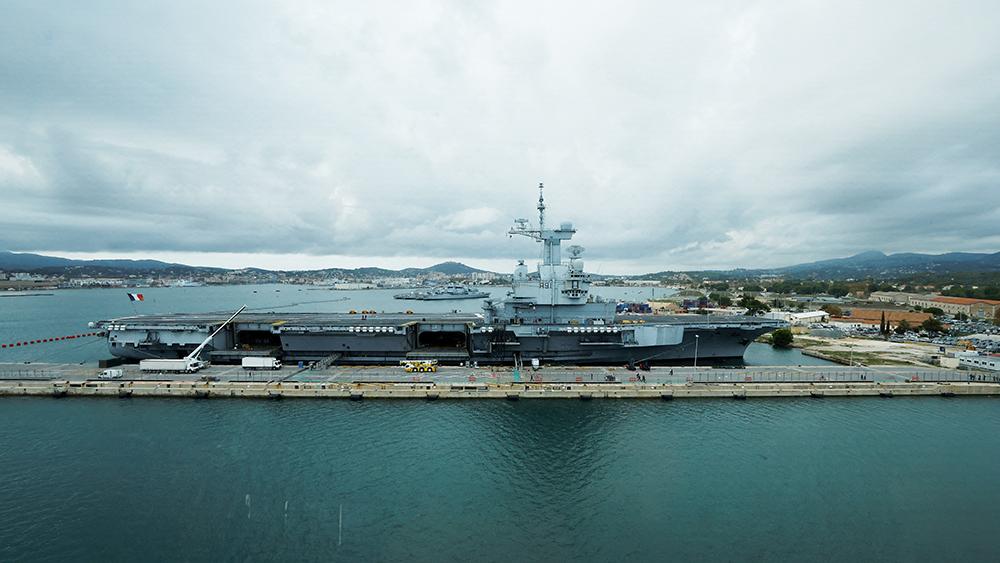
The random movements by the fleet, including occasional withdrawal from the opening of the Strait, would deny Tehran the ability to claim it has driven Europe away. Revolutionary Guard commanders, already preoccupied with US military harassment, would incur an additional stressor, tracking the movements and feints of the European vessels. If bolder, “expressive force” were necessary, France could recall to the theater its aircraft carrier, the Charles de Gaulle.
Formally, the current EU “Aspides” mission covers operations in the Strait and has already absorbed non-EU states from the prior “Agenor” maritime initiative. This means that Asian nations like South Korea, under heavy US pressure to support the effort in the Strait, could participate. The broader the composition of the flotilla, the more daunting the risks to Iran from a violent response. A regime attack could shift the global calculus, including in China, once the conflict loses its exclusive, Iranian-American character.
Yet failing to repel the Europeans would further erode the regime’s credibility, just as Tehran is about to proclaim a new “restricted zone” outside the Strait—on top of its prohibitions inside the waterway. With perceptions guiding the struggle over Hormuz, Tehran’s inability to enforce its absolutist boasts and threats would cost the regime, spurring more commercial shippers to test the southern routes.
Psychological leverage would translate into political leverage, as pragmatists in Tehran gain sway, blaming the rigid hardliners for the introduction of other Western actors. With direct communication channels to Tehran, French and British settlement proposals would find purchase. Pro-negotiation factions could argue that an agreement brokered and co-signed by the two European permanent members of the Security Council is far more likely to endure through the Trump presidency, than a deal with the Americans alone.
The Rising Cost of Inaction
Given reports that Tehran is already eyeing US targets in Europe, Paris, London, Berlin, and other European capitals might stay wedded to a “permissive environment” as the condition for deployment. Iran has already struck British positions several times, including on the territory of EU member state, Cyprus. Also in March, Iran launched two missiles some 2,500 miles toward UK-US bases on Diego Garcia.
That unforeseen range underscores the countervailing risks—including in Ukraine—of failing to assert a meaningful European role in the Iran-US impasse. The stunning disclosure that Russia has been helping Iran develop supersonic cruise missiles lays bare the expanding partnership between the regime and the Kremlin.
In Russian President Vladimir Putin’s warm meeting in Bishkek this month with Iranian President Masoud Pezeshkian, he broached Moscow’s interest in sustaining the Middle East war as a means of advancing Russian goals in Europe. Depleted stocks of US missile interceptors, due to transfers to the Middle East, have enabled Moscow to strike Ukrainian cities at will, while raising fears that an emboldened Kremlin will advance hybrid and kinetic attacks in Europe.
In sum, the Europeans no longer have the luxury of “letting the Americans deal with the Iran problem they created.” They hold shared interests with the US in the outcome of the conflict—and independent capacities, relationships, and values that make intervention from the continent viable. A calibrated Franco-British maritime mission, taking advantage of vulnerabilities in Tehran, may be the best way of bringing the regime to port.
Edward P. Joseph is lecturer and senior fellow at the Merrill Center for Strategic Studies/Foreign Policy Institute at Johns Hopkins School of Advanced International Studies (SAIS).