
The headlines have become eerily familiar by now: Come summer, and France breaks a temperature record; then Germany; then the United Kingdom; then Spain.
As the world’s fastest warming continent, Europe remains profoundly unprepared for the extreme heat that lies ahead. The scorching sidewalks of Berlin, blistering bus rides of London, and torrid Metro trains of Paris exposed some of these vulnerabilities as infrastructure across the continent has, quite literally, buckled under this summer’s sweltering heat. However, the consequences of extreme temperatures extend well beyond damaged roads and disrupted trains. The scale of health impacts associated with this summer has demonstrated just how dangerous this new era will be.
To address the suffocating heat, air conditioning has emerged as an obvious intervention. Yet, across Europe the technology has become a proxy battle in a much larger climate-policy war. Nowhere is this more evident than in the public exchange between France’s far-right former presidential candidate Marine Le Pen and her hard-left opponent Jean-Luc Mélénchon. Le Pen’s Rassemblement National has adopted an expansive, but vague pro-AC stance. By contrast, Mélénchon, leader of La France Insoumise, has adopted a radically different posture toward the intervention, citing its environmental harm as the reason for his opposition.
It’s a good example of politicians engaging in the wrong debate. The question is not whether Europeans should cool their homes. They will. Instead, it should be what kind of cooling infrastructure needs to be built and whether Europe can use this transition to accelerate the realization of broader decarbonization goals.
The Heat Will Kill You First
Extreme heat is Europe's most lethal climate killer. In Germany, 14,000 heat-related deaths were registered this summer, while Spain and France recorded 7,300 and 4,500 excess deaths respectively. These staggering statistics reveal vast under preparedness across the continent. American environmental journalist Jeff Goodell’s predictions in his 2023 book The Heat Will Kill You First ring eerily true.
Casualties resulting from extreme heat can go far beyond just the impact of higher temperatures on health. For instance, increased aggression caused by soaring temperatures can lead to increases in fatal assault, as well as femicide—mortality incidences not currently captured in excess heat death statistics. Also obscured are the profound neo-natal consequences, with one study linking an additional 1° Celsius increase in temperature (above the 90 percentile) during the week preceding delivery to an increase of approximately four additional stillbirths per 10,000 births.
In addition to fostering violence, heat has also been shown to reduce cognitive functioning in young adults living in non-air-conditioned buildings—a concerning sign in an era of virtual work. There are also implications for those working in an office, suggesting that mild heat can impair team performance. Productivity losses are particularly pronounced in outdoor sectors, such as construction and agriculture, where exposure is prolonged, difficult to avoid, and extremely high risk for workers in the sector.
Most consequently, heat likely affects the long-term accumulation of human capital. Recent evidence has identified significant impacts on educational outcomes with children demonstrating lower learning, reading, pattern recognition, and memory outcomes, as well as even lower test scores on university entrance exams. These consequences can disadvantage already vulnerable children, as low-income families are less likely to have consistent cooling. The cumulative effects of prolonged heat exposure will not be fully realized until this generation of heat-exposed children have come of age.
A Climate Dilemma
While the impacts of heat on human wellbeing are impossible to ignore, there is still a significant cooling gap between the United States and Europe. The Europeans’ resistance to air conditioning sharply contrasts with the acceptance of the Americans, who have, for decades, normalized the presence of AC units in homes. Roughly 90 percent of Americans reported having AC, as compared to 23 percent of Europeans. The dearth in Europe is partly historical, but the climate that European infrastructure was originally built for no longer exists.
Air conditioning offers an obvious form of adaptation, but it also presents a climate dilemma. While AC protects people from rising temperatures, it can contribute to the very emissions that cause them. The true greenhouse gas emissions associated with an AC unit depend on many factors, including the unit type (room air conditioners versus central air conditioners), the product’s energy efficiency, the source of electricity (sustainable or carbon-intensive grid), and the product’s age. As such, AC has the potential to become a “maladaptive” solution in the green transition.
Given the urgency of the heat emergency in Europe, plug-in technologies that can be installed in residential and commercial buildings without significant infrastructure retrofits, tenant disturbances, or permitting processes are crucial. In key buildings, such as hospitals and schools, immediate interventions are necessary to protect those most at risk. Window-mounted or packaged terminal air conditioners—popular in the American HVAC model—are a natural champion in this sense, but their performance is limited and may present long-term barriers to Europe’s climate ambitions. Ultimately, this raises a question for European policymakers: What adaptation technology should governments promote to reduce heat-associated health risks whilst minimizing long-term climate harm?
Two Birds, One Stone
One technology that can simultaneously provide cooling relief and accelerate decarbonization objectives are heat pumps. Heat pumps in window-mounted or packaged terminal configurations are nearing commercial readiness in Europe and are capable of both cooling and heating interiors with higher efficiency than electric resistance heating systems in traditional HVAC designs. Heat pumps maintain interior temperatures by transferring heat from indoors-to-outdoors or vice versa. Heat transfer is inherently more efficient than heat generation via electric resistance, with conservative studies indicating heat pumps consume roughly 64 percent less electricity. Room heat pumps’ higher-efficiency cooling and heating services provide an opportunity to expand Europe’s cooling coverage while also contributing to the decarbonization of building heat.
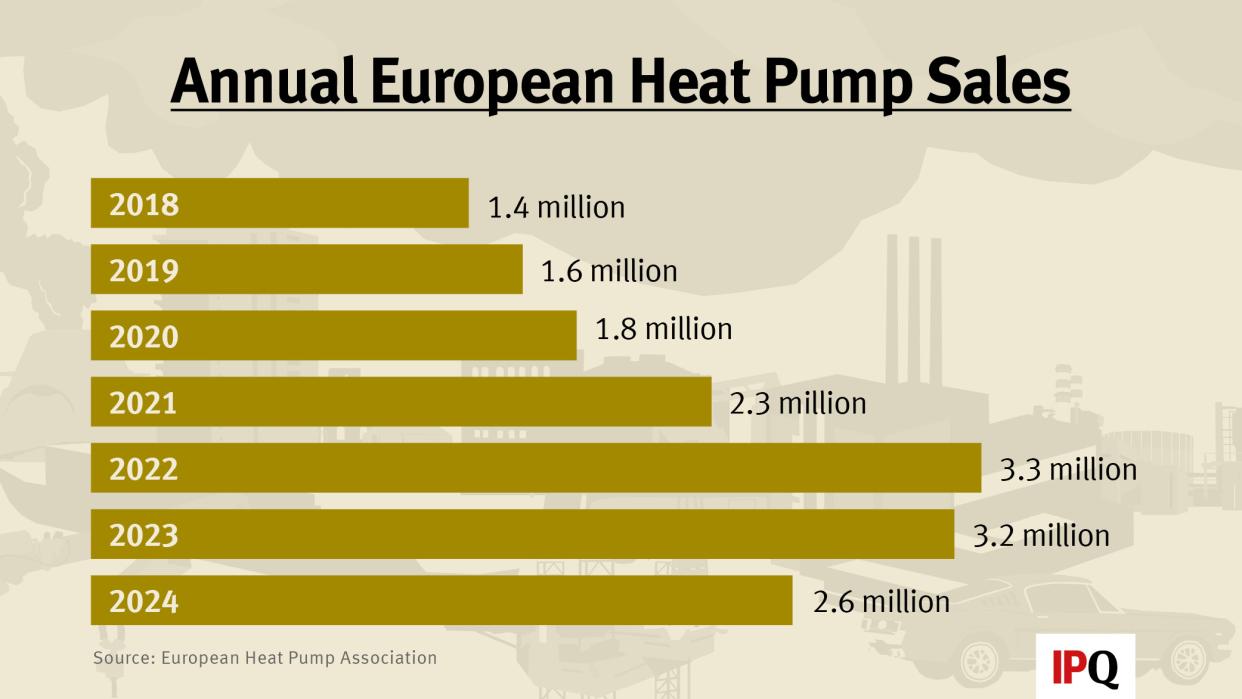
What’s more, Europe is a frontrunner in heat pump installation, with 7.3 million heat pump units sold across the continent in 2025 alone. Norway is a national leader globally, with over 60 percent of the country’s households equipped with a heat pump, of which 93 percent are air-to-air models—the technology used in window-mounted and packaged terminal devices. Across the Nordics, air-to-air heat pumps account for 21 percent of primary heating in Finland and 11 percent in Sweden. France and Italy led European heat pump sales in 2025, with 528,000 and 423,000 units sold, adding to existing stocks of 7 million and 5 million, respectively. Air-to-air units account for roughly 50-80 percent of installation in southern Europe.
Heat pumps concede nothing on cooling performance while also delivering a low-carbon, highly efficient heating service. The technology’s twin functions provide solutions to Europe’s near-term cooling challenge while contributing to its long-term decarbonization agenda, including the EU’s 2040 fossil fuel boiler phase-out, all without complex retrofits or tenant disruptions. Incentivizing room heat pumps is the kind of efficiency climate policy that is urgently required at this moment.
Policymakers in Brussels have recognized this potential and introduced several incentive packages for heat pump adoption. At the EU level, the Electrification Action Plan targets 4 million heat pump installations per year by 2030, up from 2.4 million in 2025. The plan also calls on member states to bring household electricity-to-gas price ratios down to a maximum of 2.5, which directly impact the operating economics of heat pumps. Member states with the lowest ratios already record three times the heat pump sales of those above 3.0.
Additionally, the EU’s Energy Performance of Buildings Directive has barred member states from offering grants, preferential loans, or reduced tax rates for stand-alone fossil fuel boilers. The resulting policy environment prioritizes electrified heating (and with heat pumps, cooling) as the only subsidized path forward.
At a national level, support differs between heat pump technologies. Most programs were designed to replace fossil-fuel boilers, and therefore assume a machine connected to the building’s water circuit, which lack the installation simplicity of air-to-air room units. Italy provides the most favorable regime for air-to-air, extending both its Ecobonus and Conto Termico 3.0—worth up to 65 percent of system costs—to air-to-air units. France likewise recognizes reversible air-to-air systems under its Certificats d’Économies d’Énergie scheme.
In principle, the technology with the fastest deployment window and the lowest retrofit burden should receive the greatest support. However, significant policy variance at the national level must be addressed to facilitate wider adoption. For instance, Germany’s development bank provides up to 70 percent of costs or €21,000 per dwelling, but air-to-air units are only eligible if they serve as the primary heating system covering at least 65 percent of demand in addition to other performance characteristics. The Netherlands’ ISDE incentive excludes air-to-air systems entirely, as does the United Kingdom’s Boiler Upgrade Scheme.
An Opportunity
In response to the urgent push brought on by this summer’s heat, European policymakers have an opportunity to address an adaptation barrier and mitigation priority in tandem. Roughly three-quarters of European homes do not yet have air conditioning, but as temperatures rise to unbearable levels, that will change.
To prevent the emergence of a negative feedback loop from AC to emissions, to warming, policymakers need to capitalize on this window of opportunity before homes purchase their cooling technology. Strategic subsidies and targeted information campaigns on heat pumps can offer European consumers an alternative to traditional air conditioning, one that simultaneously delivers on long-term climate goals, including decarbonization, sustainable cooling, and the fossil-fuel boiler phase out.
It has become increasingly clear that cooling is not a luxury good, it is a necessary form of adaptation. As each successive summer smashes records, policymakers should support cooling technologies that can simultaneously address human health and climate needs.
Dan Helmeci co-writes IPQ’s Carbon Critical column and is a master’s student at Columbia University.