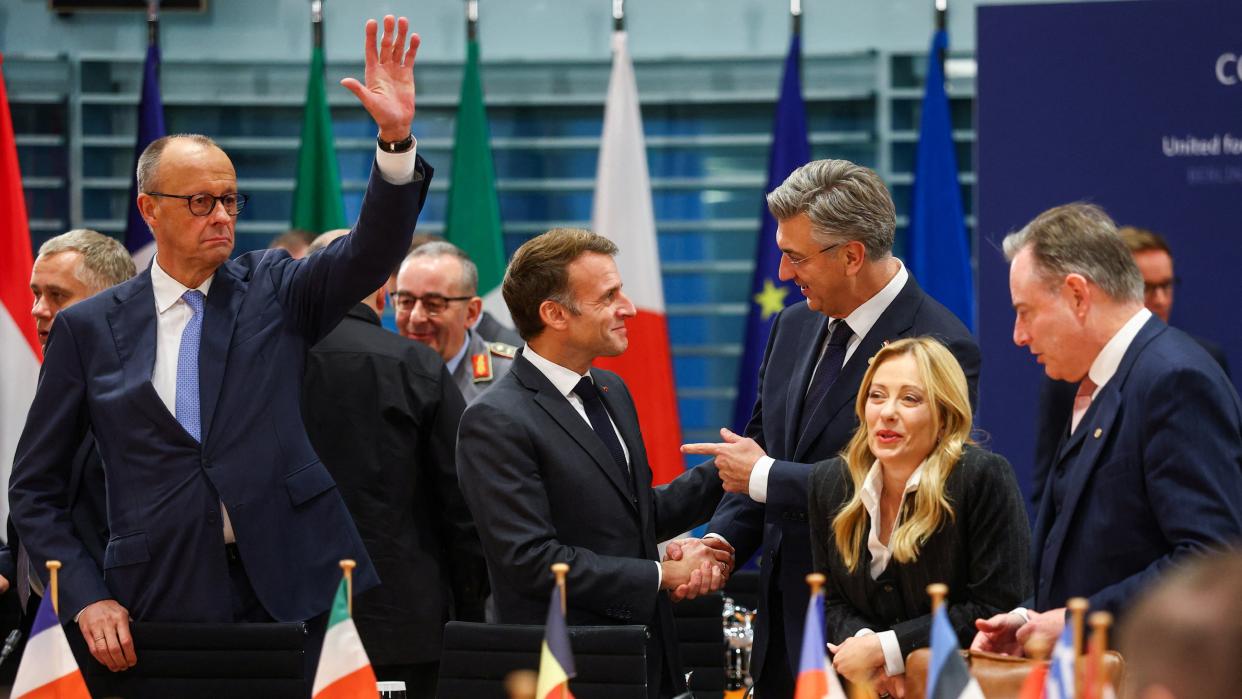
In her annual State of the European Union address to the European Parliament on September 16, 2026, European Commission President Ursula von der Leyen called for the creation of a European Security Council bringing together Canada, Norway, Ukraine, the United Kingdom, “and other relevant actors.”
The idea of a mechanism for consultation and coordination that would allow Europe to respond more swiftly and effectively to crises—whether an outright attack on a member state, potentially triggering the mutual defense clause under Article 42(7) of the Treaty on European Union, or hybrid attacks—is not new. French President Emmanuel Macron and then-German Chancellor Angela Merkel already endorsed the idea in their 2018 Meseberg Declaration.
In January 2026, in an article widely circulated among European defense policy circles, European Commissioner for Defence and Space Andrius Kubilius proposed making such a council the EU’s “supreme” body for crisis coordination and decision-making. Like many experts before him, the Lithuanian commissioner drew on a model inspired by the UN Security Council, combining permanent members—Europe’s major powers, selected according to criteria such as population size and military strength—with non-permanent members rotating every six months. The council would comprise 10 to 12 members in total, including representatives of the European institutions responsible for defense and security.
Yet von der Leyen’s proposal has reopened a debate that has been inseparable from the history of European integration since the end of World War II—a “minefield of misunderstandings,” in the words of British historian and sociologist Perry Anderson: the question of what Europe actually is.
Far from following an inevitable path, European integration has been shaped by competing visions of what the European project should become. The proposal for a European Security Council brings these questions back to the fore, raising three existential political questions: Who belongs to “strategic” Europe? Where does Europe begin and end? And finally, can—and should—Europe’s geopolitical actorness be extended beyond the boundaries of the European Union?
Two Visions of Europe
The first fault line underlying the European Commission president’s proposal reflects the tension between two visions of Europe: a community of equal states versus a space structured hierarchically by power. Who would actually belong to this “Europe of great powers”? Germany, France, Italy, and Poland immediately come to mind; Kubilius also proposed including Spain.
But what about Greece, on the front line of migration pressure, grappling with Turkish maneuvers in the Eastern Mediterranean, and spending 3.1 percent of its GDP on defense in 2025? Or the Baltic states, living under the immediate threat of an aggressive Russia? And what about smaller Central European states, whose marginalization could further fuel their ambivalence toward EU integration?
The risk is that small-and-medium-sized member states, particularly those that are neutral or lagging behind in the race toward the 5-percent defense spending target, will find themselves permanently relegated to the outer circles of power and decision-making. The debate over the composition of a European Security Council is therefore also a debate about political legitimacy in Europe: does greater power now confer greater rights in the conduct of common affairs?
A second fundamental question concerns the very boundaries of Europe. As philosophers Ludwig Wittgenstein and Michel Foucault remind us, the choice of words is never neutral: Von der Leyen speaks of a “European Security Council,” not an “EU Security Council.” The United Kingdom, Norway, Ukraine, and Canada (von der Leyen mentioned them by name) could thus participate in a European body without being EU member states, forcing us to confront a question that has repeatedly been avoided: Is Europe a clearly defined and structured entity, with its own members and rules, or a broader political and strategic community with shifting boundaries?
In doing so, the European Commission is effectively claiming the authority to determine who belongs to this strategic community, and according to which criteria—making Canada “European” in the process. The controversy surrounding von der Leyen’s separate proposal to grant Canada “associate membership” of the EU—a term subsequently dropped from the joint EU-Canada summit declaration—further illustrates the political sensitivities involved in redefining Europe’s boundaries.
By opening her proposed European Security Council to four non-EU countries, von der Leyen risks diluting European identity and undermining the legitimacy of the EU’s existing institutional framework. Neither the Council of the EU nor the European Council—previously the most obvious institutional frameworks for such a body—could readily oversee a security council including non-EU countries. Canada’s inclusion also throws Turkey’s exclusion into sharper relief, despite the latter’s close geographical ties to Europe and its considerable strategic weight within NATO.
As for Ukraine, how could a country at war be directly involved in decisions concerning European defense and security? Supporting Ukraine’s struggle for sovereignty and regularly inviting it to Council meetings is one thing. Institutionalizing that relationship and giving it a role in European crisis management is quite another, particularly when other longstanding candidate countries remain caught in protracted accession processes. Still, Ukraine has turned into a highly resilient and innovative “steel porcupine” which is, in effect, already part of the NATO/EU security system. It is therefore in Europe’s interest to bring it into its orbit, especially since the prospects of Ukraine’s entry into the Atlantic alliance has been buried by the Trump administration.
How to Build a United and Effective Europe?
A final, more fundamental tension brings us back to a question that has haunted Europeans since the 1948 Congress of The Hague: how to build a united and effective Europe. The European Security Council would add to the growing number of initiatives operating beyond the EU’s institutional framework: the European Political Community (EPC), the much-discussed Coalition of the Willing—in short, a patchwork of targeted partnerships and ad hoc arrangements.
Here, too, the debate is an old one. From the Community method to intergovernmental cooperation, from a multi-speed Europe to proposals for concentric circles, European integration has always been torn between deepening common institutions and building smaller groups of states. The proposed European Security Council brings this fundamental choice back to the heart of the European project: Should we give the EU itself the capacity to act, or accept that Europe as a geopolitical power will be built, at least in part, outside its institutions?
The creation of a European platform for coordination and rapid crisis response addresses a genuine need. The transatlantic rift and US President Donald Trump’s threats over Greenland, the return of war to Europe, and Moscow’s increasingly frequent hybrid provocations all highlight the cumbersome nature of unanimity-based decision-making in the EU’s Common Foreign and Security Policy (CFSP). Without more effective political leadership, the efforts to strengthen its strategic autonomy and the rapid rearmament drive embarked upon by the EU in 2025 risk coming to little.
Yet “staying in the race,” as the European Commission president urged in her speech on September 16, requires first settling a number of questions that go far beyond institutional efficiency. The institutional framework Europe chooses will not merely determine how it responds to crises; it will also help shape the political community in whose name those decisions are taken. Von der Leyen’s proposal thus reopens a fundamental debate: who belongs to Europe, who has the right to speak on its behalf and, ultimately, what kind of Europe do we want to build?
One thing is certain: The very fact that the proposal of a European Security Council did not strike a chord in the European capitals confirms a certain level of mistrust toward European institutions when they position themselves as key players in the broader European security architecture. With crucial elections approaching in several member states, strengthening the “geopolitical” EU no longer seems to be the priority. This reinforces the vicious cycle of Europe’s marginalization, which is starkly evident in light of the Abu Dhabi negotiations between the United States, the Russian Federation, and Ukraine (November 10-11) and the Shenzhen meeting of Trump, Chinese President Xi Jinping, and Russian President Vladimir Putin (November 19): The world does not want to wait around for Europeans to settle this debate once and for all.
Hanna Murat is a geopolitical analyst and IR lecturer based in Paris.
Loïc Simonet is a research fellow at the Österreichisches Institut für Internationale Politik in Vienna.