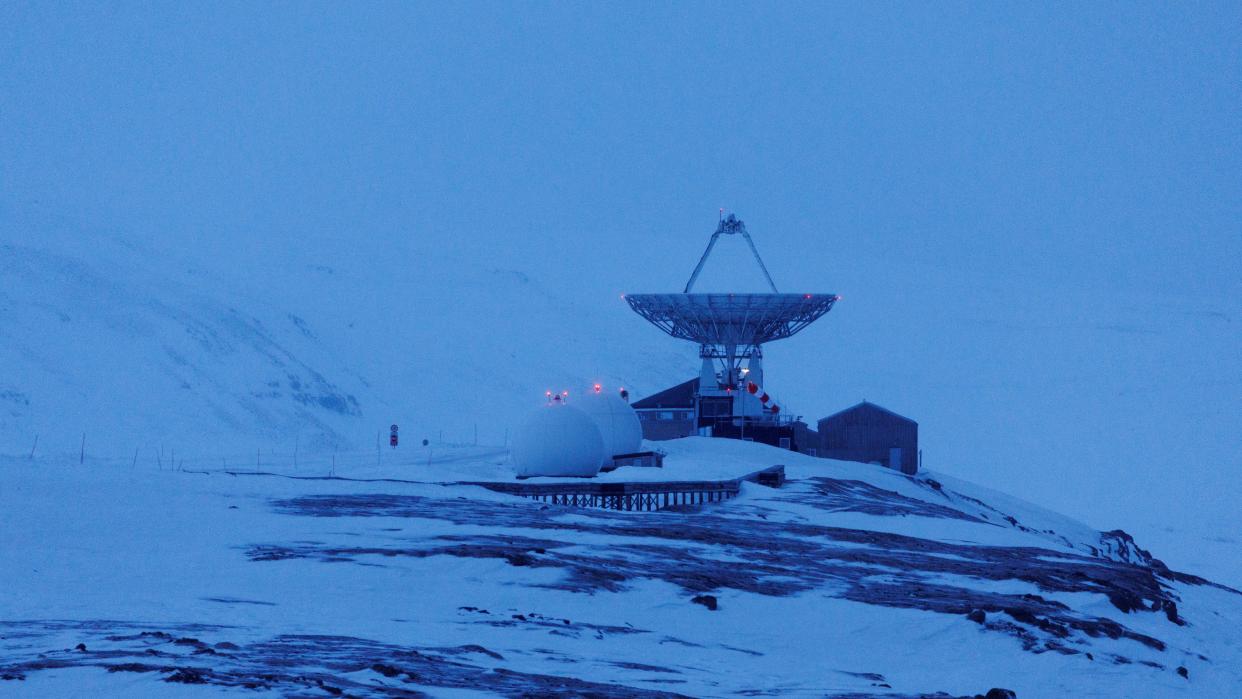
Brussels is once again updating its Arctic policy. European Commissioner Jozef Síkela, who is responsible for international partnerships, spent the spring touring Greenland and Norway’s capitals, Nuuk and Oslo, as well as Kiruna, Sweden’s most northerly town, promising more money for Greenland, closer security ties with Norway, and strengthening the European Union’s Arctic engagement more generally.
The choreography is familiar: a tour, consultations, a communication (Brussels shorthand for a non-binding policy document to signal priorities) and the catchphrase officials have repeated since 2019—“more EU in the Arctic, more Arctic in the EU.” Since 2021, EU officials have put this Arctic engagement in a “geopolitical” frame, without ever quite explaining what the term is supposed to mean for concrete EU decision-making. What is more, it is unclear whether another Arctic policy statement actually commits EU member states and EU institutions to anything at all.
That is not an accident. When European officials say they want the EU to become “geopolitical,” they rarely specify which of geopolitics’ several meanings they are referring to—becoming more active in international relations in general; acknowledging the changing global context of EU actions; the classical concern with physical geography; the use of hard power; power politics as opposed to rules, or simply a break from economic liberalism.
Josep Borrell, who was EU foreign policy chief from 2019 to 2024, wanted the EU to act on realist, power-based logic while still holding onto its liberal values—a balancing act he never quite pulled off. European Commission President Ursula von der Leyen promised a “geopolitical commission” without ever saying what this geopolitical ambition was aimed at—tougher sanctions on Russia, more say over which raw-material projects get EU financial backing, or simply better branding? Those are just a few of the possibilities.
These geopolitical ambitions remain undefined, although the upcoming European Security Strategy may provide some clarity on the EU policymakers’ mindset. However, that undefined ambition may have a concrete fix in the Arctic context: by defining which Arctic the EU actually means and being honest that it is a primary actor in one version of that space (the European Arctic) and a bystander in the other (the circumpolar Arctic).
Geopolitical Confusion
For nearly two decades, the European Commission and the European External Action Service (EEAS), the EU’s diplomatic service, have produced Arctic policy documents that read like compilations of everything the EU already happens to be doing in the North, rather than statements of strategic intent. The Northern Dimension—the EU’s framework for cooperation with the wider North, launched in 1999—was formally terminated in September 2025, and no successor framework has been proposed. The Barents Euro-Arctic Council, a separate regional body that Norway launched in 1993 with Russia, the Nordic states, and the EU as members, is faring little better: Russia withdrew in 2023, followed by Finland at the end of 2025. Talks among Norway, Finland, and Sweden on a replacement have stalled.
Much of that institutional fog is geographic at root, and fixable. The EU is not one kind of actor across the entire Arctic. In the European Arctic—Fennoscandia, the North Atlantic, the Barents Sea, where its law applies directly, including via the European Economic Area Agreement with Iceland and Norway—it is a primary actor, arguably the most consequential regulatory power in the region. In the wider circumpolar Arctic—the Arctic Ocean—it is a secondary participant at best.
A policy that keeps conflating these two spaces will lead the EU to continue chasing a circumpolar status it will not get, while underinvesting in the region where it already has real leverage. It is also a continuous challenge for communicating the EU’s Arctic objectives, as many Arctic readers of EU documents struggle to understand which statements are relevant for their positioning vis-à-vis the EU. That avoidance of geography is not accidental: Saying where the EU is central and where it is not would force Brussels to make a choice: to admit that in the European Arctic, it actually governs—and that in the circumpolar Arctic, it mostly does not. Avoiding that admission is naïve: avoiding geography does not stop the EU from making geopolitical claims, it just obscures them.
The Curse of Geography
Moreover, the Europeans suffer from what might be called a curse of geography: Their continent is chronically short of the raw materials they need for their own green and digital transitions—one of the few areas where the “geopolitical” ambition of the EU is easier to understand. Brussels is forced into resource diplomacy across three continents with partners it does not control.
The European Arctic is the one region where that scarcity does not apply. The region sits on exactly the deposits the EU is scouring the globe to secure elsewhere. That should change how Brussels talks about the region—not as a remote frontier to be managed from afar, but as the one part of “geopolitical Europe” where the EU might actually have the resources to match its ambitions.
The presence of resources in the European Arctic does not automatically translate into value. Greenland’s critical minerals are a persistent headache precisely because the problem is market-driven: Brussels cannot force companies to buy Greenlandic materials, and mining projects face a chronic shortage of equity. That is not unique to the Arctic. Across the world, the real obstacle to mining new critical minerals is rarely a lack of money—it is that investors do not trust the numbers and local communities do not trust project developers. These projects take decades to pay off, cost enormous sums upfront, and offer no guarantee of a return, which makes banks and investors wary regardless of how valuable the minerals are. Rare-earth projects face an extra problem: Existing suppliers, chiefly China, can undercut new entrants on price before they even get started.
The harder question is this: How much extra should it cost to source materials to the standards the region and its people demand—call it an “Arctic premium”—and who ends up paying that difference? What’s more, having the resources does not give the EU the right to extract them however it likes. Any new Northern framework—one that would replace the old formats—needs to be built on co-ownership. The EU should hold itself to the same standards it already demands from others: Indigenous and local co-decision from the start, and benefit-sharing built into agreements rather than added on later. Systematic Arctic-proofing is also needed—a process that screens EU (often general, pan-European) decisions on space, raw materials, and the green transition for their regional consequences before they are made.
What Brussels Should Offer Oslo and Reykjavík
A clearer geographical understanding of the EU-Arctic nexus will not work without Norway and Iceland, the two states without whom “the European Arctic” is an incomplete category. Neither needs to be treated as a standard EU accession candidate; both deserve a specific offer—arguably not unlike what should have already been offered to Greenland.
Norway is the EU’s most consequential Arctic neighbor, a NATO ally, a key energy supplier, and the state most directly exposed to Russia’s Northern Fleet on the Kola Peninsula. It also hosts the Arctic Council Secretariat. The country, therefore, warrants an elevated partnership: maritime domain awareness across the Barents Sea, a clear fisheries framework under the Svalbard Treaty, and formal integration of Norwegian space infrastructure—Andøya spaceport for example—into EU programs. None of this will be straightforward: Norway’s own priorities vis-à-vis the EU are narrower (chiefly fisheries) and its relationship with Brussels is complicated by some Norwegian ports still granting access to Russian vessels.
Iceland is a different case, and it is a more time-sensitive one: Its August 29 referendum will decide whether to reopen EU accession talks, with actual membership possibly years away. It is not an Arctic Ocean coastal state, so adding a fourth seat of an EU member state at the Arctic Council table would be largely symbolic. But its location astride the Greenland-Iceland-UK (GIUK) gap—key for maritime power in the North Atlantic—and transatlantic cables still makes a substantive EU-Iceland Arctic dialogue worth building now, regardless of the referendum’s outcome.
The EU offers should depend on Oslo or Reykjavík resolving their own accession debates first. Much of the EU’s Arctic cooperation with both capitals already runs on parallel tracks, through the EEA and at agency level, regardless of membership status. What they need instead is deliberate investment: spending diplomatic and financial capital on partnerships that can be built now, in areas where the EU already has a genuine foothold.
If Europe wants to be taken seriously as a geopolitical actor, it should start with the most basic geopolitical act there is: drawing a map and admitting what is and is not on it. The European Arctic is modest enough in scale for Brussels to deliver and close enough to matter. It is a region where the EU has the resources it lacks almost everywhere else, not only in the circumpolar North but also globally.
Andreas Raspotnik is the director of the High North Center for Business and Governance at Nord University, Bodø (Norway) and a senior researcher at Fridtjof Nansen Institute, Oslo.
Adam Stępień is a researcher at Nord University, Bodø (Norway) and a researcher at the Arctic Centre of the University of Lapland, Rovaniemi (Finland).
Andreas Østhagen is Research Director Arctic and Ocean Politics at the Fridtjof Nansen Institute, Oslo, and a senior advisor at the High North Center for Business and Governance, Nord University, Bodø (Norway).