Germany’s passivity before Russia launched its full-scale war against Ukraine in 2022 is now looked back on with regret by many, including former Chancellor Angela Merkel.
History may well now repeat itself in the case of Taiwan.
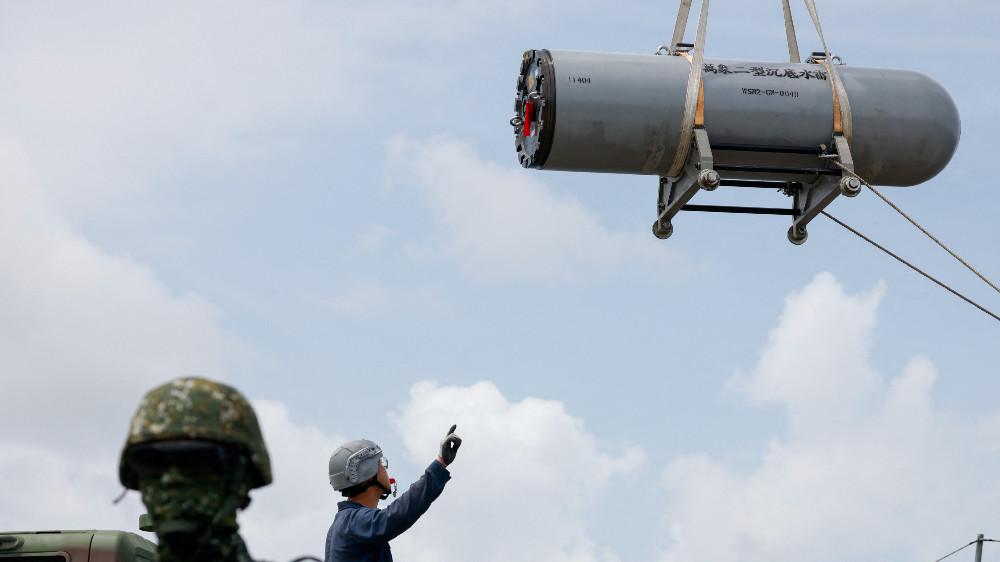
The country, which China considers a renegade province, has run into severe difficulties with its defense acquisitions as the United States is lagging far behind its promised deliveries of weapons. The value of the current US backlog is close to €18.5 billion. While China is constantly increasing pressure on Taiwan and building up its military at home, the Taiwanese gap in defense capabilities is becoming more and more visible.
Most recently, Taiwan received arms damaged by mildew and water. The delay in weapons’ shipments could potentially result in a major problem as, according to US officials, President Xi Jinping ordered the Chinese military to be ready to take Taiwan by 2027. Although Xi would likely prefer to incorporate Taiwan without a military conflict, he may order an invasion if he deems this path unfeasible.
Furthermore, China has upscaled its military exercises around Taiwan since 2018, whose sophistication has been increased, including live-fire maneuvers and the training of scenarios, including blockades and amphibius assaults. Hence, the delivery of M1A2T Abram tanks, MQ-9B unmanned aircraft, air-launched Harpoon missiles, Stinger missiles, field information communication systems, and many more capabilities (complete list here) whose shipment has been delayed by the US, should urgently be made up for.
To ensure that Taipeh is not solely reliant on US deliveries, a more diverse group of countries supplying Taiwanese defense and surveillance systems should contribute to countering any potential US supply shortfall. This is where Germany can step in.
Germany’s Interest in Defending Taiwan
Although Germany is the world’s second largest military supporter of Ukraine due to its Zeitenwende policy, Berlin has remained passive when it comes to addressing a second potential flashpoint that could impact the Eurasian continent: Taiwan.
Germany has a profound interest in defending Taiwan, not least because the theaters of conflict in Europe and Asia are deeply intertwined. China has been a key supporter of its Russian partner in its war against Ukraine, including supplying components for military equipment that go directly into warfighting, with lethal consequences. Simultaneously, Russia is running a military program in China to produce long-range attack drones at scale. A Chinese takeover of Taiwan would further bolster China’s capacity to supply Russia.
A Chinese invasion or blockade of Taiwan would have severe economic consequences for Germany, too. It would disrupt several critical supply chains, particularly in semiconductors. Taiwan produces 23 percent of Germany’s imported semiconductors. In fact, Taiwanese production represents 60 percent of the world’s semiconductors and over 90 percent of the most advanced chips. An invasion of Taiwan would cut off Taiwan Semiconductor Manufacturing Company (TSMC), the largest Taiwanese chip producer, from Western technology and likely damage factories if they were intentionally or unintentionally targeted in an attack (before he took office, Elbridge Colby, the current Under Secretary of Defense for Policy, advocated for the complete destruction of TSMC in case of a Chinese invasion).
In a worst-case scenario, China taking Taiwan by force could halt chip supplies altogether, collapsing the semiconductor industry, and crippling global technology production. The result would be rising prices and inflation. According to some estimates, global GDP would collapse by up to 10 percent, the equivalent of €8.5 trillion.
Germany’s Increased Engagement
Thus far, Berlin has responded to rising Indo-Pacific tensions with naval and air force deployments, signaling that Germany is paying more attention to the situation. As part of last year’s deployment, a frigate, a support ship, and 32 aircraft were deployed between May and November 2024. Together with greater political engagement, this can certainly be read as a willingness to pay more attention to the region.
Although these efforts and discussions are important, they are clearly insufficient to effectively deter China. Current German military deployments in the region remain too temporary and small-scale to materially contribute to Taiwan’s defense.
How, then, can Germany contribute to deterring China? Berlin’s message to Xi Jinping should be two-fold: that the costs of an invasion or blockade would be economically steep and that military action would have a low chance of success. This would require Germany to consider arms deliveries to Taiwan, and US territories in the Pacific, building on deliveries of the past, though on a small scale. These included missiles and rockets as well as special naval equipment. Looking ahead, channelling deliveries via the US, which in turn is planning to continue shipping equipment to Taiwan, might reduce the risk of Beijing retaliating against Berlin for its actions.
What Weapons Deliveries Could Look Like
Given the urgency of the situation, Germany would need to ensure early on that delivered weapon systems are compatible with the arsenals of Taiwan and the United States, and can be deployed effectively. Such systems include the Stinger anti-aircraft missile, used by Germany, Taiwan, and the United States, as well as the Harpoon anti-ship missile, which is being integrated with the indigenous Hsiung Feng III anti-ship missile. In parallel, Berlin should contribute to the regional stockpiling of larger quantities of equipment to facilitate rapid supply in the event of a crisis and to aid in deterrence against China.
If China takes clear steps toward escalation, the following capabilities would be crucial for Taiwan’s defense: air-defense missiles, ground-based air-defense systems, anti-tank missiles, and anti-ship missiles. Sea mines, as well as surveillance and combat drones, would also be vital. Germany has suitable systems, including anti-tank missiles, air-defense systems, and drones, that could support Taiwan in repelling a Chinese intervention. Similar to its approach to the Philippines, Germany should consider providing Taiwan with surveillance drones that could be deployed to monitor coastal areas.
A Special Responsibility
Germany’s central role within Europe confers on it a special responsibility. Given its prominence in the European Union, Germany’s actions could set an example for other European nations, ideally forging a unified stance and sending a more robust message to Beijing. Moreover, as China’s largest trading partner in Europe, Germany wields a unique influence that could deter Beijing from pursuing escalation. Coupling the offer to support Taiwan via weapons’ deliveries with the prospect of economic consequences would have a better chance of deterring Beijing and lowering the risk of aggression against Taiwan.
Germany cannot currently supply these systems in large quantities on its own. The European defense industrial base displays significant gaps in terms of producing capabilities on a large scale. Yet, (European) NATO allies have recently agreed to move their core defense budgets up to an equivalent of 3.5 percent of GDP. If implemented, this could free huge resources for re-armament efforts.
Germany alone has committed to reaching NATO’s new defense pledge by 2029 already (instead of 2035, the official target year agreed upon by the allies), with the aim of spending €152 billion on defense that year. This rapid expansion allows not only for strengthening the German arms industry but also contributes to closer cooperation between European governments and defense companies, collaborative investment, research, and procurement.
Collaboration with Indo-Pacific partners to jointly develop military equipment is also on the table. The transfer of South Korean military hardware and technology to Poland and their co-production of weapons demonstrates what European-Indo-Pacific defense industrial cooperation can look like. Accelerating the procurement of capabilities that are currently lacking in Europe is essential—for Ukraine and for securing NATO’s northeastern flank, but increasingly, too, to bolster Taiwan’s deterrence.
Aylin Matlé is a senior research fellow in the Center for Security and Defense at the German Council on Foreign Relations (DGAP).
Valentin Weber is a senior research fellow at the Center for Geopolitics, Geoeconomics, and Technology of the DGAP.