Precisely 10 years ago, I accepted an invitation that would change my understanding of politics in the United Kingdom, and elsewhere. I was speaking at a cultural event in Manchester—no big deal, you might think, unless like some Londoners you shudder at the prospect of veering north—when a colleague came up to me afterwards and suggested I visited the theater he ran in nearby Bolton.
I accepted with curiosity; the next morning I made my way along the Oxford Road Corridor—an array of fancy, newly built university, tech, and creative buildings—to the train station. The journey from downtown Manchester to its outer reaches cost barely £2 and lasted15 minutes; it took me to a different world.
On arrival, as I walked to the theater, I passed countless pawn shops and discount retailers; children who should have been at school and adults who presumably should have been at work, if they had any. My snapshot—and it was brief—was a cliché vision of a once-proud home of textiles and heavy industry that had fallen on hard times. It’s no surprise that four months before my visit, Bolton had voted by 58 percent to leave the European Union, a typical result for areas of a similar demographic profile.
I admit I haven’t been back since, but despite considerable regeneration efforts and despite great work by the theater, I’m told that not much has changed. Bolton is one of the UK’s most deprived towns—and there’s no shortage of competition for this mantle in the north of England.
And yet, it is on the periphery of a city that is held up by some, not least by the new prime minister, as the model of modern Britain. Of the various proclamations he has made in his few months in office, Andy Burnham has talked with no greater passion than about Manchester and Manchesterism.
Burnham sees the city as the key driver to decentralizing power and, in so doing, to redistribute wealth, jobs, and investment away from the mega-center that is London and the counties of Southeast England that surround it.
He has been talking about this for years, making it his mission as mayor of the combined region of Greater Manchester, an office he held for nine years. But what exactly is Manchesterism? What is its economic plan? What area does it precisely encompass? And what does it mean for the whole of the UK, now that he is responsible for all of it?
King of the North
The term first received prominence during the COVID-19 pandemic. Burnham, by now mayor the Greater Manchester Combined Authority (to give it its proper title), became a national figure as he challenged the Conservative government over financial support for the region. He earned the nickname “King of the North” for speaking up for places that felt they were once again being overlooked. At a time when many people felt disconnected from Westminster, he gave Manchester a recognizable voice.
The role, and the location, gave Burnham important mid-career definition.
In his early 20s, he received his first break in politics, working as a researcher for a prominent Labour Member of Parliament, Tessa Jowell, who would go on to be a cabinet minister under Tony Blair and Gordon Brown. Speeding along the fast track, Burnham then became an advisor to another senior minister, before becoming an MP himself in 2001, aged only 31. His rise continued effortlessly into the cabinet, first in charge of culture, then health.
Then, when Labour lost two successive general elections, his career stalled. He twice stood for the party leadership, in 2010 and 2015, and twice lost. He saw in Manchester an opportunity to remake himself.
It came to him easily. As he likes to say, he looks northern and sounds northern, because he is northern. He was born closer to Liverpool than Manchester and brought up a Catholic in a quiet commuter belt village midway between the two rival cities. He has described—which is part of the folklore that surrounds him—how he was inspired to join the party at the age of 14 after being moved by a BBC TV drama about life on the dole. He embraced the famous Manchester music scene of the late 1980s and 1990s.
Though it might pain him to admit it, he didn’t invent the Manchester success story.
Since the early 2000s, the city-region has been one of the fastest growing outside London, with an average annual growth of 3.1 percent—twice as much as the UK as a whole. The expansion of knowledge-intensive services helped attract investment. It was already doing well by the time it secured its “devolution deal” in 2014 from the central government. Its structures and talent pool are strong; its universities work closely with each other and with the public and private sectors.
The former Conservative Finance Minister, George Osborne, whose Tatton constituency was to the south-west of Manchester, also draped himself in the iconography of the city and its surroundings, conjuring up his own slogan, “the Northern Powerhouse.” During that period, a Conservative national government in Whitehall worked hand in hand with Manchester’s Labour-led council. Its leader, Richard Leese, and chief executive, Howard Bernstein, became pivotal figures.
Master Communicator
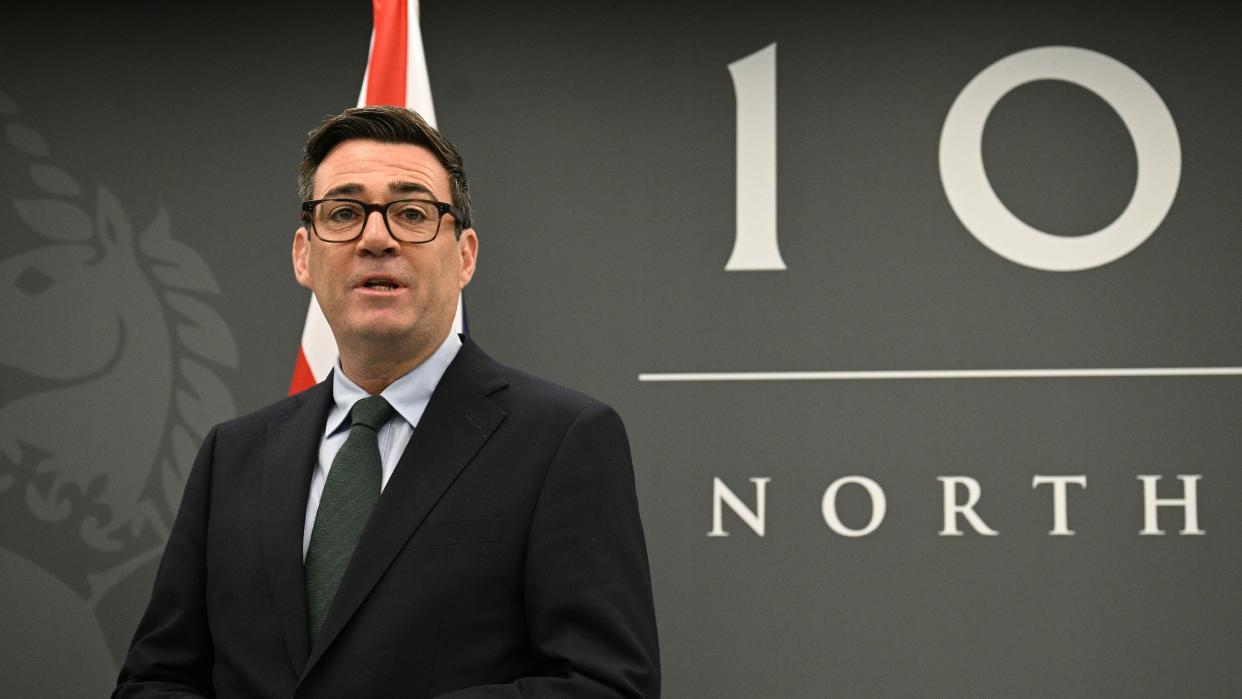
What Burnham did, when he became mayor of the newly formed region in 2017, was to give the project a higher profile. A master communicator (a direct opposite to his often gloomy and awkward predecessor, Keir Starmer), Burnham used his first announcement on becoming prime minister to create a “Number 10 North.”
Skeptics immediately assumed this was a classic piece of symbolism, of spin. Burnham has sought to disabuse them. This northern wing of Downing Street—housed in an unremarkable office building in the center of Manchester—has been given responsibility for a wider devolution agenda and put under his influential deputy, Louise Haigh.
Burnham has also turned up regularly on his way to his family home in a leafy suburb not far away. Or he has popped in on his way to watch his beloved football team, Everton (which is the local rival of Liverpool), and where he recently took Canadian Prime Minister Mark Carney to a game.
It is one thing to give a region—and the notion of devolution—priority billing; it is quite another, however, to know what you want to do with it. The ever-present criticism of Burnham is that in his time in politics so far, he has veered between pro-market, ultra-centrist (Blairite), to soft left (Brownite), and ardent left when he served briefly in former Labour leader Jeremy Corbyn’s shadow cabinet.
And so, it has continued as prime minister, his detractors say. On the campaign trail, he promised to enact the most radical changes for 40 years; once in office, he has trimmed several promises back.
The End of Neoliberalism?
As for the term Manchesterism, its definition depends on who you ask. Do the gleaming new tower blocks in the city center mark a celebration of high-wire, free-market economics? After all, the influx of global companies helped propel Manchester to be “the star performer of the UK economy since 2008,” according to research firm Oxford Economics. The two star football teams, Manchester City and Manchester United, have long given the city a global big-money attraction.
Does Manchesterism, instead, mark “the end of neoliberalism, the end of trickle-down economics?” Burnham said exactly that in a campaign video launching his by-election bid to become MP for Makerfield back in May, and eventual successor to Starmer. He has already jettisoned this kind of language.
Or is it neither of these two extremes, but simply a mechanism to speed up constitutional change, to give the UK’s regions greater powers? In Head North, a 2024 book Burnham wrote with his friend and political ally, Liverpool City Region Mayor Steve Rotheram, he argued, “To us, ‘Take Back Control’ didn’t stop with powers brought back to Westminster from Brussels. It also meant neglected places in the north being able to do much more for themselves, such as re-regulate buses and build council houses.”
Burnham and Rotheram suggested replacing the UK’s unelected House of Lords with an elected “Senate of the Nations and Regions” partly made up of “people from places and professions that have traditionally been neglected by parliament.”
It could be done as soon as the next national election, due in 2029, they said. With the best will in the world, it won’t be. That’s because constitutional reform in the UK has a stop-start history. Blair was enthusiastic, promising a rewriting of the British constitution (which does not exist as a single document), ending up only tinkering with parts of it and giving up on the rest.
The subject is often dismissed as an obsession of political nerds, a judgement that may be flawed but continues to have salience. Burnham insists it has real-life consequences, devolving nuts and bolts issues to the locality. In European Union terms that is denoted as subsidiarity. In terms of Germany, whose Grundgesetz(or “Basic Law, the country’s 1949 constitution) Burnham regularly praises, it is about a codified and clear definition of jurisdictions.
Unequal and Centralized
The United Kingdom, by contrast, is a patchwork mess, one of most geographically unequal and also centralized countries in Europe, if not the world. Infrastructure is wildly skewed toward London and the southeast. After all, prestigious though they might be, was there a reason to build motorways to Oxford (in the 1960s) and Cambridge (1970s) except for prominent people to visit their offspring who were studying there or attend dinners?
The bias continues to the present day, with tens of billions of pounds being spent (i.e., wasted) on a high-speed railway that takes Londoners only as far as Birmingham, cutting about 10 minutes off their journey time, while trains in the north resemble sardine cans.
This Burnham knows all too well. The most visible legacy of his tenure in Manchester is local: the popular public takeover of the region’s once privatized and uncoordinated bus and tram network, and alongside it the imposition of a maximum ticket of £2. Burnham has in the past talked of Manchesterism as introducing “public control” of not just transport, but also other “basics of life” such as energy and water.
Yet, some experienced Labour Party insiders question whether, with all the threats in the world—from Vladimir Putin to Donald Trump, from climate change to generative AI—a bottom-up approach involving subsidies for pubs and caps on bus tickets is what’s needed.
“The danger is that this municipal ideal becomes an argument for parochialism,” wrote Tristram Hunt, a former Labour cabinet member, now the director of the Victoria and Albert Museum, recently in the Financial Times. “The government has already chosen to raid the international development budget to cap prices on local buses. This comes alongside watering down commitments on climate change and a studied unwillingness to challenge the economic self-harm of Brexit.”
Just a Term
Which brings me back to where I began: Bolton. Although the UK has particularly unequal regional inequality, the dilemmas facing Burnham are not unique to him. France faces it. Germany faces it (though the debate is dominated by the unending East-West argument over reunification).
Where should a middle-ranking European country, with slow growth and pockets of intense deprivation, focus its devolution priorities? Should it be on “left behind” small towns, either remote or on the peripheries of conurbations? Or should it be identifying and championing a cluster of national champions capable of competing on the world stage? Think London/Manchester, think Rome/Milan, think Madrid/Barcelona.
Between 2010 and 2025, Manchester’s urban center has seen a 17-percentage point fall in deprivation—the largest of any UK city—but areas outside have seen more polarization and more poverty. Bolton is but one of many. Do big cities act as catalyzers for wider areas? Or do they largely look after themselves?
And what about the rest of the north of England? Since focusing on Manchester, Burnham has made a point of visiting places like Newcastle and Leeds. And what about other parts of the UK that also have been starved of investment and attention? In the Midlands (Birmingham is technically the UK’s second city, but it’s always eclipsed by Manchester), in the more rural southwest and even in the generally wealthy southeast deprivation can be stark. And I haven’t begun to mention Scotland or Wales, which are now run by pro-independence parties. And Northern Ireland is another special case entirely.
Manchesterism is just a term, just as Blairism and Thatcherism were. It will take some time to find its definition. And it will take much more time to assess its effect. But it is a start. Burnham has realized, in a way that Starmer never could, that political leadership needs an over-arching theme to help guide policy, even if obliquely, and to give voters a sense that government is about more than incremental administration.
John Kampfner is a British journalist and author. His latest book, Braver New World, was published in April.
