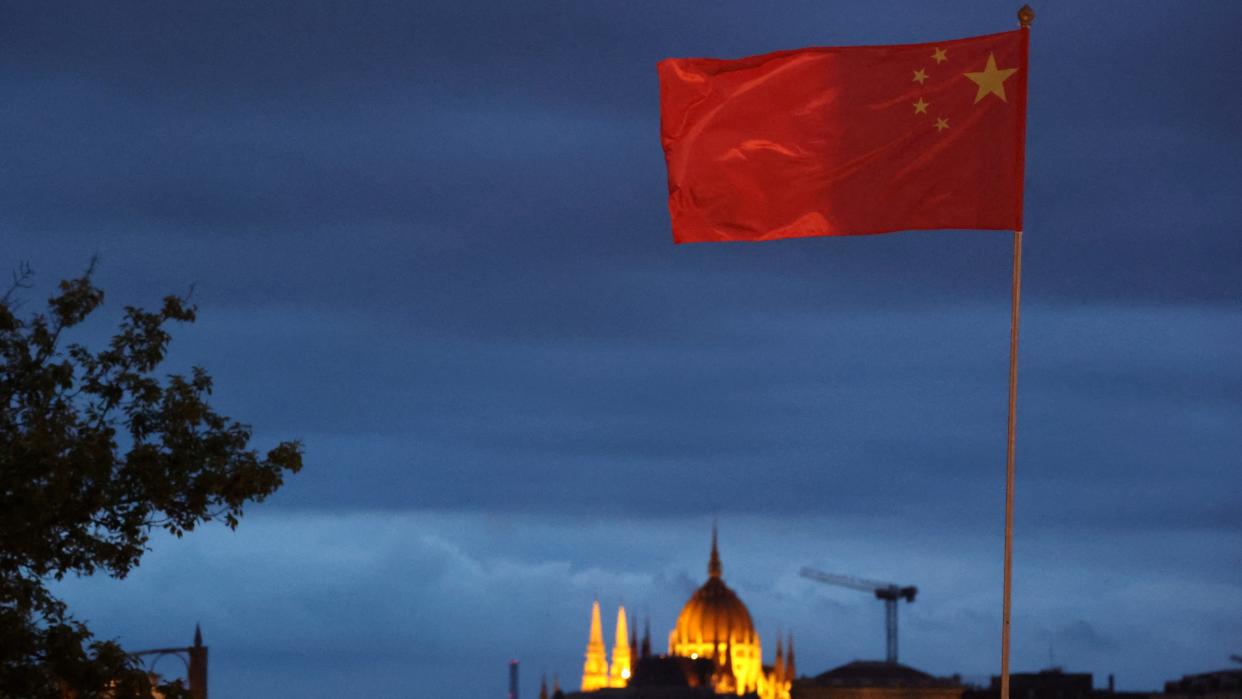
For a long time, Hungary stood apart from much of the European Union in its approach to China. Former Prime Minister Viktor Orbán’s governments cultivated unusually close political relations with Beijing, repeatedly defended Chinese positions at the EU level, and sought to make Hungary a major European production base for Chinese electric-vehicle and battery manufacturers. The result was not simply a foreign policy partnership. China acquired a privileged position within Hungary’s political and economic strategy.
That era now seems to have ended. But despite palpable optimism felt in Budapest about the foreign policy course being charted by the new government of Prime Minister Péter Magyar, who took office after his Tisza party defeated Fidesz in the April 2026 parliamentary election, Hungary’s China policy is unlikely to take the form of a dramatic geopolitical reversal.
Interviews I conducted with Hungarian analysts and policy stakeholders in Budapest around the Budapest Forum on October 1 suggest that looking at the transition simply as a change of government misses the scale of the transformation in the country. Hungary has not only changed government; it has been undergoing a change of regime.
Orbán’s government, which had held power for 16 years, remains a constant political reference point for Tisza, with the prime minister at times giving the impression that he’s still running an election campaign. Deals are being investigated, allegations of corruption and conflicts of interest remain politically salient, new institutions are being created, and personnel changes are taking place across the state administration, including at the Ministry of Foreign Affairs and the Hungarian Institute of International Affairs where new members of staff, not associated with the previous administration, have been brought in to take leading positions.
There are good reasons for this urgency. Fidesz left behind not only policies but deeply embedded political, administrative, and business networks. Furthermore, the new government cannot assume that the current political constellation will be permanent. Fidesz remains an important political force, and the experience of nearby Slovakia—where Robert Fico returned to government after previously losing power—is a reminder that political transformations in Central Europe don’t always move in only one direction.
For Magyar, the immediate priorities are domestic institutional reconstruction and Hungary’s relationship with the EU. His government has sought to restore rule-of-law standards and reduce the confrontation with Brussels that characterized the later Orbán years. In May, the European Commission released €16.4 billion in previously frozen funding, and Hungary subsequently joined the European Public Prosecutor’s Office.
Against this backdrop, neither China (nor Asia, in general) currently ranks particularly high on the political agenda. Interestingly, this relative lack of attention may be the most consequential change in Hungary’s China policy.
No More Privileged Access
Under Orbán, China occupied a position that went far beyond the economic significance of the relationship. Budapest’s “Opening to the East” policy gave Beijing unusually direct political access, while Hungary repeatedly proved willing to shield China from criticism within the EU. Chinese investment, meanwhile, became part of a broader political narrative presenting Hungary as a bridge between Europe and China and as an alternative destination for Chinese capital inside the EU. The extent to which this relationship became intertwined with the Orbán government’s economic strategy has been documented extensively.
It is this political exceptionalism, rather than the economic relationship itself, that has disappeared most clearly since the election. According to interlocutors in Budapest, the Chinese embassy as well as the representatives of Chinese businesses operating in Hungary have responded with intense activity, seeking meetings with the new government. An outreach toward Hungarian China researchers has followed as well. This suggests that Beijing itself recognizes the changed environment—access that could previously be taken for granted now has to be rebuilt.
Magyar’s government, for its part, has so far treated relations with China primarily through the lens of the broader institutional clean-up. Shortly after the election, Magyar said that major Chinese investments would be reviewed, but explicitly stopped short of calling for their cancellation. Companies such as BYD and CATL would still be welcome, he argued, provided they observed Hungarian environmental, labor, and transparency standards and generated greater opportunities for domestic firms.
There are also hard economic limits to how far Magyar’s government could rapidly reverse the Orbán-era opening to Chinese investment. Hungary is now deeply integrated into Chinese electric-vehicle and battery supply chains. CATL’s €7.3 billion battery plant in Debrecen, where trial production began in September 2026, is intended to supply European manufacturers including BMW, Stellantis, and Volkswagen. BYD is constructing its first European passenger-car factory in Szeged and in 2025 announced a European headquarters and research and development center in Budapest. It has also continued expanding existing production: its Komárom electric-bus and truck facility received a further $94 million investment in 2025.
The significance of these projects extends beyond bilateral China policy. They are connected to employment, local development, Hungarian suppliers, and the country’s position within the European automotive industry. Chinese investment in EV supply chains has consequently become a structural feature of Hungary’s industrial model rather than something a new government can simply undo by changing its foreign policy orientation.
This helps explain why the first tangible changes have been regulatory rather than geopolitical. The new government has announced a dedicated pollution watchdog and tougher sanctions for battery and electric-vehicle producers. These kinds of measures are clearly not challenging Chinese ownership or investment as such. They instead remove the assumption that politically important Chinese projects should receive exceptional treatment.
The harder question concerns projects where Chinese economic engagement became entangled with the domestic networks of the previous government. The most striking recent case involves former Foreign Minister Péter Szijjártó, one of the principal architects of Hungary’s relationship with China. In July, Szijjártó left parliament to take an executive position with BYD, after having played a central role in negotiations over the company’s Hungarian investments. Magyar accused him of representing foreign interests, and the government subsequently opened an investigation into the BYD agreements, including state subsidies, permits, environmental concessions, and possible conflicts of interest.
The Budapest-Belgrade railway presents an even more important test because of both its scale and its political symbolism. The Hungarian section has been financed predominantly through a Chinese loan, while a major beneficiary of the construction contract was a company controlled by Lőrinc Mészáros, one of Orbán’s closest business associates.
The previous government classified details of the project. Magyar has questioned the benefits Hungary derives from the project and criticized its reliance on Chinese financing, technology, and labor. Yet outright cancellation would now be both costly and impractical: The project is advanced, financing has been committed, and substantial resources have already been sunk into construction. But here the record remains incomplete. Despite the government’s broader commitment to greater openness, the Budapest-Belgrade railway contract was still not public as of early October. If the new administration wants to demonstrate that China-related projects are no longer protected by the political rules of the Orbán era, disclosure of legacy agreements such as this one will be a more meaningful indicator than diplomatic rhetoric.
Toward Normalization
If Hungary is indeed moving away from the highly personalized and politically privileged China policy of the Orbán era, the next question is what kind of approach will replace it.
The Central and Eastern European China Policy Audit 2025–2026, which I co-authored, suggests two broad directions that countries in the region have increasingly followed as relations with China have become less ideologically charged and more differentiated.
One is a more security-oriented approach. Countries such as Poland, Romania, Estonia, and the Czech Republic (despite the announced “mainstreaming” of China policy by a then-national security advisor to Prime Minister Andrej Babiš) have increasingly viewed China through the prism of national and economic security, critical infrastructure, technological dependencies, and exposure to strategic risks. Their policies don’t necessarily exclude economic engagement, but security considerations have acquired greater weight in decisions about investment, telecommunications, research cooperation, and other sensitive sectors.
The second model is more pragmatic. Here, governments neither seek a particularly close political relationship with Beijing nor define China primarily as a security problem. Instead, they keep relations largely within the parameters of the wider European debate, pursuing economic opportunities where they see benefits while avoiding major political departures from EU positions. Latvia has moved broadly in this direction, as have several Western Balkan countries, despite very different levels of economic exposure to China.
For post-Orbán Hungary, the second trajectory currently appears more plausible. A sharp turn toward a security-centered China policy would require more than removing the political preferences of the previous government. It would also require a significant reassessment of interests that are now deeply embedded in Hungary’s industrial structure. Chinese investment has become closely linked to the automotive sector, while the government faces no obvious domestic political incentive to turn China itself into a major security issue. At the same time, the new administration has already framed its scrutiny of Chinese projects mainly in terms of transparency, environmental regulation, conflicts of interest, and the quality of individual agreements rather than the strategic risks of engagement with China as such.
This points toward a more pragmatic recalibration: China would cease to occupy a special place in Hungarian foreign policy, but economic relations would continue where they can be justified on their merits. Budapest would become less likely to defend Beijing politically simply because a dispute involves China, while remaining willing to protect investments or economic interests that it considers important for Hungary.
Such an approach would also fit the broader foreign-policy pattern emerging under Magyar. The clearest change since the election has not been automatic alignment with every position taken in Brussels, but a reduction in Hungary’s willingness to define itself through opposition to the EU. The distinction is important. On Ukraine, for example, the government has moderated the confrontational posture of its predecessor without abandoning all Hungarian red lines. A similar logic may develop in relations with China: less obstruction of common European positions, but no presumption that Budapest will support every restrictive measure simply because it originates at EU level.
Unlike during much of the Orbán era, Hungary’s China policy is likely to be shaped increasingly within an EU framework rather than in deliberate opposition to it. This does not imply that a single European China policy already exists. Member states continue to differ significantly over trade, investment, de-risking, and the extent to which economic security considerations should constrain relations with Beijing. But the boundaries within which national policies are made have become more influenced by the European debates.
The distinction may at times be difficult to observe from the outside. A Hungarian government defending Chinese EV investment against a particular EU measure could look superficially similar to its predecessor. The political logic, however, would be different. Under Orbán, economic interests and political affinity with Beijing frequently reinforced one another. Under Magyar, the economic interests may remain while the political layer falls away.
External developments will therefore be crucial in revealing what the emerging policy actually means in practice. A more assertive EU economic-security agenda could push Budapest toward choices it would otherwise prefer to avoid. Disputes over individual investments may raise questions about security or dependencies beyond the transparency concerns currently dominating domestic debate. Conversely, if EU policy allows substantial space for continued Chinese investment, Hungary may have little reason to move much further than it already has.
The availability of alternatives will matter as well. As long as Chinese companies provide capital, technology, and industrial capacity for which there are no readily available substitutes, pragmatism will place clear limits on how far the government can distance itself economically. If credible alternatives emerge, the room for policy adjustment will grow.
The most likely outcome, therefore, is not a Hungarian China policy defined by a new grand strategy. It is a gradual normalization in which individual questions are increasingly decided through the same combination of domestic interest, regulation, and European coordination that shapes policy elsewhere in the region.
This would still mark a profound change from the Orbán years. The defining feature of the previous model was not simply that Hungary traded with China or welcomed Chinese investment. Many European countries do both. What made Hungary unusual was the political significance attached to the relationship and Budapest’s willingness to translate that relationship into support for Beijing at the European level. With this element disappeared, China can remain economically important to Hungary while becoming politically much more ordinary.
Ivana Karásková is a China Team Lead at the Association for International Affairs (AMO), a Prague-based independent foreign policy think tank.